Trustees: Bobolinks, Farming Can Thrive Together
 Pennsylvania Game Commission
A male bobolink. |
Bobolinks need large fields to nest in, said Rene Wendell, a conservation ranger with the Trustees of Reservations. "They find Sheffield one of the best of Berkshire towns because of the active farms."
The birds return to the Berkshires from Argentina the first week of May. You can watch for them in large, open fields. About 6 inches long at maturity, males are black with white markings along their backs and yellow napes; females are buff with black streaks on their heads and backs and dark wings.
The Trustees is hosting a guided walk on "Bobolinks and Grasslands" at Bartholomew's Cobble this Saturday, June 20.
"They are a really fun bird to watch," said Wendell. "They look like they are wearing a reverse tuxedo, with a black vest and yellow coat and tails, and the call sounds like R2-D2. You can expect them to occupy their ground nests in the hayfields until the young fledge in early July."
Unfortunately, like the bobolink, farming is on the decline and this means that habitat for grassland nesting birds is shrinking. Many areas that were once fields or pastures are now forests or house lots. Also farming itself has changed so fewer fields are left fallow each year.
"The good news is that it is possible to manage active hayfields for the benefit of wildlife, too," said Wendell.
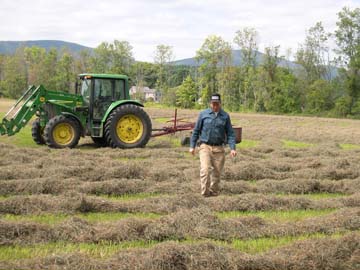 Photo courtesy The Trustees of Reservations
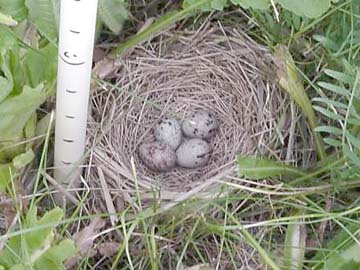 Farmer John Bottass has been working with The Trustees to provide grassland habitat for wildlife. Left, a bobolink nest photographed by U.S. Fish & Wildlife Service. Farmer John Bottass has been working with The Trustees to provide grassland habitat for wildlife. Left, a bobolink nest photographed by U.S. Fish & Wildlife Service. |
"John works several fields at the Cobble, but the largest is managed without the traditional early hay harvest to allow bobolinks and other species to successfully raise the next generation," said Wendell.
"The needs of farmers and the needs of wildlife can be considered at the same time, so that both can benefit," said Trustees ecologist Julie Richburg. "We invite people to take a closer look at the habitats, plants and wildlife on their land, because there are ways to manage grasslands and other habitats to benefit wildlife and support landowner needs."
Bobolinks are not the only species to benefit from thoughtfully managing open lands.
 A U.S. Geological Survey chart
shows the birds' decline. |
In this way, open space and farm land can extend more value to the wider landscape and to the community. During Saturday's walk, Trustees naturalists will aid in observing nesting bobolinks and other grasslands species, and discuss how to manage open fields as habitat for plants, birds, and other wildlife.
The walk begins at 10 a.m. on Saturday with Wendell and Richburg as guides. The walk is free to Sheffield residents, Trustees members and with Bartholomew's Cobble admission. For more information about other events and Trustees properties, go to www.thetrustees.org; for information or register for the walk, call 413-229-8600.