An emergency room doctor at St. Vincent’s Hospital trauma center prepared for a huge influx of injured from the Sept. 11 World Trade Center attack — but those patients never came.
Another doctor, a surgeon in a burn center, is still dealing with the devastating effects of the attacks, embodied by patients who suffered extensive burns and are still undergoing treatment.
One wishes he could erase the images, seared on his memory, of bodies falling through the air.
Another, who had served in the U.S. Navy, credited his military training for his ability to focus exclusively on helping his personnel to reach safety.
A couple who lived in Battery Park City said they doubt they will return to the neighborhood they loved, because it no longer exists. While camping out with family, they try to approximate a normal life with their two young children.
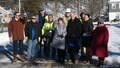
These were among the “Views from Ground Zero†voiced by 19 Williams College alumni who told their eyewitness accounts of the World Trade Center bombings and destruction Sunday night at Adams Memorial Theatre.
As eyewitnesses recounted their experiences of the Sept. 11 terrorist attacks, slides flashed on a large screen overhead: the second hijacked jetliner heading for the second tower, the flames and smoke, the fleeing people, the rescuers bringing out the injured.
And images recurred in their stories: the paper storm, the dust, the smoke, the sensation of unreality, the survivor guilt — and the workings of chance in who lived and died.
They remembered people lined up along the floors of the buildings, people jumping, bodies fallen. But they also remembered the valiant resolve of rescue workers and the kindness of strangers.
One speaker after another thanked listeners for coming to hear their stories. The event was sponsored by the Gaudino Forum, which has been sponsoring programs on topics related to the attacks, terrorism, American foreign policy, the Middle East, and Islam. Gaudino Scholar and sociology professor Robert Jackall moderated the discussion.
Joshua Zucker’s wife credits one of her husband’s friends with his survival. After the first plane hit, Zucker and the friend were on the 44th floor — the terminus of express elevators — when they and others were told they could go back up to their offices. When Zucker asked the friend if he was going up, the response was unequivocal: “He said, ‘I’m getting the hell out of here.’ â€
Bohn C. Versari Jr., a 1998 graduate, was looking out the window in the cafeteria on the 44th floor when he saw the paper — his first thought was, “Is there a ticker-tape parade?â€
Making his way downstairs, when Versari reached the 16th floor he heard “a huge explosion. My legs turned to Jell-o.â€
Once outside, he found debris, fire and body parts.
Nick Spangler, a 1998 graduate and a journalist was on his way to cover a City Council race when he saw the first plane fly above him. He started running because he figured he should be there, and crouched under a ledge. By then the second plane had hit, and he was surrounded by rubble and glass.
“I thought I was pretty close to dying, and I really didn’t have to be there,†he said. “I saw bodies falling. They were indistinguishable from the rubble, but once they hit, you knew they were bodies,†Spangler said. “There was a feeling of unreality, seeing people coming out of the sky.â€
“No one can anticipate something so absolutely unreal,†he said. “Maybe that’s why people went back to their desks, and that’s why they died.â€
In the aftermath, he said, he has been feeling “a real kind of rage. I’m ready to snap. It’s primitive, and not really right. I wanted somebody to pay. I wanted someone’s blood. I don’t think that goes away so quickly.â€
Mark Schein, a 1988 graduate, had taken his son to his first day at school, and arrived at the World Trade Center at quarter to nine, then he heard the first plane hit. He was engulfed by swirling documents — “In my clothes, in my shirt. I guess I thought I was going to return them to somebody.â€
“I realized people were falling all around me. The building had peeled away. I can see people lined up, looking at us. It was so surreal, so orderly.â€
When the second plane hit, Schein was thrown into a window, which, because it was an ATM window, held and did not break. He was one of “five complete strangers†who held one another as tightly as possible. He started walking, and at 14th Street got on a bus, where “almost every person on it was crying their eyes out.†The bus went nowhere, so he got out and walked uptown.
“We’re all carrying so much luggage,†he said. “We got out, and others didn’t. It’s much more important for us to tell our experiences to you than it is for you to hear them.â€
When Patrick Delivanis stepped out of the Wall Street subway station he came upon “a very, very large crowd standing in the middle of the street looking up at a big, gaping hole†in the first World Trade Center tower. “As we were looking I heard a really loud roar, and saw the bottom of the second plane as it turned and slammed into the second tower.â€
Delivanis went to his office in a nearby building, which would be evacuated, and, as the elevator doors were closing, he managed to telephone his sister in Boston and ask her to call their mother in Egypt to tell her he was all right.
Philip M. Polomsky, a 1992 graduate, left the Trinity building nearby to help volunteer at the stricken World Trade Center, but when the towers started to collapse, he was engulfed by smoke.
Polomsky, who had taken cover behind a van, remembered thinking that “it came down like a hurricane, and I wondered if getting buried was a possibility. I realized that I couldn’t breathe, and I thought, ‘This is it. Smoke inhalation. This is how people die in fires.’ â€
Out in the street, he said, “It looked like a nuclear holocaust. The light was greenish. People were going around like zombies.†He lost three friends, hockey-playing buddies, that day, and went to the hospital for smoke inhalation.
Scott Davis, a 1972 graduate, said he never would have expected, when he was a student in Art 101-102 in that auditorium, that he would be returning to speak on his experiences in a terrorist attack.
The phone message he left his wife, with sirens in the background, is still on the answering machine, and he said he is not quite ready to erase it.
Although his office building, 130 Liberty St. across from the towers, was being evacuated, he wasn’t quite ready to leave.
“I saw the buildings starting to come down. I couldn’t believe it.â€
He was able to dive into an inside office, as the windows blew in, then climbed up walls tipping at 45 degrees and jumped over them to get out. He hitched a ride, and when he reached home at 96th Street, was asked why he was home early and why he was covered with dust.
Rick Bowers, a 1990 graduate, had gone across the street from his World Financial Center office for coffee and a cigarette when the first plane hit. The impact blew towards him, and flames burst through the building.
“I realized things were falling. They looked no bigger than CDs, but they were chairs and desks,†said Bowers.
He returned to the building to call his girlfriend to tell her to turn the TV on, and looked out the window overlooking the roof of the Marriott Marquis.
“I saw what I thought was a body, and I remembered that a colleague kept a pair of binoculars in his desk, and sure enough, it was a woman who was intact, pushed by the initial impact. She was wearing a pink sweater, and there were no flames, but [her body] was smoking. I thought, ‘I’d better call the Marriott. Somebody should go and deal with that woman.’ “
“Then my colleagues started screaming. People were jumping. Dozens of people leaping from the buildings,†he said.
“I couldn’t turn away from it,†he said. “Something inside me said, ‘Watch this. It’s historic.’ And I don’t know that that sits well with me.â€
Peter R. Miller, a 1972 graduate, was working no more than 20 feet from where he had been when the World Trade Center was bombed by Islamic terrorists in 1993. A financial analyst in the aviation department of the N.Y. Port Authority on the 65th floor, he was absorbed in his computer when he heard the approaching plane, then felt the impact. He ran toward the center of the building, and felt the floor rock as the building oscillated.
“Everyone ran out to the stairwells,†he said. Once outside the building, he wanted to call family, but had to go some distance to find a pay phone because he had no cell phone.
“A lot of colleagues went back out of a sense of duty,†he said. Seventy-four were lost.
Thomas E. Willoughby Jr., a 1971 graduate, deals with casualties as a marine insurer.
Willoughby credited his Navy training with his reaction. He was the senior man in the office on the 9th and 10th floors across the street, so he was clear about one thing: “I had to take care of my people. That’s your job.â€
And that meant managing the evacuation in an orderly fashion.
“Bodies had fallen from the airplane and from the building. There were dozens of bodies, in addition to the paper and the debris. And there were people jumping,†he said. “I haven’t had a chance to deal with this.â€
Williams students, he said, “Will be in positions of leadership someday. Let me tell you one thing. Take care of your people.â€
John (Jock) MacKinnon, a 1971 graduate, had also been at the World Trade Center during the 1993 bombing. “I could see the debris outside the window, could feel the building tilt.â€
He was part of “an incredibly well-ordered crowd†going down an interior stairway.
“People were sharing cell phones, getting awful news,†he said. “ At first we thought it had been an accident, then we heard that the second plane had hit, and realized it must’ve been a terrorist attack.â€
“My indelible memory is of firemen coming up the stairs, carrying hoses,†he said. “They were really very calming on the crowd,†he said. Firemen told the group that the problems were above, and that it was important to stay calm and exit the building. The trip down the stairs took 30 or 40 minutes.
Once outside, “We looked and saw the tower coming down. That’s the first time I saw panic,†he said. He felt, he said, “shock, grief and anger, all at the same time.â€
“The city is scarred, and there are thousands of horrible stories,†he said.
There has, however, been a coming together. “I sense that people really are much nicer to each other. People work together, and there is pride in that.â€
Tom Gass, a 1978 graduate, recalled that the last time he had been in the AMT he was appearing in a Pirandello play, Six Characters in Search of an Author. Gass lives in Greenwich Village, about a mile away from the disaster, but his 11-year-old son Darius attends school at I.S. 89, only about five blocks away from the WTC on the West Side Highway. Gass and his wife Susan set out to find him.
“We were running against the crowds to get him out of school,†Gass recalled. “People were covered in ash and dust.â€
And police wouldn’t let them past the lines, telling them the schoolchildren had been evacuated up a bike path along the river, where they eventually found their son.
“In the days afterward, we had no cars, no visitors, and for two weeks he was home. Now the school has a mandatory therapy hour.â€
“I walked with my son to each fire station,†he said. And in Washington Square, they saw an American flag with the red stripes dripping like blood. Seeing that many people had written poems or messages in Union Square, Gass asked his son if he would like to write something, too. This is the poem Darius wrote:
“There’s a kind of being scared that’s full of noise and commotion.
“And then there’s fear that’s dark and quiet.
“Which kind of afraid are you?â€
Timothy Yarter and his wife, Anne O’Malley, both 1988 graduates, lived in Battery Park City, with their three-year-old daughter and five-month-old son. Yarter and O’Malley grabbed their children and headed for the lobby where they and others waited.
“The doors rushed open and emergency workers came in, covered in soot,†Yarter said. “Another fireman said, ‘Follow us,’ and, holding my kids, I focused my vision on my wife’s head.â€
“We wound up spending five or six hours in a triage center in Jersey City,†he said. Then they were shunted to Bayonne, N.J., where they were marooned in a parking lot.
“A nice woman saw us, and said, ‘Come to our house.’ She took us in and fed us dinner. We stayed there until my wife’s family could come to get us. That’s one of the things I remember most, her kindness.â€
O’Malley said, “Our life was gone, our community was gone.â€
The World Trade Center lights had been a constant presence, casting their light into the apartment when she got up in the night to tend the children.
The family has moved in with O’Malley’s sister on Long Island, a family with two young daughters, and, she said, completely different rules regarding bedtime and television-watching. O’Malley is trying to work from her sister’s basement, and is, in consequence, tying up the telephone line.
O’Malley said they made the difficult decision to buy a house in New Jersey rather than stay. “Do you want to look at the site of the tragedy, then endure construction? And more disturbingly, we’ve learned about toxins in the air.â€
“Basically we’ve been living life as refugees,†she said. “We haven’t had the feeling of comfort, of being home.â€
Although their belongings are still in their apartment, the couple intends to discard them because, they believe, they are contaminated. The baby broke out in a rash within 45 minutes of being dressed in a garment, even though it had been washed.
Brett H. Schneider, a structural engineer, worked a block east of the WTC.
“I understand exactly what happened that day,†he said. But Schneider finds a “certain disconnect†between his technical knowledge, and his visceral impressions.
“There was the snow of paper. There were people standing on the ledge [where the building had been peeled away] not because they were thrown, but because they chose to be there, to jump,†he said.
And the rescue personnel were coming up with red bags “this big,†said Schneider, holding his hands so close together, “because that’s the size of what they’re finding.â€
“For me it had been a matter of concrete and steel,†he said. “My knowledge was useless. That void in the sky contained thousands of people.â€
Wilfred Chabrier, class of 1977, was taking a shower when his wife told him that the first tower had been hit. An employee of the N.Y. Port Authority, Chabrier new instantly that it was a terrorist attack, and that he needed to shift operations to the Newark office from the 21st floor of the World Trade Center. In case more infrastructure might be targets, they shut down the George Washington Bridge, the Port Authority bus terminal, and the tunnels into the city.
Chabrier plunged into a 36-hour workday, followed with a brief sleep and more 14-hour and 12-hour days.
He credited the professionalism of the organization for its ability to continue functioning.
The entire human resources, payroll and executive office departments were wiped out, from their offices on the WTC 21st floor. But by Thursday, two days after the attacks, 7,000 people got paid. Those without direct deposit had their paychecks delivered by UPS or FedEx.
“We lost 74 people,†he said. And still, upon seeing a coworker, he exults, “Oh my God, You’re alive.â€
Chabrier’s daughter is home from college on medical leave, suffering from migraines and insomnia. She told him, “I’m afraid to go to sleep. I’m afraid when I wake up you won’t be here.â€
Chabrier praised not only the much-lauded heroic rescue workers, but “the unsung heroes,†who simply put their arms around people.
“There are just thousands of stories,†he said. “And the pictures, pictures of lost people.â€
“It’s the pictures. It’s the stories. It’s incredible.â€
Dr. Leonard Bakalchuk, by virtue of being the first at work at the emergency room at St. Vincent’s Hospital — the nearest trauma center to the twin towers — was the doctor in charge of the ER. Getting coffee at Starbucks, he bumped into a man who described the jetliner crashing into the first tower.
“When I got back to the ER, nobody believed me, because I’m always joking,†said Bakalchuk. “It’s an incredible process, preparing a hospital [for a catastrophe],†he said. “In my mind I was expecting to see thousands of people.â€
The hospital was practically emptied of patients, except for those on ventilators, to make way for the expected influx. The intensive care unit was converted to an extension of the ER, and the entire pharmacy moved to the ER. Another 100 beds were set up in the street on 7th Avenue, with hundreds of doctors volunteering their services. In the first hour and a half, between 350 and 400 people arrived, of whom 60 to 70 were critically injured.
“They had a look of absolute terror,†he said. Those badly burned were sent to the New York Hospital Cornell Medical Center burn unit on the Upper East Side.
But after the first surge, after the buildings had collapsed, “we sat around and waited.â€
“We were expecting people to survive.â€
Dr. Palmer “Joe†Q. Bessey Jr., a 1966 graduate and a surgeon at New York Presbyterian Hospital’s burn unit, said that unit received 19 critically-burned victims. One died before arriving, another almost immediately, and three have died since. Five have gone home and seven remain hospitalized. Of those, three seem headed for recovery.
“For me, the events of Sept. 11 are still going on,†said Bessey. “There is for sure a lot of misery in New York City.â€
“They got 25,000 out [of the towers]. Five thousand perished. That’s more than D-Day, more than Pearl Harbor.â€
“There are still 2,000 bodies unaccounted for, and the pile is smoldering. It’s really a funeral pyre.â€
If you would like to contribute information on this article, contact us at info@iberkshires.com.
Your Comments
iBerkshires.com welcomes critical, respectful dialogue. Name-calling, personal attacks, libel, slander or foul language is not allowed. All comments are reviewed before posting and will be deleted or edited as necessary.
No Comments
RFP Ready for North County High School Study
By Tammy Daniels iBerkshires Staff
NORTH ADAMS, Mass. — The working group for the Northern Berkshire Educational Collaborative last week approved a request for proposals to study secondary education regional models.
The members on Tuesday fine-tuned the RFP and set a date of Tuesday, Jan. 20, at 4 p.m. to submit bids. The bids must be paper documents and will be accepted at the Northern Berkshire School Union offices on Union Street.
Some members had penned in the first week of January but Timothy Callahan, superintendent for the North Adams schools, thought that wasn't enough time, especially over the holidays.
"I think that's too short of a window if you really want bids," he said. "This is a pretty substantial topic."
That topic is to look at the high school education models in North County and make recommendations to a collaboration between Hoosac Valley Regional and Mount Greylock Regional School Districts, the North Adams Public Schools and the town school districts making up the Northern Berkshire School Union.
The study is being driven by rising costs and dropping enrollment among the three high schools. NBSU's elementary schools go up to Grade 6 or 8 and tuition their students into the local high schools.
The feasibility study of a possible consolidation or collaboration in Grades 7 through 12 is being funded through a $100,000 earmark from the Fair Share Act and is expected to look at academics, faculty, transportation, legal and governance issues, and finances, among other areas.
The city has lifted a boil water order — with several exceptions — that was issued late Monday morning following several water line breaks over the weekend. click for more
The bridge had been closed to all vehicle traffic since March 2023 after being deemed structurally deficient by the state Department of Transportation. click for more
The Water Department has been responding to multiple water line breaks throughout the city since Friday, causing temporary loss of water in some areas. click for more
Nearly a year of study and community input about the deteriorating Veterans Memorial Bridge has resulted in one recommendation: Take it down. click for more