Berkshire Museum's Mummy Exhibit Wrapping Up
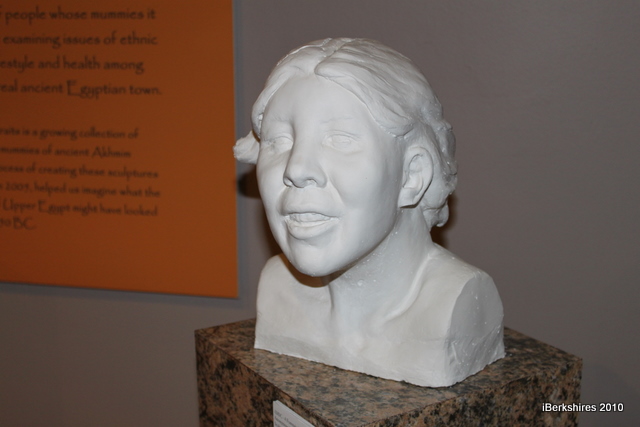 Busts put a human face on the ancient remains explored in the Berkshire Museum's 'Wrapped!' exhibit. |
PITTSFIELD, Mass. — Time stands still for mummies but not for the Berkshire Museum's exploration into those preserved remains of ancient days.
Major advancements in technology, particularly forensic science, now allow historians and archeologists an opportunity to demystify Egypt’s most sacred objects.
The museum has taken full advantage of this technology in its current exhibition, "Wrapped!: The Search for the Essential Mummy." The exhibit, which ends Oct. 31, was developed by Jonathan Elias, director of the Akhmim Mummy Studies Consortium in Harrisburg, Pa. While the highlight of the collection is Pahat, the museum's own mummy, along with two other mummies on loan including Pahat's son Shep-en-Min, who was found to be residing at Vassar College. It also explores Western culture's long-held fascination with the wrapped beings of the past.
"In the late 1800s and early 1900s the aristocracy would, for their entertainment, attend unrollings where they would watch as a mummy was slowly unwrapped," said Jeremy Goodwin, communications director at the museum. "They called it a public science night and most often the mummies would be disposed of shortly after."
These pseudoscientific evenings would eventually become much more serious forays into science as artifacts and tombs were uncovered. "Wrapped!" makes good use of many artifacts from the Akhmim region including amulets, cartonnage fragments (masks or panels made with layered and molded linen or papyri ), elaborate cannopic jars, shabtis (funerary figures) and mummified animals such as a cat, a falcon and even a baby alligator.
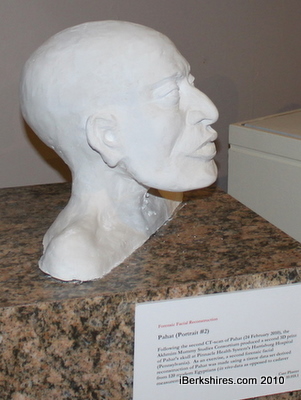 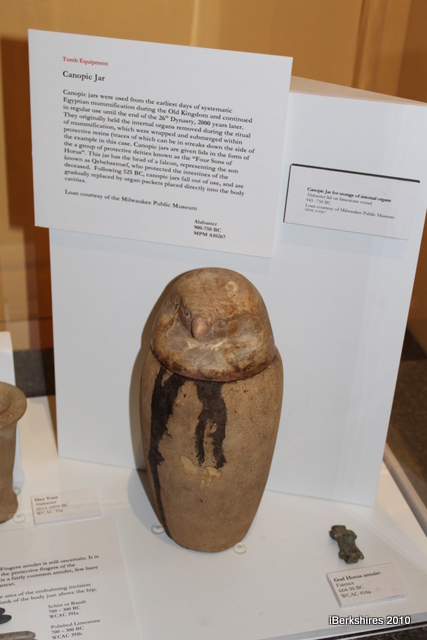 The face of Pahat, who died more than 2,300 years ago in Egypt. Pahat's mummified remains have lain at the museum for a century. At right is a canopic jar. The face of Pahat, who died more than 2,300 years ago in Egypt. Pahat's mummified remains have lain at the museum for a century. At right is a canopic jar. |
In addition to the found artifacts, the exhibition also includes historical documents such as newspaper clippings, illustrations and literature, all chronicling the "rise" of the mummy in Western culture. Perhaps of most interest is an early photograph of Rameses II (1270-1213 B.C.), whose mummy was discovered in 1881. The photograph, while eerie, demonstrates clearly how well preserved the great ruler was; his skin is intact and his hair still clings to the side of his head.
These photographs set the scene for the forensics portion of the exhibit, which seeks to explore the inner (literally) life of the mummy. Touch-screen computers allow visitors to uncover each layer of the mummy, from its external skin to its deep tissues. These high-resolution images were gathered at Berkshire Medical Center, where Pahat was given a computed axial tomography, or CT, scan earlier this year. Likewise, his son was also put under the radiology microscopic, revealing more than just how well each took care of his teeth.
"We can see the mummies much closer than those early days," Goodwin said. "We know that Shep-en-Min most likely died from a badly broken leg. He may have been given his father's cartonnage because they had everything ready for Pahat when he died. We know that they were both priests. We never would have known this otherwise."
Shep-en-Min's untimely death also brings a very human element to the exhibition. As the mummies and artifacts are combed over, a daily existence is revealed, one that includes riches, ailments, food choices and grief. The physical embodiment of this humanity can be found on the faces of the dozen or so forensic facial reconstructions that are in display. These reconstructions reveal the fine details, giving life to the leathery faces of the mummies who continue to haunt the annals of history.
"Wrapped!" also include several public and educational events. For more information call 413-443-7171 or visit berkshiremuseum.org.