Berkshire Museum Explores Tradition In Native American Art
 |
|
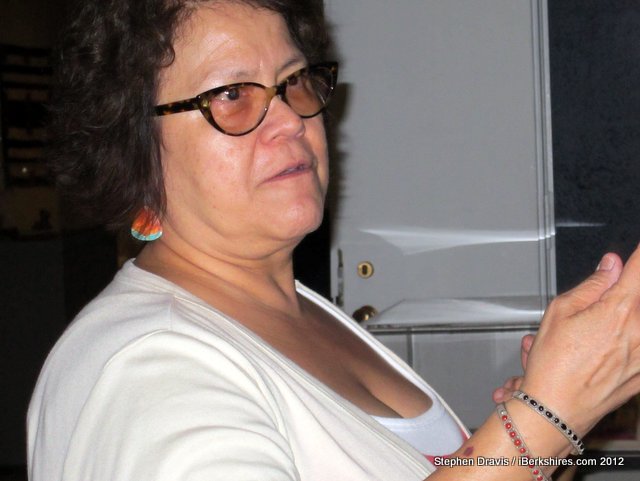 |
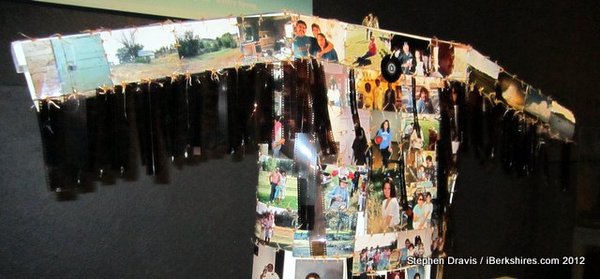
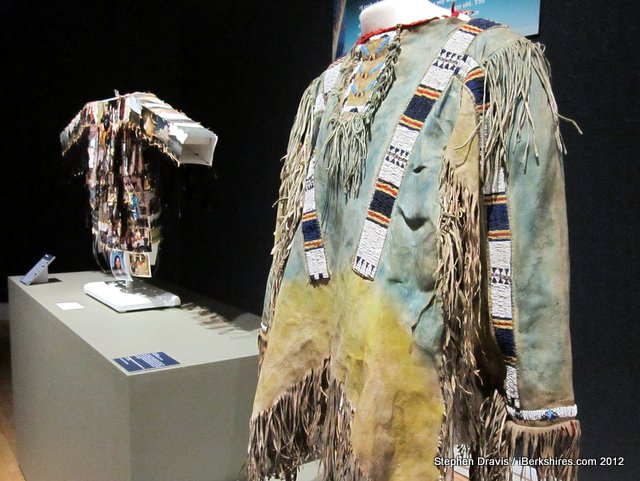
Bently Spang's 'War Shirts Series,' left, is displayed alongside a traditional Sioux Indian shirt in the Berkshire Museum's gallery. Left, co-curator Margaret Archuleta, a doctoral candidate in art history at the University of New Mexico, talks about 'Rethink! American Indian Art' |
From a distance, you almost think the two garments are made from the same materials. But look closer and you find that while the former utilizes buckskin, dye and beads — as you might expect — the latter uses family photographs that have been stitched together and strips of photographic negatives for tasseling.
Look deeper still, and you find that the two are really not that dissimilar at all.
"Taking the materials that are around you and using them to make objects is not new," Berkshire Museum Director of Interpretation Maria Mingalone explained during a Saturday morning tour of "Rethink! American Indian Art" at Berkshire Museum.
"The idea of multimedia art, of taking what happens to be around you, is traditional."
So while Spang's ancestors may have used shells or animal teeth or other "found objects," it is natural that he might use similar everyday items in new and creative ways.
Put another way, Spang's "non-traditional" media really is traditional, explained visiting scholar Margaret Archuleta, who co-curated "Rethink!" alongside Mingalone.
"Tradition is a fluid word and changes over time," said Archuleta, who is of Tewa heritage and is a former director of the Institute of American Indian Art Museum in Santa Fe, N.M. "What is your tradition in your family, and how has it changed?"
That's the kind of question that "Rethink!" aims to get visitors to think about during its six-month run at the South Street institution.
Mingalone and Archuleta asked six contemporary artists of Native American descent to contribute original works to display side by side with historical pieces from Berkshire Museum's permanent collection.
About 7 percent of that collection was used in creating "Rethink," which occupies three gallery spaces on the museum's second floor and runs through Jan. 6.
As part of the process of creating the exhibit, the museum catalogued its Native American collection and invited the contemporary artists in to look at the historical items to find connections between past and present, Mingalone said.
Those connections are at the heart of "Rethink."
"Our curatorial approach is to create a community dialogue between contemporary artists and historical material," Mingalone said. "We could have simply shown this material as stagnant objects of the past. That wasn't the direction we chose to follow. We wanted to bring the voices of living artists into the conversation."
Those artists come from different parts of the country, different Indian nations and different artistic backgrounds, said Archuleta, who has curated similar shows in the past.
Preston Singletary, for example, has extensive training in glass blowing, having studied in Italy. But he combines that knowledge with the tradition of the Tlingit Nation of the Pacific Northwest and helps teach other Native American artists how to use glass in their art.
Teri Greeves holds a bachelor's degree from the University of California at Santa Cruz, but was raised on Shoshone and Northern Arapaho Wind River Reservation in Wyoming and learned traditional beading techniques as a young child from the women in her family.
Diego Romero is descended from the Cochiti Pueblo but was born and raised in Berkley, Calif., and holds a master's in fine arts degree from University of California at Los Angeles.
Romero's work is the centerpiece of a display that shows how different artistic traditions can be blended in thought-provoking ways.
Romero's ceramic art in the tradition of Pueblo of the Southwest appears alongside a Grecian urn from the 6th century B.C.E. on loan from the Williams College Museum of Art and Marvel comic books from the mid-1960s. The connection? Romero adorns his ceramics with images inspired both by the classic Greeks and pop-cultural icons like Captain America.
 |
|
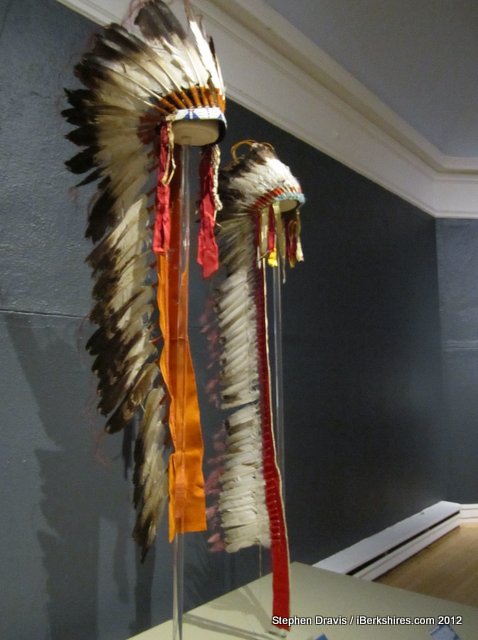 |
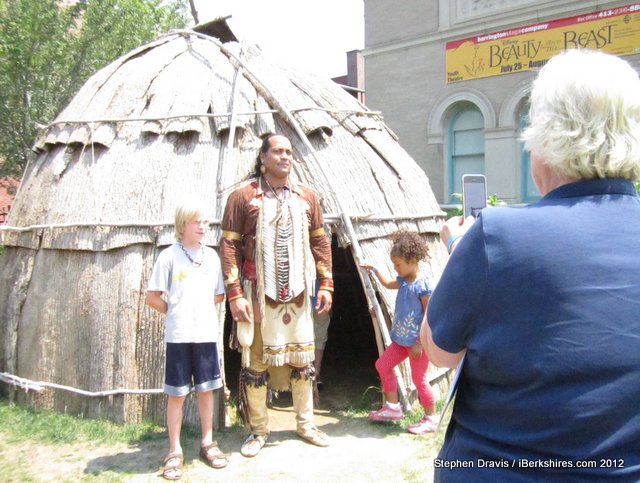
Right, a Lakota Sioux headdress, left, and a headdress from the Great Plains, are part of the museum's extensive Native American collection. David Weeden of Mashpee, who helped build the wigwam on display, poses with visitors Saturday afternoon. Weeden was dressed in the regalia of the Eastern Algonquian after performing traditional songs and dances in the museum's theater. |
"Preston's subject matter is very traditional, even though glass is not seen as a Native American material," Archuleta said. "Diego is doing non-traditional storytelling with traditional pottery."
It all helps carry the theme of "colliding cultures" that runs throughout "Rethink." The exhibit strives not only examine the impact of European culture on Native American art but also the influences that different native peoples had one another.
"There's a perception that things were static until the Europeans arrived," Mingalone said.
"But change was happening all the time," Archuleta said. "Trading between peoples was not new. You always have to keep moving and changing."
And audiences today have to stop thinking about Native American artifacts only through the prism of how they were used. That is another important theme of "Rethink," which aims to recapture the idea of historical objects as works of art.
"Today, we tend to separate things more. We have stuff that we use, and then we have 'art' that we might hang on a wall," Mingalone said.
For Native Americans, the distinction was not as relevant.
"We have these decorative baskets," she said. "And if you're only looking from an anthropological, utilitarian perspective, yes, they were used to carry things. But even if they were meant to be used, there's still an aesthetic."
Tags: American Indian, Berkshire Museum, exhibit, multimedia, Native American,