North Adams Master Planning Process Seeks Input
|
The city's master planning process is expected to wrap up this December. More information on the process and documents can be found here. |
NORTH ADAMS, Mass. — The city's set to wrap up its first master planning process in 40 years by December and will be looking for a part-time planner to help it follow the new roadmap.
"We identified just a lot of things over the last 12 or maybe 15 months that give us great potential and great hope," said Mayor Richard Alcombright. "It's going to be our road map to growth and growth initiatives as we move forward as a community."
The mayor, Michael Nuvallie of the city's economic development office and Amy Kacala, a senior planner with the Berkshire Regional Planning Commission met Monday morning in the mayor's office to provide an update on the planning process so far in hopes of encouraging more residents to take part.
The city embarked on a master plan in 2011 in conjunction with the BRPC's Sustainable Berkshires project. The countywide plan is being funded by a nearly $600,000 grant; North Adams and Great Barrington are both completing their master planning by "piggybacking" on the county plan.
The process, dubbed "Vision 2030," has so far included broad visions of what the city (and county) should consider priorities — such as green space and economic development — and what assets already exist.
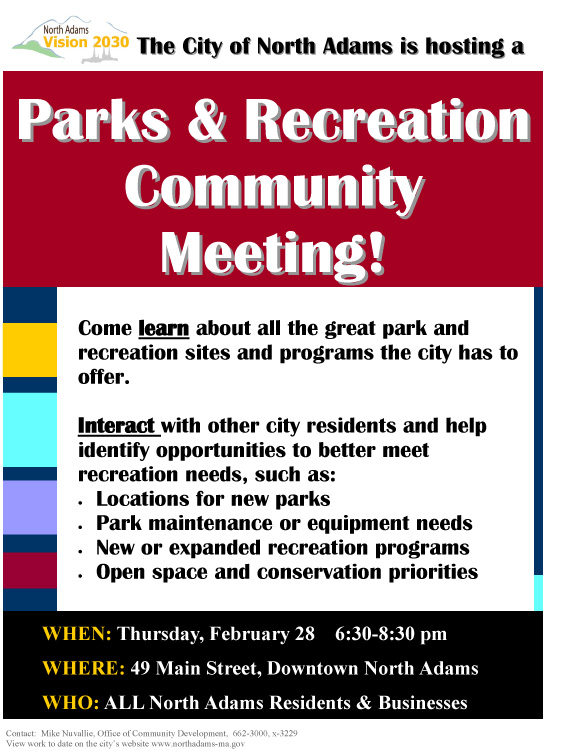
The latest discussion will take place Thursday, Feb. 28, from 6:30 to 8:30 p.m. at 49 Main St. with a focus on recreation and conservation.
Kacala said residents are encouraged to come in and stay as long as they want. Getting people involved "is a perpetual problem," she said, and new ways of getting people to meetings are being tried. This time, for instance, fliers were sent home from schools to engage parents and the meeting is being held in a downtown storefront for easier access.
"If you haven't had a plan in 40 years it's not necessarily something people are used to talking about," said Kacala. Particularly with the plan now turning toward neighborhoods and land use, "we really want to make sure we get broad public involvement."
Even so, she said many of the previous groups have had a diverse mix of people. Alcombright said the representation in terms of sectors — tourism, arts, business, environmental — has been good but more would be better.
"We're really coming into the final stretch and we'd like to get whatever we can before we finalize this thing," he said.
The conservation and recreation will look at community, well-being and health as well as ways to capitalize on the city's natural and recreational sources for economic growth.
"It's not just 'parks are pretty,'" said Kacala. "It really does have a big impact for the way the city is representing itself to potential employers, current residents and ... it's fun"
|
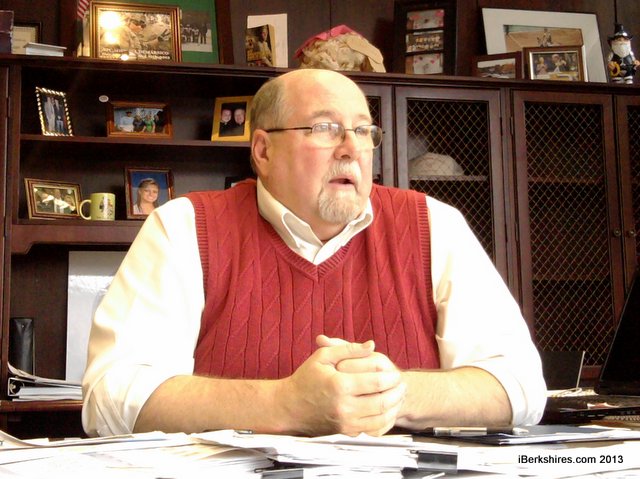
Mayor Richard Alcombright said the planning forums have already generated ideas that are moving forward. The next forum, on conservation and recreation, is set for Thursday from 6:30 to 8:30 at 49 Main St. |
The conversation may be about better signage for the trails in the area, the future integration of Mount Greylock State Reservation, the development of a walking loop and, a consistent theme Kacala said, of the extension of the Ashuwillticook Rail Trail to and through North Adams.
The mayor said one aspect of the plan may be the concept of "complete streets," in that street reconstruction will go beyond paving to considering bike routes and better sidewalks.
"How do you use our streets so they're not just car friendly, but bike friendly, pedestrian friendly, moms with baby carriages friendly?" said Alcombright. "A lot of this stuff were starting to think about more globally."
That will include hiring a part-time planner within the next 30 to 60 days to work in conjunction with the planning process so the individual will have a good grasp of what the city has and where it wants to go.
The mayor expected the job to be posted within the next few weeks once a job description had been worked out. The post would be funded in part by a $20,000 line item in the budget and in part by Community Development Block Grant Funds. How part time the job will be has not yet been determined.
The planner will be tasked with reviewing the city's zoning and ordinance and how they align with the goals of the master plan. Some of that will require updating antiquated or obsolete ordinances.
Nuvallie said he could see the plan "being used very significantly" to apply for different funding sources.
"I can't even imagine the kinds of dollars we're going to get back in return," he said. "It's going to be used as a way to better compete for various pots of money.
 "But when you have a comprehensive master plan, you have to make sure you're existing zoning and bylaws and ordinances are up to date. There is an evident need to bring the antiquation back up to today's standard so the master plan and all this other stuff works harmoniously together."
Alcombright said the master plan would become an important part of the city's future growth by helping bring so far dislocated efforts together. Even if it was discarded, the discussions over the past year or so have brought up positive ideas that already have their own momentum, he said, such as the Berkshire Scenic Railway proposal, Mass in Motion and the privatization of Western Gateway Heritage State Park.
"It will not sit on a shelf," the mayor vowed. "I think it's broadbased enough and certainly modular that the groups that are driving these ideas will continue to push these things forward."
Kacala cautioned that it will take time for elements of the master planning process to move forward. "It's not a silver bullet," she said.
Tags: BRPC, conservation & recreation, master plan, planner,