Lion Miles of Stockbridge works on an unusual project: to create a dictionary of the Mohican languag

Print Story | Email Story
In Mohican, the third person pronoun is he-she-it equally, according to Lion Miles of Stockbridge. The Mohican ‘gender’ divides objects into animate and inanimate. As in French or Spanish — in which hands, silverware, dinner plates and different kinds of food may be male or female — the genders of Mohican nouns are not always obvious to a foreign speaker. Body parts are inanimate. Mountains are animate. There are no native speakers of Mohican living. Miles has been working on a dictionary and grammar for the Mohican language for five years. No one has spoken Mohican fluently since the beginning of the 20th century, he said. Mohican descendants on the Munsee-Stockbridge reservation in Wisconsin are interested in recovering language. They hope to teach it to their children in school. Miles lives in Stockbridge bowl, near hibernating bears and a flock of 50 or 60 wild turkeys. He has been teaching courses on the Mohicans with Berkshire Institute for Lifetime Learning and Elderhostel. He also specializes in the American Revolution, he said; he is a historian, not a trained linguist. He has made four trips to Wisconsin, to the Stockbridge-Munsee Reservation. At a conference in October, he said, he passed out a list of 200 words he had collected, to see whether anyone remembered any of them, even as old family expressions. No one did. Miles started from scratch, but he has found more written source material than expected. Mohicans joined several Christian missions, including the mission that became Stockbridge, and many Mohicans became literate. Lion’s first find was a Westminster Assembly’s Catechism. A conference of Clerics in England, in 1643, devised this list of the principals of Congregational and Presbyterian religious beliefs. Apparently these churches no longer use a catechism, Miles said, but in the 18th century there were hundreds of editions printed. He has a 1795 Stockbridge edition in Mohican. Loring Andrews printed it in his print shop; he later edited the first newspaper in the Berkshires. He then had to find out whether his catechism was authentic and who did the translation. He found a later one from perhaps 1818, a pocket-size edition, in modern type. On the flyleaf, a hand had written: by John Quinney and Captain Hendrick. Quinney was a school teacher with the Stockbridge Mohicans. Captain Hendrick was Hendrick Aupaumut, a Mohican who graduated from Dartmouth and served with General Washington in the Revolutionary War. He wrote a history of his people, now lost except in lengthy citations in contemporary writings. Was the flyleaf telling the truth? Miles went to the Wisconsin Historical Society and looked through the papers of missionaries to the tribe. The handwriting on the flyleaf is distinctive. It belonged to the Rev. Cutting Marsh, minister to the tribe: a letter in the same hand mentions sending the small book to Boston. So the Mohicans themselves, scholars who were fluent in Mohican and English, translated the catechism into their own language. Many white men tried to translate texts into Mohican, Miles said, but the catechism is unique. He found an English version of it from 1795, printed in upstate New York, and used it to translate the Mohican back into English. He found some intriguing words that must have been new additions to the vocabulary of Mohicans in the Stockbridge mission. They did not have a verb for ‘to read,’ since they did not have written language. They used the verb for ‘to count’ for it, as in, to read tally markings. For ‘book’ they used the verbal root for ‘to paint.’ So ‘to read the good book’ translated to ‘to tally the good painting.’ A horse they named ‘creature that carries something on its back,’ the same word for they used for ox or donkey — beast of burden. Their word for baptism came from the root of ‘to rain, to pour water.’ Miles said he has about 1,500 words, all fully inflected with proper grammatical endings. It is hard to give an exact count, because the language will take one root word and add prefixes and suffixes, to change or expand its meaning into many different words. The Mohicans translated ‘commandment,’ for example, by building a word on the root meaning ‘to teach.’ They added a pronoun prefix and a suffix that made the verb a noun. The first commandment is: thou shalt not pray to false idols, or thou shalt have no other gods besides the one true God. The word ‘gods’ is a noun prefix with the root ‘to pray,’ Miles said. In the catechism, the first object of teaching translates: not other his praying-to god sight make. He added when he discussed the catechism with the Stockbridge-Munsee a woman told him, ‘we do not worship rivers or rocks, but the spirits in them.’ He has begun the second step, organizing them into a dictionary. It is Mohican to English so far. English to Mohican comes next, and then an elementary school grammar. The catechism all in context, with grammatical endings and inflections. Miles said there has been a Mohican dictionary published, but it is simply a list of words in German script, without context. He has also used field notes from an anthropologist who spoke with native speakers of Mohican in 1934 and collected isolated words and phrases. He is trying to make the dictionary simple, so that students can use it. He is not writing the words with the diacritical markings linguists use to show pronunciation. Since there are no native speakers, he does not know, in any case, how to pronounce Mohican words. He will suggest to the Stockbridge-Munsee that they use the Munsee pronunciation, he said. There are only five speakers of Munsee left, and it is very similar to Mohican. Mohican belongs to the Algonquin language family, which stretched from Canada to the Carolinas and as far west as the Blackfeet in Montana. It even appeared in scattered groups on the West Coast. It is an entirely separate family from the Iroquois languages (including Mohawk). Miles is looking for similar words to the Mohican in other Algonquin languages, to see how they relate. There is evidence that a Mohican from the Hudson could travel to Maine and speak with the people there easily, he said. Spelling was an issue, since the Mohicans had no written language before they learned the European Alphabet. They spelled their language phonetically, and (like the colonists) spelled the same word many different ways — including their name. Beside the Puritan mission in Stockbridge, Moravian missions sprang up in Dutchess County, N.Y. and in Connecticut. Some Mohicans studied there, and have given Miles his second treasure trove. They learned German language and orthography. He visited Moravian archives in Bethlehem, Penn., and there he found hymns translated into Mohican. He found letters written in Mohican, by Mohicans; a cantata with Mohican and German lyrics; a Passion story that details the life of Christ from the Last Supper to Resurrection. He can read old German script, and he has found a 1799 hymn book, to be sure he has all the hymns in translation. This new material is doubling his vocabulary, he said. The Passion story he has in three languages: he has the English text for much of it, because it quotes the Bible directly. Some of the Moravian writings have stress marks, indicating a raising or lowering of pitch. Some are in iambic pentameter. The meter gives clues to the rhythm of the speech, and rhyming verses give guide to the pronunciation of some words. Miles added that he liked the Mohican word for ‘love.’ The root of the word is the noun for ‘heart.’ To love someone is to give them your heart. He said Peace Pagoda in New York is setting up a peace pole with four or five languages. They asked him for a phrase in Mohican. He replied, Taukh wnaukootw aukun hkeek tonneh: Let peace on earth be done. The Native American Institute at Columbia-Greene Community College and the New York State Education Department, New York State Museum, present “Mohican Seminar 2002: The Challenge, An Algonquin People’s Conference” at the New York State Museum, Albany, N.Y., March 8 - 9. For information, call (518) 325-3408.
If you would like to contribute information on this article, contact us at info@iberkshires.com.

RFP Ready for North County High School Study

By Tammy Daniels iBerkshires Staff
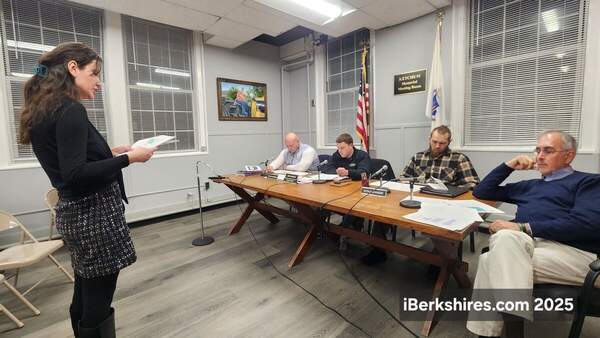
NORTH ADAMS, Mass. — The working group for the Northern Berkshire Educational Collaborative last week approved a request for proposals to study secondary education regional models.
 
The members on Tuesday fine-tuned the RFP and set a date of Tuesday, Jan. 20, at 4 p.m. to submit bids. The bids must be paper documents and will be accepted at the Northern Berkshire School Union offices on Union Street.
 
Some members had penned in the first week of January but Timothy Callahan, superintendent for the North Adams schools, thought that wasn't enough time, especially over the holidays.
 
"I think that's too short of a window if you really want bids," he said. "This is a pretty substantial topic."
 
That topic is to look at the high school education models in North County and make recommendations to a collaboration between Hoosac Valley Regional and Mount Greylock Regional School Districts, the North Adams Public Schools and the town school districts making up the Northern Berkshire School Union. 
 
The study is being driven by rising costs and dropping enrollment among the three high schools. NBSU's elementary schools go up to Grade 6 or 8 and tuition their students into the local high schools. 
 
The feasibility study of a possible consolidation or collaboration in Grades 7 through 12 is being funded through a $100,000 earmark from the Fair Share Act and is expected to look at academics, faculty, transportation, legal and governance issues, and finances, among other areas. 
 
View Full Story

More North Adams Stories