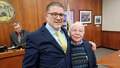
“When I turned on the TV on Sept. 11 I felt duty bound to let someone know what I could do,†stated Lee resident Maude Bryt.
Although a Berkshire resident for most of her life — and an EMT with the Lee Ambulance Corps for the past seven years — Bryt was born in Manhattan and has spent many years roaming through its concrete canyons.
Bryt explained that she “knew the area well: I had been a gofer for the Louis Dreyfuss Corporation. I knew all the buildings, that entire area of town, the basements, and the concourse really well. So I pulled out a New York City phonebook and called the first precinct that my finger landed on.â€
To Bryt’s astonishment she was able to speak with a desk sergeant who asked her some questions and then “she asked me to please come down. I headed down that day and started working in triage.â€
Bryt was one of the first to do a walkabout — along with a physician and a paramedic she had met — around the disaster area. “It was utter carnage. There were chunks of buildings, no lights, no electricity, everything was on fire. There were no sounds. It was so quiet and the worst part was that there was no one screaming for help. Silence, silence, silence, and darkness.â€
Bryt ended up working alongside firemen and helped find and treat one of the few people found buried alive that day. “The man was pinned at the chest by a piece of a building. I went in with the doctor and paramedic to help get the man out and we set up a triage area right there that very first day. All in all we took care of lots of smoke inhalation, cuts, people with all that dust in their eyes.â€
The following Saturday Bryt learned that a French canine search-and-rescue team was coming in to the city. “I decided to tell a few of the volunteer coordinators that I spoke fluent French and have a medical background. I grew up with medicine: my dad is a physician from Tours via Paris and was a doctor in the French Army during WWII. Both he and my brother are affiliated with the NYU Medical Center.â€
Bryt did not hear anything else that day regarding the French Team, and a day or two later, “While I was out looking for bandages I ran into a FEMA (Federal Emergency Management Administration) representative who mentioned that the French canine team had arrived. I told him of my abilities and that I could help them out. He took down my information, then gave me the name of someone I could call who was working with the team.â€
Bryt continued her search for medical tape and eventually ran into a man “looking around in shock. I asked him if he was OK and he said yes, it was just devastating, and that he was with a bunch of French guys. I was pleasantly surprised and so I let him bring me to them and I ended up working with them after all.â€
Now that she had finally connected with members of the French canine team, Bryt reports that she “saw the dogs do amazing things in their search and rescue that U.S. dog teams weren’t doing. The U.S. dogs just didn’t seem as productive — not that they weren’t as well trained, just trained differently.â€
Bryt gives the example: “U.S. dogs have shoes on their feet to protect their feet. The French believe that it is important to use everything that nature has given the dogs and that making them wear shoes unbalances them, changes their receptiveness to temperature. They believe in using all of the dogs’ natural senses and they work with them from when they’re still puppies so that they’ll be prepared for the harshness of their job.â€
The French canine search-and-rescue team is known as GICRS (Groupement d’Intervention Cynophile de Recherche et de Sauvetage – Canine Intervention Group for Search and Rescue).
Patrick Wackernie, head organizer of GICRS, had felt the need to start a U.S. branch of French-trained canines. “I stayed in touch with him by phone,†said Bryt. “We both started working on it and eventually the Lee Ambulance Corps let me know that they were interested.â€
A day came in late- to mid-October when Wackernie called Bryt and asked her to come to Paris for a Mass to bless their dogs. “The event was filmed and ended up on a popular French television show, their equivalent of Animal Planet. I felt like I was representing all the 9/11 rescue workers and FEMA.â€
Bryt stated that she feels that it is imperative that this French style of training should be utilized in the U.S. “We have the teachers ready, we’ll even get you the dogs; what we lack is proper funding. The U.S. has 30 building collapses a year, we have the San Andreas fault, national parks where people get lost. Right now what we have in the way of search-and-rescue isn’t as good as it can be.â€
While some of the canine training techniques are similar between the two countries, Bryt stated that “the biggest difference is in the results: I don’t know exactly what the statistical numbers are, but I can say that our group didn’t miss even once during 9/11.â€
The French training techniques employ a much more holistic attitude towards search-and-rescue training. “The training is more intense, goes on for a longer duration, with many multi-faceted angles,†explained Bryt. “The training focuses on the nature of the dog and the relationship between the man and dog; they study the physiology of dogs too. These dogs are all trained for mud slide, avalanche, and rubble search and rescue. It’s much more comprehensive. My own dogs are going through the training. One is only 10 months old and the other is 16 months old.â€
Upon completion of the course, the GICRS conducts a test held in the Alps where each man/dog team must find the test victim in under 20 minutes, both with and without an item of the victim’s to go on. “I always think that the most important result of this job is that it means that there will be less widows and orphans, fewer people that will be hurt or unsure. We have to move forward to a new normal, not back to normal, to be even better than ever as a nation.â€
GICRS, in cooperation with the Lee Ambulance Corps, will be holding a Mass Casualty Demonstration on Saturday, April 13 at 1:30 p.m. at the Tyringham Firehouse.
“We’re staging a plane crash,†explained Bryt. “We’ll have victims, debris, the rescue dogs. We’re also offering Continuing Education Credits (CEUs) to emergency personnel who show up and participate.†A class will be held April 11 which will be good for three CEUs and another good for four CEUs on April 13. This event is open to the public and a donation is requested.
For more information on the demonstration, to make a donation, or if you have any questions regarding GICRS, write to them at P.O. Box 924, Lee, MA 01238, or call Maude Bryt at 243-1763.
If you would like to contribute information on this article, contact us at info@iberkshires.com.
Your Comments
iBerkshires.com welcomes critical, respectful dialogue. Name-calling, personal attacks, libel, slander or foul language is not allowed. All comments are reviewed before posting and will be deleted or edited as necessary.
No Comments
RFP Ready for North County High School Study
By Tammy Daniels iBerkshires Staff
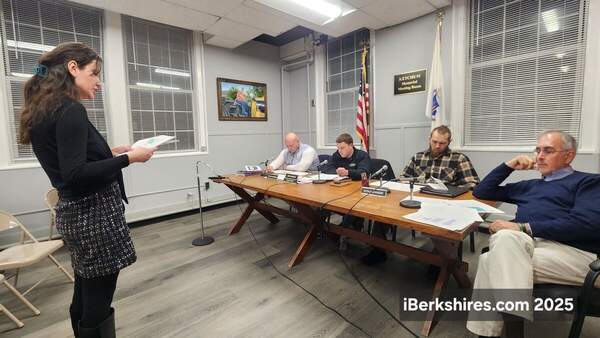
NORTH ADAMS, Mass. — The working group for the Northern Berkshire Educational Collaborative last week approved a request for proposals to study secondary education regional models.
The members on Tuesday fine-tuned the RFP and set a date of Tuesday, Jan. 20, at 4 p.m. to submit bids. The bids must be paper documents and will be accepted at the Northern Berkshire School Union offices on Union Street.
Some members had penned in the first week of January but Timothy Callahan, superintendent for the North Adams schools, thought that wasn't enough time, especially over the holidays.
"I think that's too short of a window if you really want bids," he said. "This is a pretty substantial topic."
That topic is to look at the high school education models in North County and make recommendations to a collaboration between Hoosac Valley Regional and Mount Greylock Regional School Districts, the North Adams Public Schools and the town school districts making up the Northern Berkshire School Union.
The study is being driven by rising costs and dropping enrollment among the three high schools. NBSU's elementary schools go up to Grade 6 or 8 and tuition their students into the local high schools.
The feasibility study of a possible consolidation or collaboration in Grades 7 through 12 is being funded through a $100,000 earmark from the Fair Share Act and is expected to look at academics, faculty, transportation, legal and governance issues, and finances, among other areas.
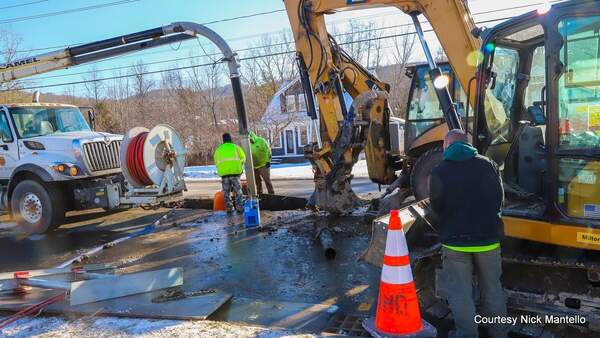
The city has lifted a boil water order — with several exceptions — that was issued late Monday morning following several water line breaks over the weekend. click for more
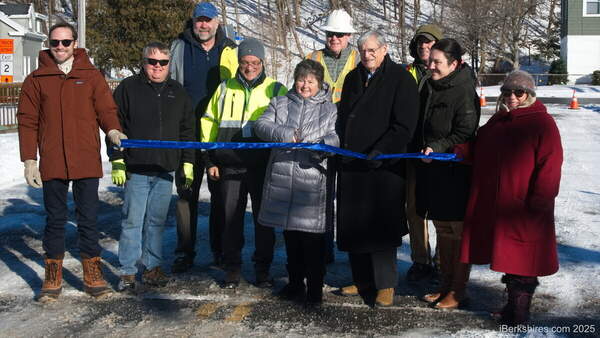
The bridge had been closed to all vehicle traffic since March 2023 after being deemed structurally deficient by the state Department of Transportation. click for more
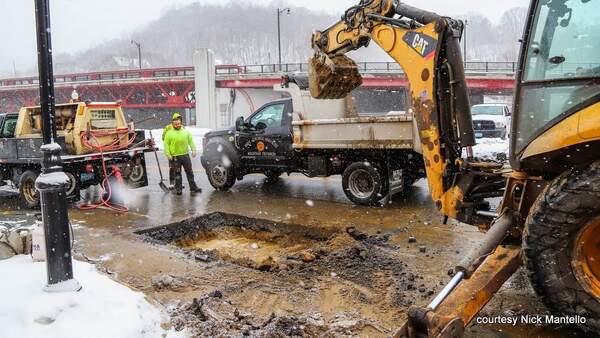
The Water Department has been responding to multiple water line breaks throughout the city since Friday, causing temporary loss of water in some areas. click for more
Nearly a year of study and community input about the deteriorating Veterans Memorial Bridge has resulted in one recommendation: Take it down. click for more