Pittsfield Enters 2nd Year of Tyler Street Revitalization Program
.JPG)
Amequsika 'Sika' Sedzro has been appointed by MassDevelopment to head the efforts. She is paid by the agency for three years to help in Pittsfield's district.
Entering her second of three years, the first steps in rolling out that plan will be taking shape this year.
The Tyler Street and the Morningside neighborhood are the next targets for a complete redevelopment, following nearly the same plans as implemented on North Street over the last decade.
"We're not limiting what it is that can happen in this city, we are just providing the framework and guidance," Sedzro told the City Council on Tuesday night.
"It is the same thing that happened on North Street and South Street and we are trying to do that on Tyler Street."
Sedzro is a fellow with MassDevelopment, a quasi-public state agency focused on economic development. The Legislature had previously approved a Transformative Development Initiative project for the so-called Gateway Cities. Pittsfield was chosen to be one of 10 communities to have a district chosen to carry a TDI designation, which opens up MassDevelopment resources and grant programs. Shortly after, the city was awarded a three-year contract to work with Sedzro.
"The purpose of TDI was not to just select a community and direct resources. This was about selecting a neighborhood or a portion of a neighborhood to have a concentration of resources directed to this area," City Planner CJ Hoss said.
The best way to look at what is about to happen with Tyler Street and the surrounding neighborhoods is to compare it to North Street. Years ago, city officials worked with downtown business groups and merchants to craft a plan. From there, the city specified redevelopment projects that included the Colonial Theatre and Barrington Stage. Those involved reached out to people like Richard Stanley and got him on board in building the Beacon Cinema.
Then the city worked to secure state funds and performed round after round of downtown construction projects. Over 10 years, the city focused public investments in front of areas of private investments. That's inspired other private investment. In the end, the entire length of North Street was transformed by a streetscape project that ended last fall. That has led to a slow economic re-emergence of the downtown over those years, though there is still some work to do.
Now the city is turning a corner — literally. That started with public hearings and the hiring of the consultants ELAN to help engage the public for what the future of Tyler Street will look like. It won't replicate North Street but the method of getting there will be the same.
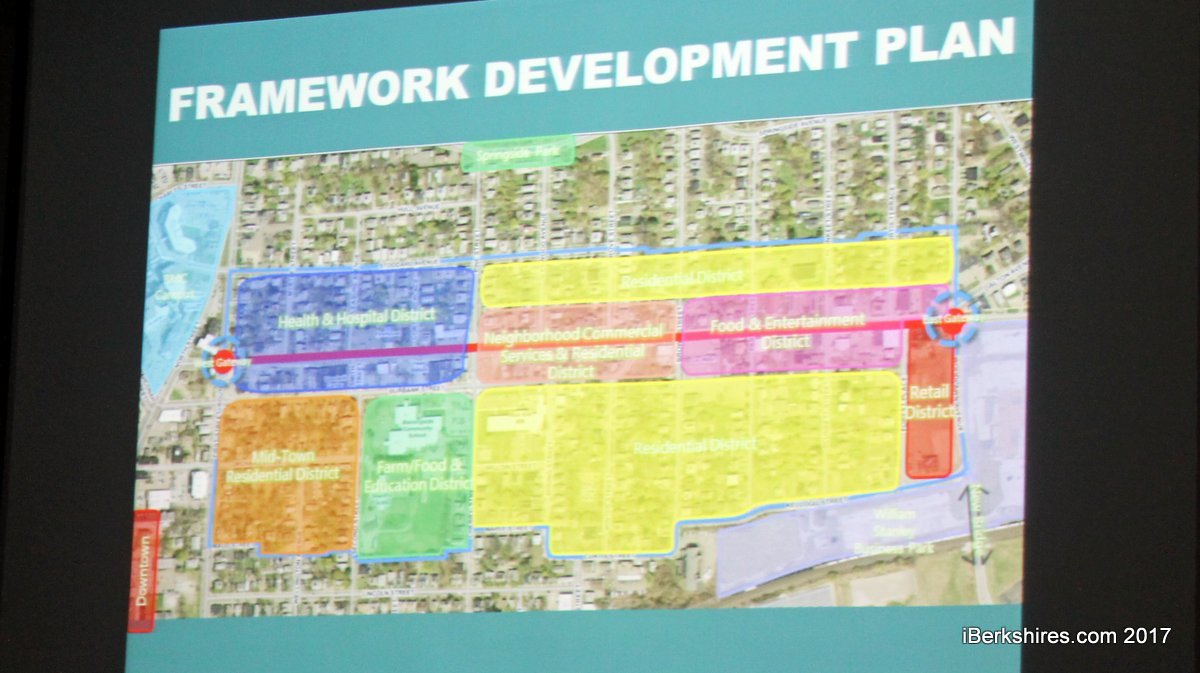
On Tyler Street, the plans embrace housing just as much as commercial development. The district has been broken down into multiple subdistricts and particular properties have been identified for redevelopment.
"We believe this is Pittsfield's next best, neighborhood revitalization project," Mayor Linda Tyer said, envisioning it as a "unique, thriving, working, multicultural neighborhood."
The district is anchored by the William Stanley Business Park on one end and Berkshire Medical Center on the other. In between, those involved have identified "linchpin" properties that are hoped will spur development. Council Vice President John Krol says one of those is the former St. Mary the Morning Star property.
"I think that is the major linchpin for this neighborhood," Krol said.
That site had once been eyed for a Dunkin' Donuts but the company pulled its plans in face of widespread opposition. Tyer says the new developer will be for market-rate housing for three of the buildings — but the church itself hasn't been planned for redevelopment. The redevelopment of the church itself would be a "Phase 2" project that hasn't been determined.
"We now have a very experienced local developer who has entered a purchase-and-sales agreement with the diocese," Tyer said.
Another key property could see some answers on March 9, when the city opens the bids for redevelopment of the former Tyler Street fire station. Tyer said the request for proposals was issued in hopes to find a developer who can bring it back into productive use.
Ward 4 Councilor Christopher Connell said the building is in tough shape and questioned whether the city should pursue doing some small projects to secure it if the plan is to reuse it. He was particularly concerned with the roof, feeling that the longer the building stays unused the more difficult it will be to redevelop.
"It's a beautiful building. It is too bad somebody couldn't just button it up now," Connell said.
Berkshire Children and Families had been interested in the past and performed a feasibility study that found the building could be saved. But, Tyer said the agency was unable to get an operating budget in place to support the planned reuse. That feasibility study, however, was shared with the city and Tyer hopes that information will help bring on a developer for that structure.
Other properties include the Shell gas station at the corner of First and Tyler and the Hess station. The owners of the Shell station have been considering tearing down and rebuilding the gas station and Hoss said his office has been in communication with them. He said he had a call with them on Tuesday and expects another development meeting soon.
"We have had discussions with them about the expectations would be for the redevelopment and design," Hoss said.
The Hess station, however, is more unknown. Sedzro said it is only one of many properties owned by Marathon Petroleum Co. and a determination of future use hasn't been made by the company as of yet.
"This is one of the many properties on their books and they haven't really sorted out their next step," Sedzro said.
The former Second Street jail is also on the list, though for exactly what is unknown. It is currently being used by the sheriff's department and Hoss said in the future it could be put on the market. This year, those involved with the TDI will want to take a close look at the building to be prepared for any future use that could come about.
"There could be some challenges there. There is open land now and it is something where five years from now, 10 years from now, this could be an available parcel," Hoss said.
The city has also applied for a grant for facade improvements for the storefronts in the area and is crafting a program to help redevelop housing areas. The housing around Berkshire Medical Center is hoped to be improved to make market-rate units for those who work at BMC. The housing program is looked at a way to improve the housing stock throughout the district.
"It is trying to think about how we can operationalize a housing program," said of the current status of that plan.
Krol said there is a large demand for market-rate housing in the city and encouraged the city to continue with its focus on that in the TDI district. Market-rate housing has been a big push downtown with such developments as the Onota and Howard buildings.
"The housing stock in Morningside is not up to par," Krol said.
And this year will entail planning for a streetscape project. Sedzro says the plan engages the community in many ways to find out exactly what they want in the neighborhood, rather than lifting the plans from another street project.
"We're hoping to have a big event on May 13 that will start to engage the community," she said.
Some other improvements eyed are the long-awaited lighting project to improve visibility and bus stops. For the latter, residents on Tyler Street have no bus stops and have to flag down passing buses. The Berkshire Regional Transit Authority is working with Sedzro to pilot some bus stops with signage. Eventually, the BRTA would be looking to put in covered stops.
The lighting, however, is somewhat contentious because the City Council approved funds eyed to improve lighting on the north side years ago and the work was never done. Hoss said that capital allocation was for design and almost as soon as that was allocated the city got involved with the TDI. That pushed back the lighting progress while the TDI project started its plans for full development.
"We didn't want to be replicating efforts and wasting money," Hoss said.
Connell called lighting a public safety measure and urged the city take that on sooner rather than waiting. That the lighting still hadn't been done irked Ward 7 Councilor Anthony Simonelli.
"We're coming up on a budget season in June and we will have capital projects and I will want to know when something is going to get done," Simonelli said.
The efforts also include crafting a plan for when Sedzro's contract ends so the city can carry the torch.
Tags: Morningside, redevelopment, streetscape, tyler street,