Clarksburg Sets Special Town Meeting for Solar, Zoning Changes
.jpg)
The Select Board signed off a town meeting warrant for Dec. 28.
The bylaws related to zoning, marijuana production and sales, and large-scale solar installations have been developed over the past 18 months with aid from the Berkshire Regional Planning Commission. The process was funded through a local technical assistance grant — part of the town's Community Compact — that runs out on Dec. 31.
"The solar bylaw is pretty encompassing," Town Administrator Carl McKinney said. "Up until this point, folks, we've only had a public utilities component to our existing bylaws which were ... created in about 1973 and did a significant upgrade in 1992. ... But there was no allowance for windmills, cell towers, solar arrays. Those things didn't exist at that point."
Town meeting last year passed bylaws regulating windmills and cell towers; planners had hoped to have the solar bylaw ready for this past town meeting but couldn't make it happen.
Two weeks ago, residents at a public hearing on the zoning changes expressed concern over setbacks that would allow large-scale solar to be sited close to their homes. This was addressed by the Planning Board more than a week with an amendment creating a 500-foot setback.
The proposed bylaw creates an overlay district that will place solar in areas considered "least noticeable and in congruence with the character of the town," McKinney said. "That is for the large-scale industrial ones. this is not not going to impact if you want to put one on your roof or a couple standalones next to your shed."
We are looking at these huge solar arrays that have hundreds and hundreds of ugly solar panels that people shouldn't have to look at ... but we don't want to outlaw it either."
Matthew Parlon, a project development analyst with solar developer Blue Wave, asked that the solar bylaw vote be put off or the board consider solar as an agricultural addition separate from industrial use.
Parlon, and colleague Drew Pierson, were speaking on behalf of landowner AJ Randall of Daniels Road, with whom Blue Wave has been developing an installation designed for agricultural use.
"The project we're talking about is very different from solar that's been done in Clarksburg," he said. "We recognize there's been a lot of bad citizenship amongst the solar development comunity, the town has not been treated fairly."
Blue Wave was committed to paying taxes, $1 million over 20 years, Parlon said. Their request was that the Select Board and Planning Board consider allowing installations certified by the state Department of Agricultural Resources by special permit in agricultural residential zones.
DAR is looking to improve energy efficiencies for farms through the use of alternative energy. It has several grant programs to aid farmers in renewable energies and promote such energy use in the state. Agricultural solar is often on a platform that allows crops to grow or animals to graze under them.
The installation has been under development for a year and the Blue Wave representatives said they had believed it would pass the bylaw as originally proposed, with care taken to mitigate any visual impacts.
"We made a lot of decisions based on that information," Pierson said. "And it was only a week and a half ago it became completely outlawed."
Randall attended the meeting also with a number of neighbors who were in support of the project, which would provide a revenue stream for Randall's farm. They were upset that they had not known about the public hearing two weeks ago when a number of residents had pushed for changes that have since been incorporated.
McKinney said there was little to be done at this point because the grant funding for the zoning changes runs out on Dec. 31. He said he would forward the Randall and Blue Wave's concerns to the Planning Board and suggested they attend the special town meeting because amendments could be made on the floor.
The special town meeting warrant had to be signed and posted Wednesday to make the 14 required days before the meeting is held.
"This is going to be posted this evening. We can't change any language," Chairman Jeffrey Levanos said. "I'm very sorry ... This is a Planning Board thing and they have made their decision. We are here to get this warrant signed so we can get it posted."
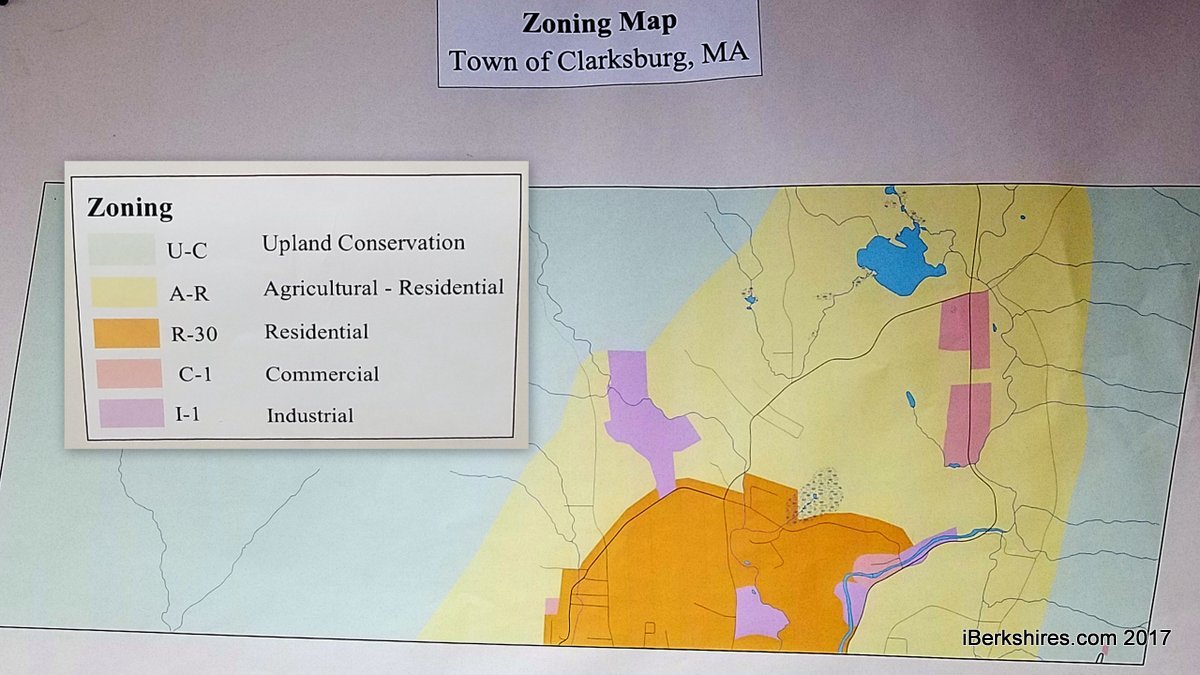
Voters will also consider changes to the outlines of several zones to bring them in line with actual property lines; creation of industrial-service zones to accommodate professional offices; the rezoning of an industrial zone to commercial on Middle Road; and a marijuana bylaw that restricts any facility to the industrial zone near Town Hall. The warrant also includes the creation of revolving funds for inspection and policing fees, installation of signs at the Town Field and the Horrigan Road cemetery, and the renaming of Town Field to Peter A. Cook Veterans Memorial Field.
Details and maps of the bylaw changes are available at Town Hall during regular business hours.
In other business, the board approved a used automobile class II license for Thomas Rotolo and discussed possible repairs at the Clarksburg School, which will be reported on in a followup article.
Clarksburg Special Town Meeting Warrant, Dec. 28, 2017 by iBerkshires.com on Scribd
Tags: bylaws, commercial zoning, solar bylaw, special town meeting, zoning,