Mount Greylock School Committee Advances Turf Field Plan
WILLIAMSTOWN, Mass. — The Mount Greylock Regional School Committee on Monday moved forward a plan that could have an artificial turf athletic field in place at the middle-high school within a year.
By a vote of 6-0, the committee authorized expenditures not to exceed $158,000 for design documents and permitting services to begin an estimated $1.7 million project to install a multi-purpose turf field to the west of the school.
The panel first heard a report from the ad hoc committee of School Committee members, community representatives, faculty and students tasked with developing a plan to address deficiencies in the school's field.
The impetus is the recently completed addition/renovation project at the school. The $64 million project — funded in part by the Massachusetts School Building Authority — triggered a requirement that the district bring its entire campus up to code under the Americans with Disabilities Act by April 2022.
Since the building project long ago hit the MSBA's cap for site work that the state agency will fund, the district plans to use part of a $5 million capital gift from Williams College to fund the field work.
Part of that $5 million — upward of $2.4 million — has been committed to a multipurpose building that will house the region's central administration, equipment for Mount Greylock's groundskeeping work, a public restroom and a waxing room for the school's Nordic ski program.
The committee also wants to preserve a portion of the gift, $1.5 million, toward an endowment for future extraordinary maintenance needs — following a model Williamstown Elementary School used with a similar gift from the college when it was built.
The committee got a little bit of good financial news on Monday evening. The $5 million gift, which has been held in Williams' general endowment, has grown to about $6.2 million, School Committee Chairman Joe Bergeron told his colleagues.
Committee member Dan Caplinger estimated that if the interest was apportioned between the $1.5 million "future needs" portion and the more immediate needs, it would mean a split of roughly $1.9 million and $4.3 million.
Taking away $2.4 million — the high end estimate for the multipurpose building — the district would have about $1.9 million to devote to its fields.
And that is where the news was not so good.
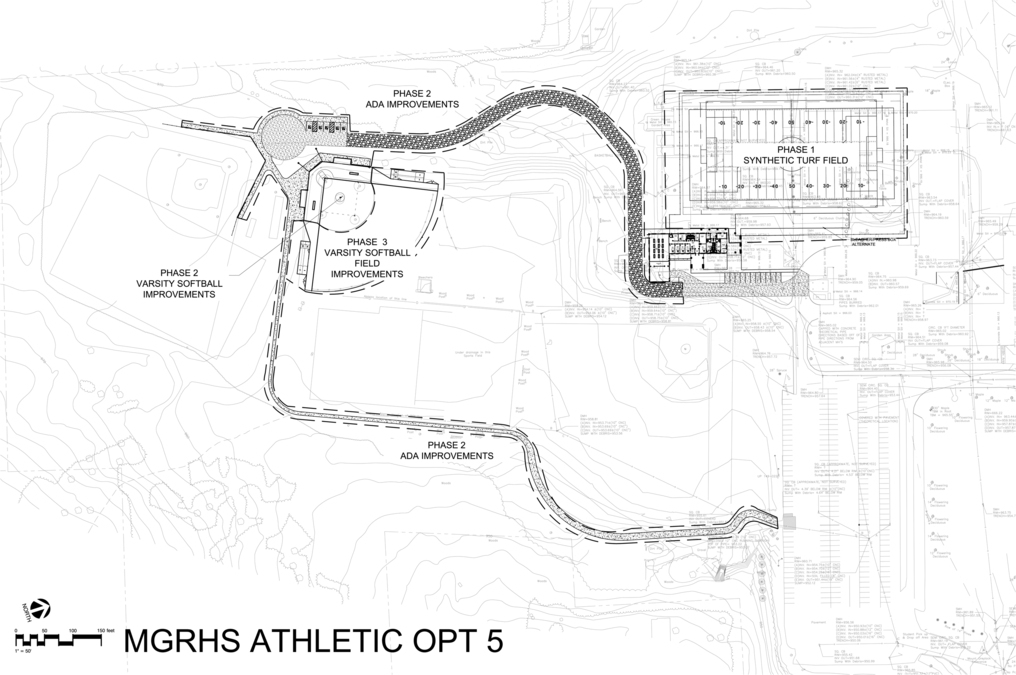
The turf field, with a price tag of $1.7 million, is just part of the puzzle. It would replace the school's current football/soccer/lacrosse field, allowing the district to tear down the non ADA-compliant bleachers and giving it a facility much easier to access for the mobility impaired.
However, there are other pressing needs from both an ADA and Title IX standpoint. In the case of the latter, the district needs to upgrade its softball fields to match the facility used by its baseball program.
There are ADA issues with the baseball and softball fields as well, specifically the fact that each requires long walks or drives over dirt roads to reach.
Phase 2 of the fields committee's plan would address those issues at an estimated cost of $612,200. The committee also identified a third phase, which addresses drainage and field conditions on the softball field, at an estimated cost of $50,400.
Combined, the three phases would cost about $2.3 million, well more than the $1.9 million remaining after the multipurpose building and extraordinary maintenance fund are deducted from what currently is a $6.2 million pot of money.
Of course, that $6.2 million figure is a moving target. While the college's investments obviously have done well since it gave the $5 million in 2016, the actual amount available will fluctuate with the stock market, Bergeron noted.
School Committee members Regina DiLego and Al Terranova each stressed that the district needs to target portions of the Williams gift for specific purposes.
"I keep as sacred the $1.5 million," Terranova said, referring to the reserve for future building needs. "That is untouchable. Five or 10 years from now — long after I'm off the committee — someone will take part of that money to fix the boiler or something."
DiLego expressed concern about the phasing, specifically the idea that the turf field is "Phase 1" while installation of parking and drives to the fields (at a cost of $165,800) is listed in "Phase 2" of the plan presented to the School Committee.
"The ADA compliance isn't optional," DiLego said. "That has to happen.
"If we use the $1.65 million on the other part, where do we get the $600,000? If you can't raise the funds, how do you get there? It concerns me we're not doing the required piece first and then going toward the hopeful piece."
That said, the six members of the School Committee present at Monday's special meeting endorsed the idea of creating the first artificial turf field on a Berkshire County high school campus (Pittsfield public schools do use the new artificial turf field at Berkshire Community College for their home athletic events).
In addition to wear and tear that the school's grass surface at John T. Allen Field receives from three sports (football and boys and girls soccer) in the fall and two (boys and girls lacrosse) in the spring, another concern addressed by a turf field would be availability to Mount Greylock's physical education program.
Phys ed teacher Brian Gill, who serves on the ad hoc fields committee, told the School Committee that the benefit to phys ed classes will outweigh the benefit to varsity sports.
"The primary use of the turf field would be for physical education," Gill said. "The field wouldn't get as much consistent use in the afternoons for practices as you'd think. A majority of [coaches] would prefer to be on the grass on a consistent basis."
Fields committee chair John Skavlem, a former elementary school committee member in Williamstown, stressed the educational benefit of a turf field to the Mount Greylock School Committee.
"What they always aim to do to do is get as many outdoor experiences as possible," Skavlem said of the PE department. "A turf field would allow them to get outside when they're restricted now in the fall and spring. [Gill] has estimated a gain of one or two days per week in the fall. In March, he said the impact would be ‘off the charts.' Potentially, this could mean seven to 10 weeks per year of physical education classes outside … for half the student body.
"That, to me, speaks to what this can provide above and beyond a 'game field,' which is what we've been focusing on."
In addition to the immediate needs for renovated fields and, perhaps, a turf field, Skavlem's committee presented the School Committee with data for a potential "Phase 4," the addition of a six-lane running track (with eight-lane straightaway) on the Mount Greylock campus.
For years, the high school team has practiced on a track not suited for competition and hosted meets at Williams College. But Gill reported Monday that the availability of the college track has declined over the years and that it would be beneficial to create a usable track on campus for a program that, last spring, had 98 boys and girls participating.
"As of right now, we have zero dates we can host at Williams this spring," Gill said. "We may have to use a Sunday to host a meet."
The committee, working with consultants at Providence, R.I.'s, Traverse Landscape Architects, estimated a cost of $444,500 to install a track on the campus. Gill said if the district ever decides to go that way, it makes sense to build a separate track and not coordinate one that rings around the turf field because a "stand alone" track in a grass field would allow field events, like the javelin, to be held on the infield and a field/track complex would limit the size of the turf field to accommodate a 1,600-meter track around it.
The committee members expressed enthusiasm for the idea of a track as an aspiration for the district but emphasized that fund-raising would be needed to achieve the first three phases of the committee's recommendation in their entirety, let alone the addition of an asphalt track.
In the end, School Committee member Steven Miller moved that the committee approve up to $158,000 to get architect Perkins Eastman (the firm behind the school building project) to work on design documents for the field work (Phases 1 through 3) as recommended by Skavlem's committee.
MGRS Turf Field by iBerkshires.com on Scribd
Tags: high school sports, MGRS, sports fields, turf field,