Williamstown Select Board Votes to Join Mohawk Trail Partnership
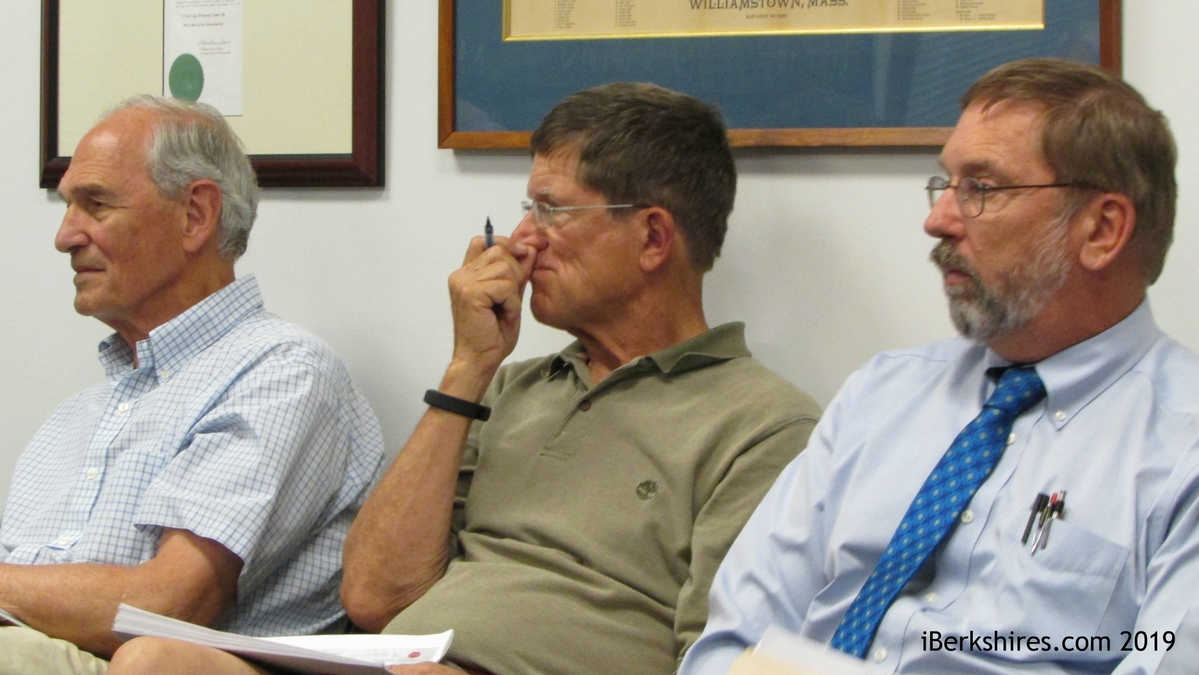
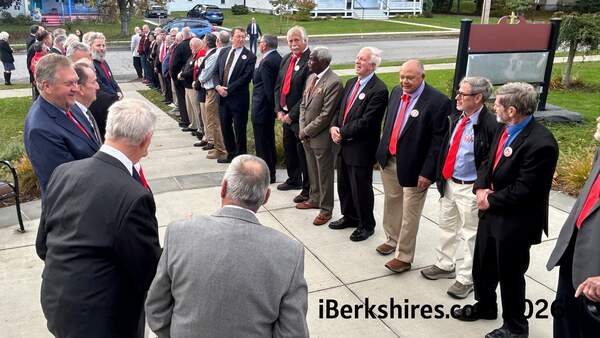
William Moomaw, left, Henry Art and Tom Matuszko wait to address the Select Board on Monday.
After listening to two of the town's leading environmental authorities make arguments for and against joining, the board voted 4-1 to join a growing list of municipalities that have joined on to the bi-county initiative.
Henry Art, an emeritus professor of environmental studies at Williams College and a member of the advisory board that created the partnership, joined Berkshire Regional Planning Commission Executive Director Thomas Matuszko in advocating that the town join the partnership.
William Moomaw, an emeritus professor of international environmental policy at Tufts and founder of the Center for International Environment and Resource Policy, expressed concern that the partnership was "heavily slanted toward turning all of our forests into working woodland forests."
Moomaw, who was out of the country at a climate change conference the first time the Select Board took up the question, argued that the MTWP will be dominated by the U.S. Forest Service and the timber industry at the expense of preserving old-growth forests and larger trees that are needed to sequester carbon in the fight against climate change.
"We do need some forest products," Moomaw said. "Having some forest management is fine, but it can't be the whole thing. And the way this [partnership' has been framed, it's the dominant story by far."
Moomaw said that in the heavily timbered state of Maine, some of the forests have been managed "sustainably," but "even the parts that are managed sustainably are storing a third as much 'carbon.'"
Art pointed out that with or without the MTWP, forests could be timbered.
"With the forest partnership, there's at least the potential to have a more sustainable management practice," he said. "It's unfortunate there is little forest management on many tracts of land in our region.
"I see this as an opportunity for an education process for what sustainable forest management would look like. … Right now, it's kind of a free for all out there."
Although Art and Moomaw disagreed about the direction the board should take on the invitation to join the partnership, Art was quick to note that their world views are more alike than not.
"I don't want people to think Bill and I are debating," Art said. "The role forests play — I think we're in complete agreement on that. There may be a disagreement on the role the forest industry plays, but they're playing a role right now.
"And we're friends."
What appeared to sway four members of the board was Art's argument that the more towns join the partnership, the more potential there is to have environmental concerns counterbalance the timber industry interests in the MTWP. Up to 21 municipalities in Berkshire and Franklin Counties are eligible to join the partnership, including the City of North Adams, which already has signed on.
"This group already exists," Select Board member Andrew Hogeland said, referring to the partnership's acquisition of 11 municipalities — the threshold set by the MTWP's enabling legislation. "They're going to vote on stuff. Why would we not want a seat at the table.
"I'm curious, if these are your concerns, why wouldn't you want us to have a vote on this," he asked Moomaw.
"Since it is in existence, it may be better for us to be inside, but I want to make sure when we are inside we're prepared to deal with the bias that is written into this," Moomaw said.
The "inside" person will be a town representative appointed by the Select Board who will be a voting member of the partnership committee — voting on the budget and the appointment of an administrator who will run the day-to-day operation of the partnership.
Art already has indicated he would be willing to serve on that committee, but Select Board Chair Jeffrey Thomas Monday indicated that the board would not appoint the town's representative the same night it joined the MTWP. Instead, Thomas said he wanted residents to have the ability to apply for the post and be considered by the board.
A resident from the floor of Monday's meeting suggested that the Select Board consider a mission statement clarifying its intentions in joining the partnership so that its representative now and in the future appreciates the importance of preserving the forest.
Select Board member Anne O'Connor argued that the board should wait to act on the invitation to join the partnership in order to allow more voices in the community to weigh in. Communities have an August 2020 deadline to join; after that, there will be a five-year waiting period to join.
O'Connor asked Matuszko what would happen between now and August 2020 and what the downside would be of waiting until the May 2020 annual town meeting to give the full town a chance to weigh in.
Matuszko replied that the partnership's board will spend the next year writing its bylaws and hiring an administrative agent.
"That helps me confirm that we want to have a vote," Hogeland said.
After failing to convince her colleagues to table the question, O'Connor voted against joining the partnership, a minority of one in a 4-1 vote.
Toward the end of a two-hour meeting, the board took up a suggestion from O'Connor that Williamstown sign on to a letter critical of the regulations proposed by the commonwealth's Department of Energy Resources.
The letter, which O'Connor credited to the Massachusetts Energy Consumers Alliance and the Partnership for Policy Integrity, says the DOER proposal will "weaken the very important state energy standard that heretofore has been an essential driver of the development of clean renewable energy resources."
Among other things, the DOER has proposed relaxing the rules that govern biomass production of energy in the state. "Both the efficiency requirement cuts and the expanded category definitions [of salvage wood and residues' will result in increased emissions."
Coincidentally, the potential of logging the Mohawk Trail forests for the biomass industry was a key concern of Moomaw's, and he alluded to the DOER's proposal in his remarks to the board on Monday evening.
O'Connor said the public comment period for the proposed regulations closes July 26 — three days before the Select Board's next scheduled meeting — and urged her colleagues to take a stand criticizing the proposed rules.
All four of the other board members said they lacked sufficient information to vote on the topic — two indicating they were just seeing the letter for the first time, although it was posted in the board's electronic packet on the town's website early last week.
"We need to be wary of opining on statewide or national issues that we don't have expertise to contribute to without researching it more, which you have done," Hogeland said to O'Connor.
"This may sound rude, but we thought we had the expertise to jump into the Mohawk Trail Woodlands Partnership," O'Connor said. "This directs to a lot of the same issues."
"The partnership was a simple issue: Do you want a vote or not?" Hogeland replied.
In the end, no one made a motion that the town sign onto the letter. No one moved that the board hold a special meeting prior to July 26 to consider it.
Tags: forestland,