'Judy': As Illustrated by Renée
Years ago, as I walked on Bleecker Street in The Village, a fellow weekend hippie in a granny dress ran up to me and excitedly exclaimed, "Chuck Berry is at So and So's apartment playing for donations." I didn't go, so I don't know if it was true. But I was gratified several years later during the Oldies Revival when a rediscovered Chuck Berry probably raked in more cash and
deserved accolades than when first he queried, "Maybellene, why can't you be true?"
Unfortunately, director Rupert Goold's "Judy," a traditionally constructed biopic about the great Judy Garland, while detailing an attempted career resurrection during a winter of '68 concert tour in London, isn't quite the all's well that ends well tale our hopeful natures would have liked.
Instead, the beautifully filmed memoire sings a more sad than sweet homage to Garland, smartly interlaced with flashbacks that rationalize if not fully justify a fate caused by the cruel perpetrations of the old studio system. On the set of "The Wizard of Oz" (1939), being a child star meant deprivation of food so as not to be anything but svelte, being demeaned lest you got a swelled head, and receiving even less sympathy from a slave-driving stage mom than one got from the tyrannically egomaniacal L.B. Mayer. While the action-reaction, mini-thesis on the environmental causes of behavior leans a bit toward the pop psychology side of motivational
study, our charitable inclination is pleased.
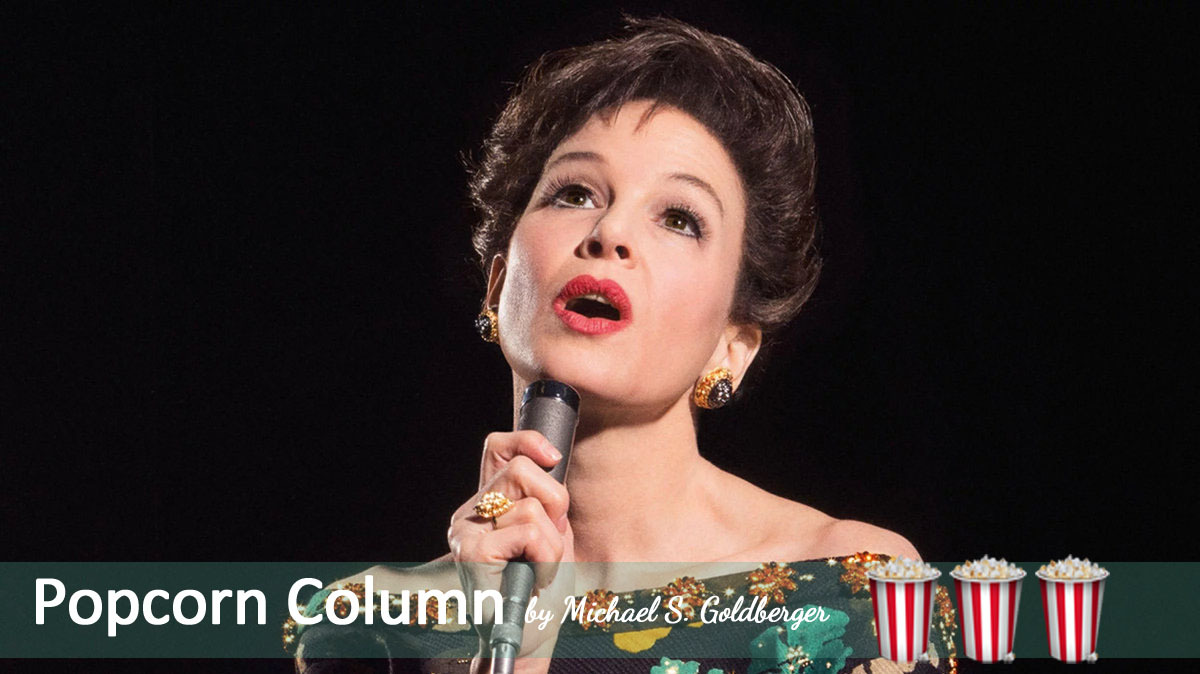
Physically and emotionally embodying the complex, showbiz wunderkind-turned-major screen star and cabaret dynamo, Renée Zellweger etches an Academy Award-worthy portrayal that rises above its albeit astonishing mimicry to suggest the indulgence that only we understand Judy. But expect no run-of-the-mill, down-in-the-mouth diatribe about the unfairness of life for movie stars
who have burned the candle at both ends. Indeed, there is a nod to the gene that causes multiple unhappy marriages, a flipping of the bird to crooked, money-grubbing agents and producers, and a reasonably credible essay on the difficulty of parenting while trying to maintain one's stardom.
But it's Zellweger's personification of Judy when she really feels something truly wonderful awaits over the proverbial rainbow that wins our hearts and, alas, perhaps our insight and understanding.
And then there's the singing. Though it's probably true, this isn't to say that I'm too lazy or not enough of an Inspector Clouseau to have played some Judy Garland albums after seeing the film in order to compare the genuine wax to Zellweger's musical stylings. Rather, in this era when we expect politicians to lie more than usual, but won't for a second brook a dubbed singing scene, I've come to expect actors to successfully do the melodious voicings themselves. In fact, it's accomplished so stunningly well here that in the old days a trailer for the movie might have rightfully boasted, "Renée is Judy!"
Zellweger's extraordinary strumming of the vocal chords is the ultimately complementing aspect of her characterization — the magical key it takes to win our suspension of belief. Just as a picture says a thousand words, when it's done right the emotive belting out of a song opens a window into the soul of the artist. And Zellweger does it right.
Less extraordinary but oh so necessary to telling the rags-to-riches-to-consignment shop story are the nuts and bolts of Garland's downward spiral and, where the narrative opens, her attempted return to grace in London. Expect most of the usual but apparently true clichés as we are put in the position of bemoaning Judy's fate. Essentially homeless, addicted to pills and alcohol and financially unable to take care of her children, her plight wreaks havoc on our sensibilities. Thus, in that vicarious simpatico that happens in the mystical dark of the Bijou, we cringe with every setback and wax ebullient with each little success as our title character strives to salvage not just her celebrity, but the dignity that is usurped when popularity wanes.
There's a great, telling little scene that conjectures volumes about the inner workings of the larger than life, showbiz phenomenon. It involves two, charmingly stage-struck gay guys who our star befriends after noticing their regular attendance both in the theater and outside the stage door. We'd like to think the soulfully heartwarming, three-way tête-à-tête, a touching testament to humanity's better instincts, is true. But Hollywoodization or not, the interlude adds an important, sociohistorical perspective to the period in question.
As the two middle-aged Brits melancholicly relate that the times are better for them now, we can't help but think about the regressive, hateful intolerance green-lighted across America in the last three shameful years. It is this added perspicacity and dimension throughout the chronicle that makes "Judy" a little more than just another saga about the fickle nature of fame.
"Judy," rated PG-13, is a Roadside Attractions release directed by Rupert Goold and stars Renée Zellweger, Finn Wittrock and Rufus Sewell. Running time: 118 minutes
Tags: movie review,