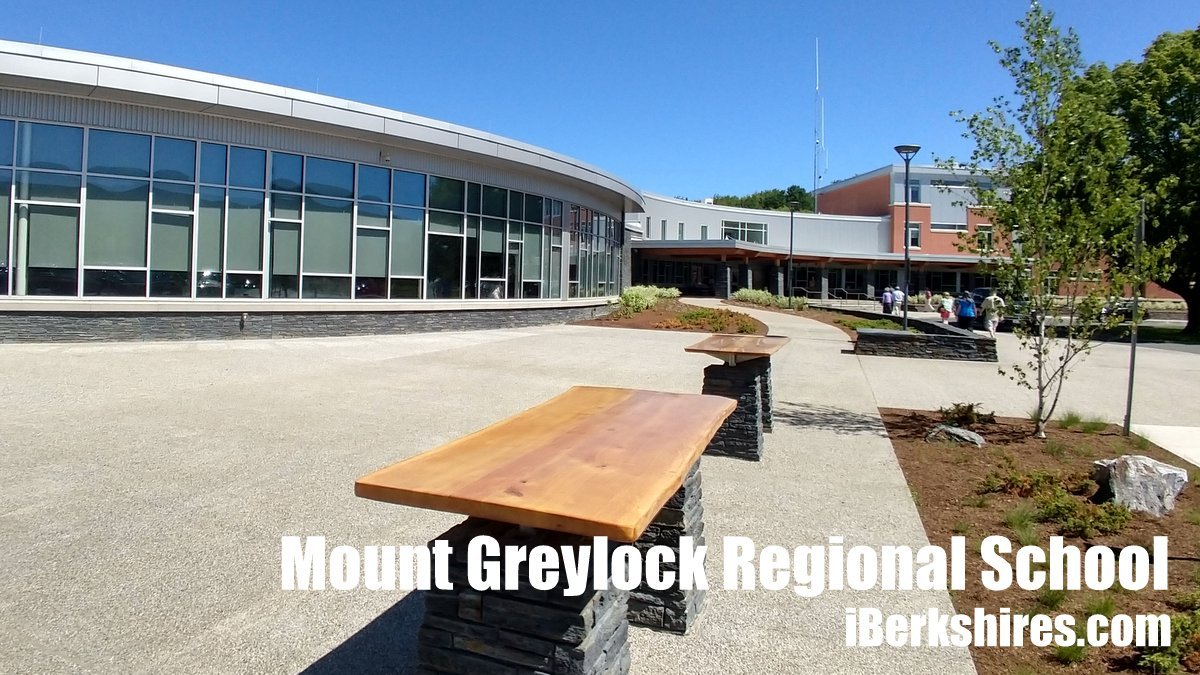
Mount Greylock District Weighs Wastewater Testing
WILLIAMSTOWN, Mass. — The interim superintendent of the Mount Greylock Regional School District Tuesday expressed interest in pursuing wastewater testing as a method for identifying early the presence of COVID-19 at the district's three schools.
Robert Putnam was reacting to a suggestion from parent Foster Goodrich, who offered his comments during a meeting of the Education Subcommittee of the School Committee.
Goodrich told the panel that he works with engineering firm AECOM, one of the companies using wastewater analysis to test sewage, a strategy that the City of Pittsfield announced the week before that it will employ in the fight against the novel coronavirus.
"I wanted to make the subcommittee aware that there are other ways to test for COVID as a whole," Goodrich said. "[Wastewater testing] is a precursor to symptoms. Because you're testing in the parts per billion and everything is passed through your system, there is the ability to test, and there is data that shows that those test results show up seven to 14 days ahead of symptoms.
"The best way to test, quite frankly, is test on a Monday and test on a Friday. I'm not advocating for testing every day. But if we were to test twice a week, I think it would be relevant."
Putnam indicated he agreed the data could be relevant.
"I was very interested in Foster's comment," Putnam said. "That was an interesting idea. … I think it's valuable for us to have a sense of what is the data on transmission in the county, within our town areas. I'm not sure how to get that information.
"Foster's suggestion, I thought, 'This is interesting.' We're not necessarily going to get accurate information on the number of folks who are living in our towns who have tested positive. This, at least would allow us … to know. I would feel assured if we knew there was no incidence of COVID that was discernible through our wastewater."
The waste testing was just one topic in a wide-ranging discussion by the subcommittee, which took reports from five of the district's working groups tasked with helping develop a plan for the reopening of schools in September.
Goodrich said tests can be conducted at a community's sewage treatment plant; Lanesborough, home of one of the district's two elementary schools, sends its sewage to Pittsfield. But the wastewater also can be treated wherever there is a manhole, Goodrich said.
Cost is a major consideration, he noted.
"The single greatest impediment to a national platform on this is funding," Goodrich said. "The federal government is not supporting it, currently. There's a vague, gray zone in which FEMA may or may not support it, and currently the state of Massachusetts, as well as other state and municipal governments do not support it because of the financial implications and the decline in tax revenue.
"As a ballpark figure, in Berkshire County, if there was only one testing source, it would be about $125,000 a year to test one source, once a week. There are economies of scale, so if all the school districts and the jail and others in Berkshire County decided to sign on board, that test cost drops down to about $500 a test [$26,000 per testing site, per 52-week year]. And given a school year, obviously, that drops the price dramatically."
Putnam indicated that $500 per test sounded like it could be a manageable number given the need for good data about the virus' spread, and he promised to raise the issue on Wednesday at a meeting of the county's superintendents.
The interim superintendent of the Lanesborough-Williamstown district, who was hired by the School Committee on July 7, has plunged head-first into the work of devising three different plans for the fall as mandated by the commissioner of education: a full return to the classroom for all students, a fully remote teaching model and a "hybrid" model that combines in-person and remote learning.
Districts across the commonwealth have until July 31 to submit those plans to the Department of Elementary and Secondary Education.
Tags: MGRSD,