Williamstown DIRE Committee Focuses on Police Procedure, Town's Response to Suit
WILLIAMSTOWN, Mass. — The town's Diversity, Inclusion, Race and Equity Committee has said from day one that it would be a place for difficult conversations.
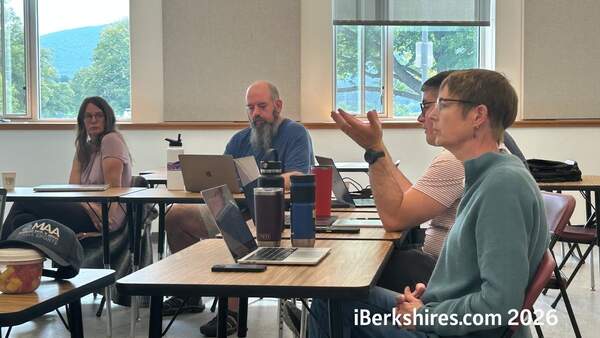
On Wednesday evening, it had one that ended with one of its own members being accused of expressing white privilege.
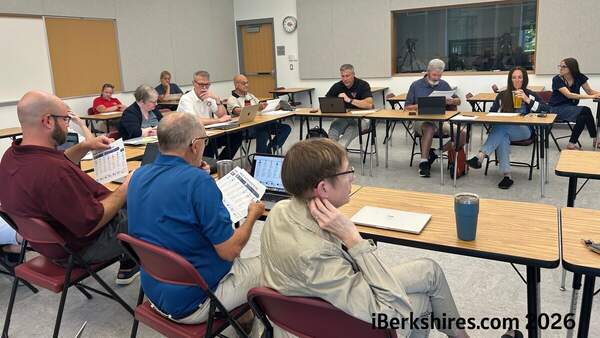
The panel, which normally meets on Mondays, held a special meeting with the stated purpose of reacting to the Select Board's response to a federal lawsuit filed against the town, town manager and police chief last week.
The conversation included DIRE Committee members' dissatisfaction with that response and a more general discussion of police practices in the town of 7,700.
In the latter context, Bilal Ansari told his colleagues about an incident just this week when he counseled a Black co-worker who was shaken and fearful after a routine traffic stop in which a Williamstown Police officer asked the driver, "Are you from this town?"
Moments later, Jane Patton related a similar experience.
"I'm going to go with the safe space thing here," Patton said, before sharing a story from 14 years ago, the day after she moved to town with her family.
"I rolled through the stop at Water Street and Main, like we all do and got pulled over," Patton said. "And again, white woman [pointing to herself]. … 'Are you from Williamstown?'
"I say that only as context. I'm not saying that happens all the time. I'm not saying it should be asked or it shouldn't be asked. I'm just saying that, new to town, Massachusetts plates, 'Are you new to Williamstown?' I probably got a warning or whatever and moved on."
Patton, who serves on both the Select Board and the DIRE Committee's town policies and procedures working group, said she had made notes on the conversation and would on Thursday start asking questions about situations like that encountered by Ansari's co-worker.
"I will ask these questions tomorrow," Patton said. "I'm not going to wait and send it in an email. … Is this a policy? If it is a policy, why is it a policy? Is it intended as friendliness but it doesn't come across that way? What is the intent behind it? … Then, might I suggest that you consider being very mindful to whom and when you ask this question because there are some people it might make feel uncomfortable."
Aruna D'Souza said she thought the question, "Are you from Williamstown?" is a sundowning technique, referencing a practice of municipalities intimidating people of color with signs at city limits saying Blacks had to leave by sundown.
Ansari immediately said Patton, as a white woman, could not understand the experience that people of color have when they are questioned by the police.
And Patton said she appreciated that.
"A hundred percent," Patton said. "That's why I said that at the beginning. I was a little anxious. I brought that up in a conversation and said, I am confident that I am treated differently simply because I am a white woman. I had never really thought about that before, and that's what all of this is about -- starting to look through things not through your own lens."
Drea Finley then sharpened the focus of that lens.
"Jane, I think I can appreciate the onus of where you started and the place where you said, 'In full vulnerability, I want to be honest about where I'm coming from,' " Finley said. "But one of the things I would say to you, Jane, even in this moment, is, you say that you're mindful of, 'Yes, Bilal, I hear you.' But yet, still, you still went to that place to offer [a story].
"That I think is an acknowledgement of your own privilege. That exactly is that moment of just exactly what white privilege is."
Finley said the comments were offered with love and that it was important that the committee acknowledge such attitudes and talk through them honestly, even in a public space.
"For as uncomfortable as we might feel in this moment, this is the work," Finley said. "This is the integrity of the work. And these are the moments that I think we sometimes can forget even when it's the forefront of our work every moment."
The three-hour meeting began with another difficult conversation, a presentation from Town Manager Jason Hoch, who offered his first public comments on the lawsuit filed last week by Williamstown Police Sgt. Scott McGowan.
Hoch began by saying that there is a lot he cannot say while the suit is active, but he acknowledged that the allegations made in support of McGowan's complaint are horrifying.
"First and foremost, I understand how reading that [complaint] feels, absolutely," Hoch said. "I understand what that looks like, the questions it raises. That's not the community we want to be.
"What is reflected there is not the Jason Hoch that I believe I am and try to be. It's certainly not who I want to be. I think, similarly, the Police Department that appears to be developed in that narrative is not the Police Department we want. It is not the Police Department we aspire to …"
"Is it the Police Department we have?" D'Souza asked, interrupting Hoch. "I'm sorry. I need to jump in because I think this isn't the time for personal apologies. What we need to hear is some idea of the facts. This is not, for me, a matter of whether you're a good person or not. It really is a question of, is this the Police Department we have? And is this the reporting structure we have?"
Hoch reiterated that he wished he could get into specifics of the allegations, but his hands are tied as a servant of the town and a named party in the lawsuit. But he did indicate that the incidents alleged in McGowan's complaint had been looked at when they came to his attention.
"On many of your questions, I wish I could get into a lot more detail than I can," Hoch said. "While this is active in the courts, I can't get into the details that I want. That's frustrating to you. It's frustrating to me. I'd love to be able to walk you through and say: Here's what I saw. Here's what I learned.
"Because not any of those things was not without followup and question on my part."
D'Souza said she understood that many of the allegations in the complaint were based on the word of the complainant and that the suit has yet to be adjudicated. But there were incidents mentioned in the complaint that appeared to be verifiable through third parties, D'Souza said.
"Even without the sense of the difficulty of making assessments without knowing the full legal understanding of the facts of the case, there are certainly moments at which the facts seem relatively verifiable that are really beyond the pale," D'Souza said.
"I completely agree," Hoch said. "And when those were things that were seen, I was angry, horrified. 'What is this?' 'This is not who we are.' 'How did we end up in this environment?'
"We've had some difficult conversations digging into those because reading them on their face -- as I read those and others on their face, it horrified me. … I would love to walk through with you each and every one of those horrifying examples and explain what we did, what we learned and where that was left. That's the box I can't get into right now.
"The thing that is helpful, that I hope we get to at some point … is: If we encounter something like that, this is how I would respond; what are we missing to do something differently, better, more supportive in the future?"
Hoch noted that municipalities are governed by rules, including labor laws and state statutes and said, "There are times that that doesn't yield a solution of the community we want to be."
D'Souza pressed Hoch on the point.
"Do you feel that those laws preclude the acting on of complaints -- not this particular complaint but complaints such as this?" D'Souza asked. "Complaints of sexual harassment, complaints of racial harassment, complaints of an unsafe work environment, anything like that. You seem to imply that what you were doing is constrained by all of these things, and I want to clarify. If you're operating under Massachusetts law that explicitly doesn't allow for communities to act on this, I want to know that."
Hoch said he did not intend to imply there is no way to address such complaints.
"My observation was somewhat more general than that," he said. "Obviously, any of those complaints you just outlawed and any other complaint are reviewed and addressed seriously. There's no free pass for any bad behavior. The questions really come from: What's the scale of the measured response in terms of discipline to that, in some cases.
"And then also there's the challenge of 'a documented event' versus a 'documented pattern.' I'm not naive enough to think that if it happens once, it's a one-off and it only happens once. I get that. The issue then becomes, in a legal situation, how much of that has been there, how much of it is traceable. When I talk about constraints, that's what I think about."
Hoch spent about 22 minutes with the DIRE Committee in the virtual meeting. Toward the end of the discussion, he reiterated that he understands the town's response and his comments will not satisfy townspeople.
"I totally get it," Hoch said. " 'Jason seems like a nice guy' doesn't help you. Right now, you're only thing to [say], 'Hey, this isn't my town,' is very much generalities or, 'no comment.' That's a hard lift, and that's not a fair ask to the rest of the community. I hear it."
Andrew Art thanked Hoch for coming, but questioned the Select Board's response to the lawsuit by pointing out that it says board members only learned of the allegations "recently" but also that the allegations were "previously disputed" by the town.
"The only way I can square those statements is the Select Board was not made aware of the investigation," Art said. "If it's true the complaint named the town manager in addition to the chief of police, and that the investigation was done without the Select Board, it's not impartial. And it can't be impartial because you can't investigate yourself if the claims are against you."
Art then repeated the calls made by the DIRE Committee and numerous members of the community for the town to commission a full, impartial study of the allegations in McGowan's complaint. Hoch said he noted the request but that he did not have the ability to engage on that issue.
Art later capped the discussion with the town manager by reiterating a point that has been made by several members of the committee about the perception of racism and sexual assault stemming from the allegations in the McGowan lawsuit.
"I said this before [Hoch] got on, but I also want to say this: People do not feel safe in our community," Art said.
Tags: DIRE, lawsuit, police,