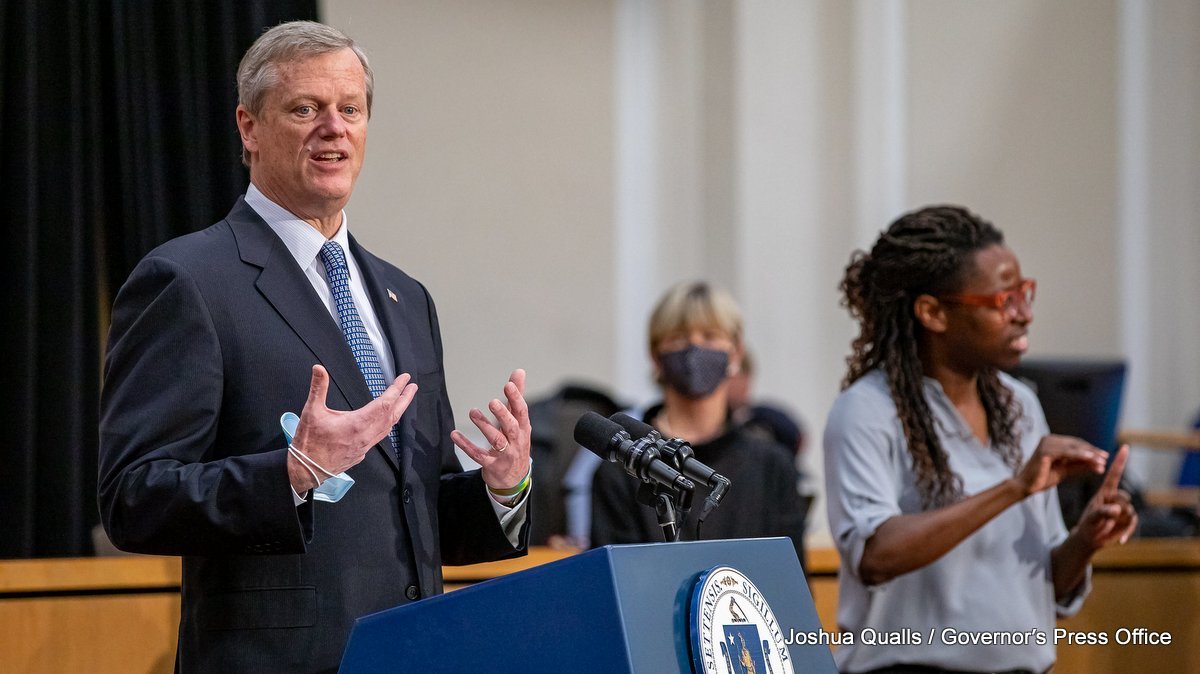
Governor Charlie Baker is joined on Tuesday by Lt. Governor Karyn Polito, Secretary of Health and Human Services Marylou Sudders, Secretary of Housing and Economic Development Mike Kennealy and Secretary of Education Jim Peyser to provide an update on the state's COVID-19 readiness heading into the fall and winter.
Millennials' Transmission Seen as Driving State’s COVID-19 Uptick
BOSTON — Gov. Charlie Baker on Tuesday declined to characterize the commonwealth as being at the start of a "second wave" of COVID-19 transmission.
But he had no trouble identifying the source of a recent surge in the spread of the novel coronavirus.
"I think it's really important to point out once again … and Dr. [Deborah] Birx said the same thing when she was here last week: The biggest single issue that's driving case growth is familiar people being familiar with each other," Baker said Tuesday afternoon. "She talked, in particular, when she talked to us, about something we've seen in our own data, which is a really significant increase in positive cases among people in their 20s and 30s."
Birx, who visited several college campuses in New England, is the White House's response coordinator for its Coronavirus Task Force.
On a day when Baker, Lt. Gov. Karyn Polito and their secretaries of education, health and economic development spent most of their time recapping the commonwealth's progress since March, the governor also acknowledged that Massachusetts is starting to see an overall increase in positive tests for COVID-19.
"I think one of the things that's critically important for this is to recognize and understand especially with respect to young people, that that community, more than any other at this point, is driving the largest single increase in cases," Baker said. "The good news is: The vast majority of them don't get as sick as someone over the age of 60 would.
"But many do, and they do have the potential to pass it on to other people in their family or their network who are older and, for whom, getting the virus could be a very terrible thing. I think that, in many ways, is one of the more important differences between where we are now and where we were in the spring."
Baker brought up the pattern of transmission among Millennials (those born between 1981 and 1996) in answer to a question about whether his administration would consider rolling back some of the state's reopening plan, as an emergency department physician at Boston's Brigham and Women's Hospital recommended last week.
The governor said that the increase in cases in recent weeks is not attributable to "formal activities" like indoor dining and shopping but to "informal gatherings," especially among younger Bay Staters. He cited evidence from the commonwealth's contact tracing initiative that demonstrates where the real source of transmission lies.
"There's no evidence that [indoor dining at restaurants] is what's driving our cases," Baker said in response to a reporter's question. "I'm not going to stop doing things just because somebody doesn't like them. Somebody needs to actually demonstrate in data that something is actually driving cases.
"Right now, the thing that's driving cases is young people -- not necessarily college kids, we're talking kids that are out of college -- who are spending a lot of time with each other in close quarters, apartments, rooftops, places like that. They're not social distancing. And they're passing the virus around."
Going forward, there are dangers that lie ahead for Bay Staters of all ages as those informal -- and often cross-generational -- gatherings move out of the back yards and into the living rooms as the holidays approach.
"We are probably going to have to talk about Thanksgiving at some point," Baker said. "I don't have what it is we should be saying about it today. But that's certainly going to be a conversation that I think a lot of people should take seriously.
"Thanksgiving is going to be the source of some interesting conversations, not only because of the family gatherings but also because it's one of the biggest travel days, historically, of the year, and that presents all kinds of other issues."
As he does routinely, Baker praised Massachusetts residents for the economic sacrifices they've made and the lifestyle changes they've adapted to help limit the spread of the virus. But he continued to hammer home a message about the need for continued vigilance, particularly as the weather turns and outdoor activities become less of an option.
"If you have a neighbor who's been traveling out of state, you're probably better off not watching the Patriots game with them on Sunday, unless they've been tested and they've tested negative," he said.
"People get that they're supposed to wear a mask when they go out, and, by they way, that's different from what it was in March and April. … They get the fact that they're supposed to social distance. They get the fact that if they can't social distance they need to [wear a mask]. They get the fact that they need to wear a mask if they go into a store. They get all that, and it's working.
"The challenge is all that other time we spend, in some cases with people who may have been out and about with others where they weren't social distancing and they weren't wearing a mask. And especially when you get into the younger communities, the 20- and 30-somethings, they do pick this thing up. They often are symptomatic. But they do carry it, and they will transmit it."
If you would like to contribute information on this article, contact us at info@iberkshires.com.
Your Comments
iBerkshires.com welcomes critical, respectful dialogue. Name-calling, personal attacks, libel, slander or foul language is not allowed. All comments are reviewed before posting and will be deleted or edited as necessary.
No Comments
Puppets Teach Resilience at Lanesborough Elementary School
By Breanna SteeleiBerkshires Staff
The kids learned from puppets Ollie and a hermit crab.
LANESBOROUGH, Mass. — Vermont Family Network's Puppets in Education visited the elementary school recently to teach kids about being resilient.
Puppets in Education has been engaging with young students with interactive puppets for 45 years.
Classes filtered through the music class Thursday to learn about how to be resilient and kind, deal with change and anxiety, and more.
"This program is this beautiful blending of other programs we have, which is our anxiety program, our bullying prevention and friendship program, but is teaching children the power of yet and how to be able to feel empowered and strong when times are challenging and tough," said program manager Sarah Vogelsang-Card.
The kids got to engage with a "bounce back" song, move around, and listen to a hermit crab deal with the change of needing a new shell.
"A crab that is too small or too big for its shell, so trying to problem solve, having a plan A, B and C, because it's a really tough time," Vogelsang-Card said. "It's like moving, it's like divorce of parents, it's changing schools. It's things that children would be going through, even on a day to day basis, that are just things they need to be resilient, that they feel strong and they feel empowered to be able to make these choices for themselves."
The resiliency program is new and formatted little differently to each of the age groups.
"For the older kids. We age it up a bit, so we talk about harassment and bullying and even setting the scene with the beach is a little bit different kind of language, something that they feel like they can buy into," she said. "For the younger kids, it's a little bit more playful, and we don't touch about harassment. We just talk about making friends and being kind. So that's where we're learning as we're growing this program, is to find the different kinds of messaging that's appropriate for each development level."
This programming affirms themes that are already being discussed in the elementary school, said school psychologist Christy Viall. She thinks this is a fun way for the children to continue learning.
"We have programs here at the school called community building, and that's really good. So they go through all of these strategies already," she said. "But having that repetition is really important, and finding it in a different way, like the puppets coming in and sharing it with them is a fun way that they can really connect to, I think, and it might, get in a little more deeply for them.
Vogelsang-Card said its another space for them to be safe and discuss what's going on in their life. Some children are afraid because maybe their parents are getting divorced, or they're being bullied, but with the puppets, they might open up and disclose what's bothering them because they feel safe, even in a larger crowd.
"When we do sexual abuse awareness that program alone, over five years, we had 87 disclosures of abuse that were followed up and reported," she said. "And children feel safe with the puppets. It makes them feel valued, heard, and we hope that in our short time that we're together, that they at least leave knowing that they're not alone."
Bedard Brothers also gave the school five new puppets to use. Viall said the puppets are a great help for the students in her classroom, especially in the younger grades.
"Every year, I've been giving the puppets to the students. And I also have a few of the puppets in my classroom, and the students use them in small groups to practice out the strategies with each other, which is really helpful," she said. "Sometimes the older students, like sixth graders, will put on a puppet show. They'll come up with a whole theme and a whole little situation, and they'll act it out with the strategies for the younger students. It's really cute, they've done it with kindergarteners, and the kids really like it."
Vogelsang-Card said there are 130 schools in Vermont that are on the waiting list for them to come in. Lanesborough Elementary has been the only Massachusetts school they have visited, thanks to Bedard Brothers.
"These programs are so critical and life-changing for children in such a short amount of time, and we are the only program in the United States that does what we do, which is create this content in this enjoyable, fun, engaging way with oftentimes difficult subjects," she said. "Vermont is our home base, but we would love to be able to bring this to more schools, and we can't do this without the support of community, business funders or donors, and it really makes a difference for children."
The fourth-grade students were the first class to engage with the puppets and a lot of them really connected with the show.
"I learned to never give-up and if you have to move houses, be nervous, but it still helps," said William Larios.
"I learned to always add the word 'yet' at the end," said Sierra Kellogg, because even if she can't do something now, she will be able to at some point.
Samuel Casucci was struck by what one of the puppets talked about. "He said some people make fun of him if he dresses different, come from different place, brings home lunch, it doesn't matter," Samuel continued. "We're all kind of the same. We're all kind of different, like we have different hairstyles, different clothes. We're all the same because we're all human."
"I learned how to be more positive about myself and like, say, I can't do this yet, it's positive and helpful," said Liam Flaherty.
The students got to take home stickers at the end of the day with contact information of the organization.
Students got to showcase their art at the Clark Art Institute depicting their relationship with the Earth in the time of climate change. click for more
The 100th annual meeting will be held on March 10, 2027, the Community Chest's birthday (there will be cake, he promised) and a gala will be held at the Clark Art Institute on Sept. 25, 2027.
click for more