North Adams Considering Adopting 40R Smart Growth Zoning
NORTH ADAMS, Mass. — The city is considering the benefits of adopting 40R zoning, a state law that would make it easier to redevelop vacant and underutilized buildings for housing and mixed development.
The state instituted so-called Smart Growth Zoning about 15 years ago to incentivize developers to largely utilize existing structures to create market-rate housing that also provided a percentage of affordable-housing units and space for retail or commerce. The statute provides certain incentives for developers — such as access to capital and lower predevelopment risk for permitting — while also giving municipalities funding, or "density bonus," to acknowledge the impact of increased housing and traffic.
Several Berkshire communities have adopted the zoning law, including most recently the town of Adams.
The Planning Board on Monday heard from Zachary Feury of the city's Community Development Office and Michael Maloy of the Berkshire Regional Planning Commission on how the law would be adopted in North Adams. Feury and Maloy gave a similar presentation to the Community Development Board last month.
"Unlike some other overlay districts, this does not supersede the underlying zoning meaning, it doesn't take precedence over it," Feury explained. "What it does do is it allows developers who might be interested in developing a particular property within the boundaries of the district to opt into the Smart Growth regulations.
"That would allow them to essentially develop a property with a higher density, meaning more units per acre than might be currently allowed in the underlying zoning, but it doesn't actually change the underlying zoning that's still in place."
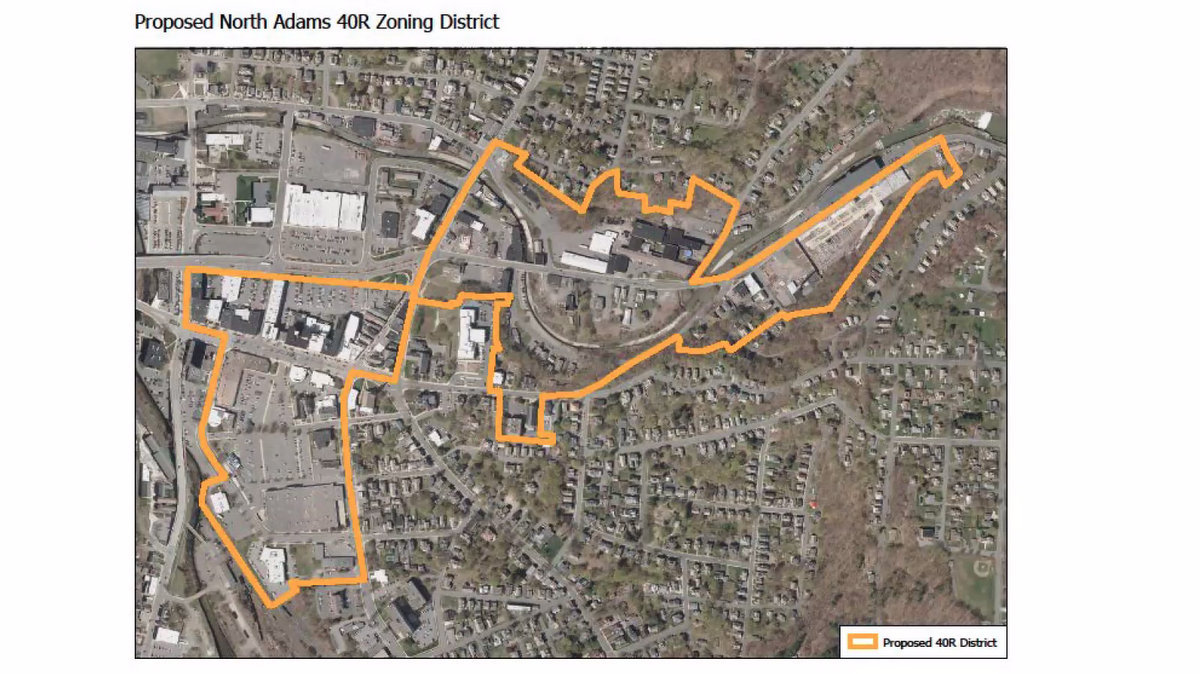
The 40R overlay would cover most of the downtown and the eastern gateway, designated as the downtown district and the mill district. More than a third of the district's 30 acres is classified as "underutilized," Feury said.
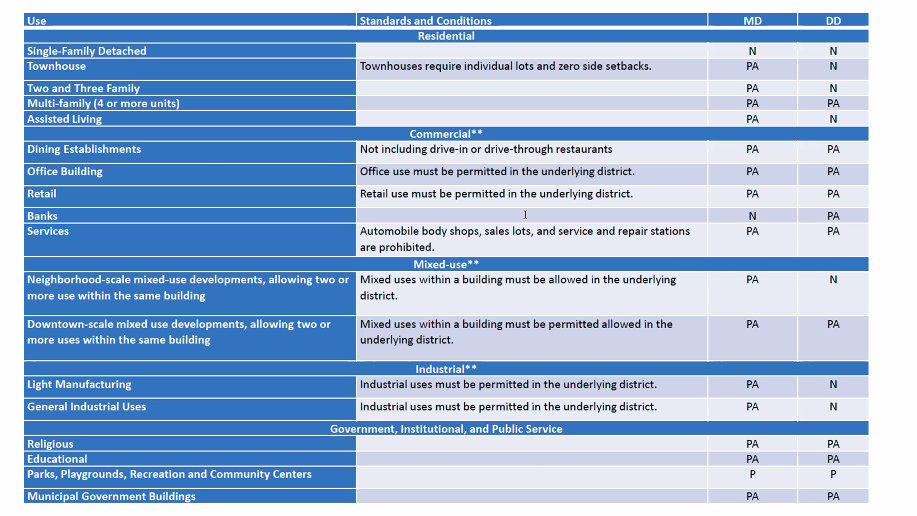
"Smart Growth development developments may include commercial uses but they must be part of mixed-use developments and allowed by the underlying zoning," Feury said. "In the downtown district, mixed-use developments must be at least 51 percent residential, while the mill district requires 75 percent of Smart Growth developments be residential."
At least 20 percent of all units and no more than 60 percent must be affordable housing. In North Adams, those qualifying for affordable housing would have incomes no more than 80 percent of the median of $80,900, or $64,720, for two people. Housing costs cannot be more than one-third of the monthly income, which for North Adams would be the maximum of $1,618 a month.
A market-rate one bedroom apartment in North Adams now goes for about $650, a two-bedroom at $1,325, and three-bedroom for $1,500, according to information provided to the Community Development Committee. All three rents are below the affordable housing rate.
Adopting the zoning would provide incentives to the city in the form of direct revenues of $600,000 and a density bonus of $3,000 for each unit built. These state funds are to provide capital for infrastructure improvements to accommodate a rise in population that could affect roads, schools, water systems, etc. North Adams could get up to about $3.84 million but it is unlikely the at the estimated 563 that could be built, will be built.
Planners Lynette Bond and Lisa Blackmer asked about bicycle use and parking, with Blackmer expressing concern over the lack of residential parking in some areas because of the city's older housing stock.
"The overlay zoning ordinance does set standards for the number of parking spaces as for vehicles and bicycles," said Feury, adding municipal lots are only about 45 percent utilized so could be part of this picture through parking permits. "This is to try to promote a multimodal transportation system."
He said Community Development had initially looked at adding in the residential areas from River Street north but decided that area didn't quite fit because of the smaller parcel sizes and because of the lack of parking.
The next step will be a preliminary public hearing on the proposal and the City Council would have to vote to submit the application to the state Department of Housing and Community Development for preliminary approval. At that point, a joint public hearing will be held by the board and council, followed by a vote for approval.
Feury anticipated a public hearing in early December but Chairman Michael Leary asked if this timing was reasonable since it would have to be held over the Zoom platform because of COVID-19 concerns.
"Are you really expecting to get the full range of comments that you might have gotten during a regular in-person meeting, which obviously is not possible?" he asked.
Feury said property owners within the proposed overlay will be notified by mail and that the expectation of lower participation because of Zoom hasn't been realized.
"We've actually been finding that in public meetings, we've actually been having higher participation than we were getting prior to COVID-19 for whatever reason that may be," he said. "It is a bit confounding to me."
Tags: zoning,