Williamstown Planners Told to Focus on 'Micro' Model for Pot Bylaw
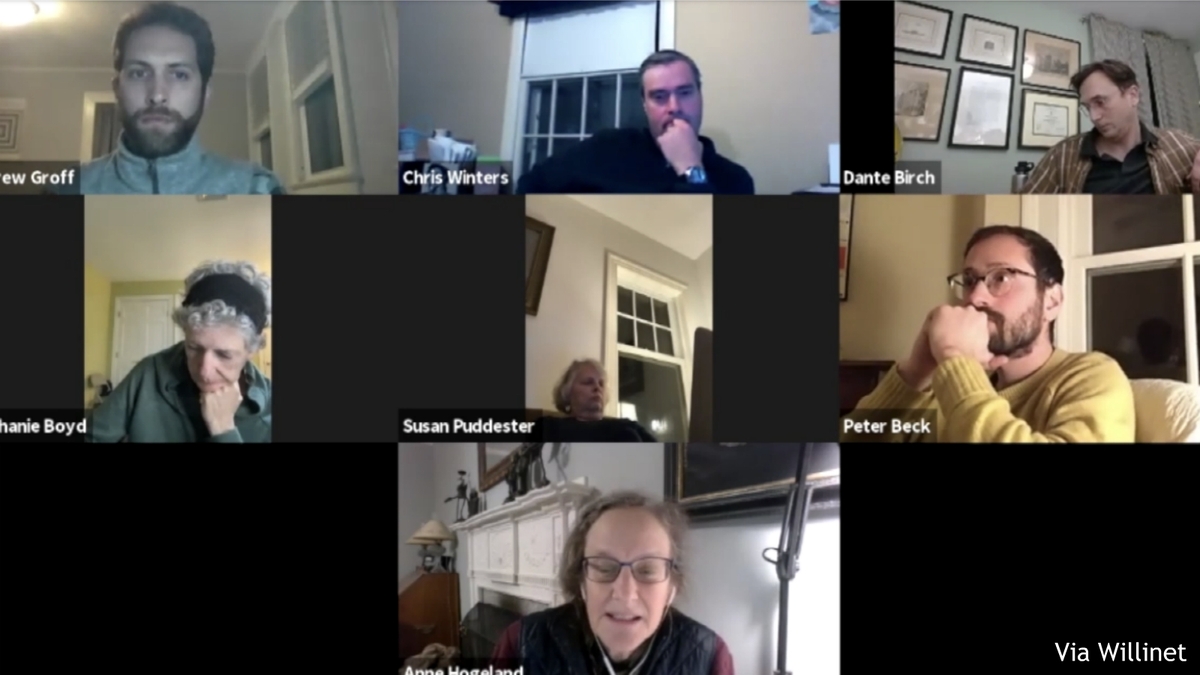
Anne Hogeland, bottom, addresses the Williamstown Planning Board and Town Planer Andrew Groff, top left.
On Thursday, one member made a plea for comments who are not quite as invested in the issue.
"I'd like to hear from the massive middle of people," Peter Beck said.
"We're going to hear those [strong advocates], and there's a reason they're the ones who are most interested. But you've got a much larger portion of the town. … That's the stress testing I'd like to know. Maybe it's not possible before you put [a bylaw amendment] up there. But I'd like to know, for the massive middle of folks, whether [setbacks] ranging from 100 feet to 400 feet, allowing the largest size [plantation] but making it more restrictive, whether these ideas are intuitive to them, whether it makes sense to them, whether it's something they could see in their town."
In August, town meeting could not find a plan for regulating marijuana production that earned the support of the two-thirds majority needed for passage.
The Planning Board, which drafted one of the proposals on table at the annual town meeting, has spent most of its fiscal 2021 deliberations focused on developing a bylaw amendment that will pass muster in May.
The board's members are keenly aware that while the necessary two-thirds plateau was not attained, the majority of residents at the meeting supported continuing a path for growers to obtain a special permit to grow pot.
A bylaw amendment drafted by members of the town's Agricultural Commission and placed on the town meeting warrant by citizen's petition was favored, 122-104, falling 29 votes short of the number needed for passage.
The Planning Board's own bylaw amendment was drafted to ban outdoor grows but was amended on the floor of town meeting to allow up to 5,000 square feet of cannabis canopy. That amended version then fell just 19 votes short of passage, with the yeas earning 156 votes to the nays' 106.
On Thursday, two residents, including the author of that 5,000-square-foot amendment, told the planners that might be the key to reaching the "massive middle."
"Good on you for realizing you have to get to two-thirds," Anne Hogeland told the board during its virtual meeting on the Zoom platform. "I don't think the community is going to get dragged into something kicking and screaming. The way you get to two-thirds is with some enthusiasm for a proposal."
She noted that the 156-106 vote for a bylaw that would have allowed up to 5,000 square feet of production got within 19 votes of passage without support of either the Planning Board or the Ag Commission, implying that the blessing of either panel this time around could be the difference in pushing a similarly-constructed bylaw over the goal line.
"Please take town meeting seriously," Hogeland said. "There's going to be another town meeting, and we need to go there well prepared."
Hogeland's is not a new voice in the Planning Board's deliberations on the issue. In the weeks leading to August's delayed annual town meeting, she cautioned against supporting the Ag Commission-drafted bylaw that may have had technical flaws. In January, she told the Planning Board that outdoor pot production would not have "a significant benefit to the community."
Also speaking at Thursday's meeting was Stan Parese, a local attorney who has represented neighbors who successfully fought off what is to date the only application for a special permit to grow marijuana under the town's 2017 bylaw, a proposed 5-acre plantation on Blair Road.
Parese has been a regular participant from the floor of Planning Board meetings over the last 12 months. On Thursday, he recommended the board consider drafting a bylaw that opens the door to 5,000 square foot canopies under the commonwealth's "microbusiness" licensing mechanism.
The microbusiness concept, which Hogeland introduced in August at Weston Field, allows small growers more control over their product, allowing them to both grow cannabis and produce products using the plant.
Parese said larger plantations in the commonwealth — including one featured earlier in the month in a Planning Board forum — are majority owned by venture capitalists, not local farmers.
"I would suggest the town is … close to being at a place with microgrows, and that it may be that gets us [to a two-thirds vote] if the objective is supporting farmers," Parese said. "If the objective is, 'Let's bring in large operations,' then that's a separate conversation and, again, one I don't know that the town is behind."
Hogeland and Parese made their arguments during the public comment period at the end of a two-hour meeting.
Much of the discussion that preceded them centered on the Planning Board's approach of allowing cannabis canopies from 5,000 feet (Tier 1 in the state's regulatory regime) to 100,000 square feet (Tier 11), the maximum allowed by state law, using an increasing range of setbacks based on the size of the canopy.
"The thinking being that what people find offensive, presumably, increases with scale," Chris Winters said, explaining the rationale for creating a range of setbacks. "For example, we're hearing mostly about smell and we're hearing about visual effects. And those increase with tier.
"The thing that controls the offensiveness of those things is the distance from the source to the witnesser. We're increasing that distance as the troublesome variable increases in scale."
Generally, there appeared to be consensus on the board for the principle of linking the tier of a grower's license to the setback of his or her plants from abutters. But there is not yet agreement on what numbers to use for those setbacks.
Winters and Beck showed their colleagues a draft of how such a schedule might look, plugging in setback distances that Winters emphasized were just for purposes of demonstration. Under the model they created, growers would need to observe setbacks ranging from 100 feet (for Tier 1, 5,000 square feet, and Tier 2, 10,000 square feet) up to 400 feet (Tier 11, 100,000 square feet).
With those minimum setbacks and assuming a hypothetical symmetrical parcel, a grower wanting to operate under a Tier 1 license would need 1.7 acres of land; a Tier 11 grower would need 28.6 acres. In those two scenarios, the cannabis canopy would be 7 percent and 8 percent, respectively, of the total lot size.
Planning Board Chair Stephanie Boyd said she needs more information to decide what distances to use for the setbacks in the scaled system. Specifically, she wants to know whether cannabis plantations would be possible on the more irregularly shaped lots typical in the town's Rural Residence 2 and Rural Residence 3 districts, where the Planning Board currently is proposing to allow outdoor grows by special permit.
"There's no sense writing '400 feet' if that rules out anyone doing it," Boyd said. "I'd like to know how many … Are there any properties left or are we just making rules that rule everybody out?"
Farmer Brian Cole, a member of the Agricultural Commission who joined the Planning Board on Thursday, agreed.
"Just thinking about the topography of Williamstown and the agricultural land base, situating a grow smack dab in the center of the parcel might drop it into the hilliest piece of the parcel," Cole said. "So this grow-to-property ratio is an interesting thought exercise, but how it plays out on the ground will probably be dramatically different."
Cole attended the meeting to give the planners the Ag Commission's recommendations for a bylaw amendment. The commission is suggesting the town allow by special permit outdoor grows up to Tier 11 in RR2 and RR3 with setbacks of 75 feet in the front and back.
The Planning Board is not scheduled to meet again until Jan. 12, 2021. At the end of Thursday's meeting, Town Planner Andrew Groff told the board he would use geographic information system mapping to begin an analysis of how various setbacks would work "on the ground" in existing plots in the relevant districts and outline a draft bylaw based on the points of agreement that the Planning Board has reached.
In the meantime, Boyd encouraged residents to provide their feedback to the panel at planningboard@williamstownma.gov.
Tags: marijuana, Planning Board,