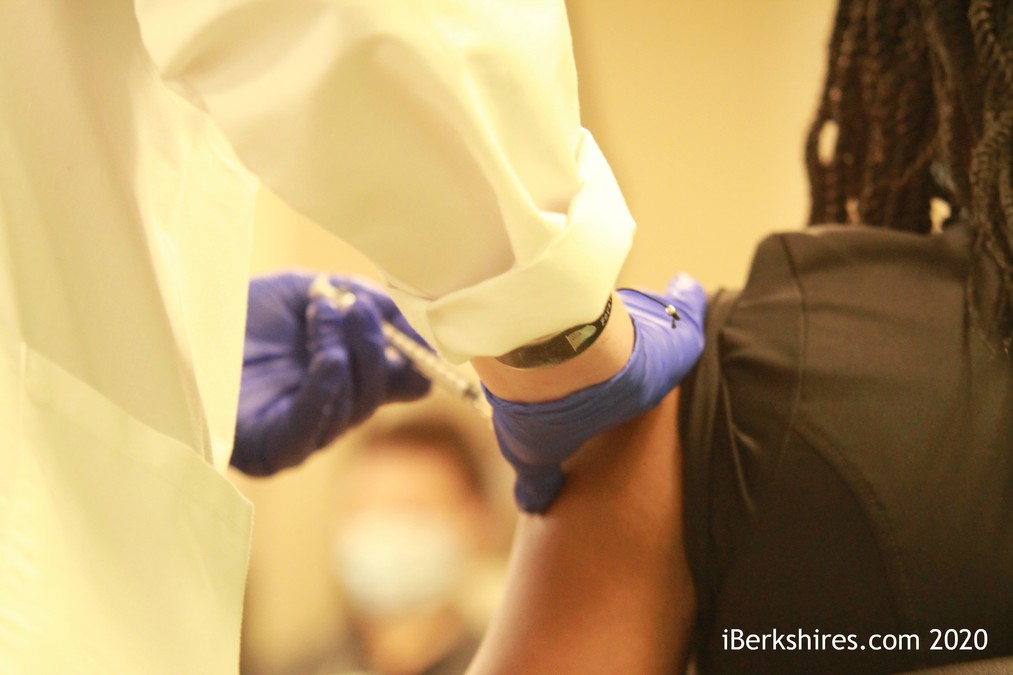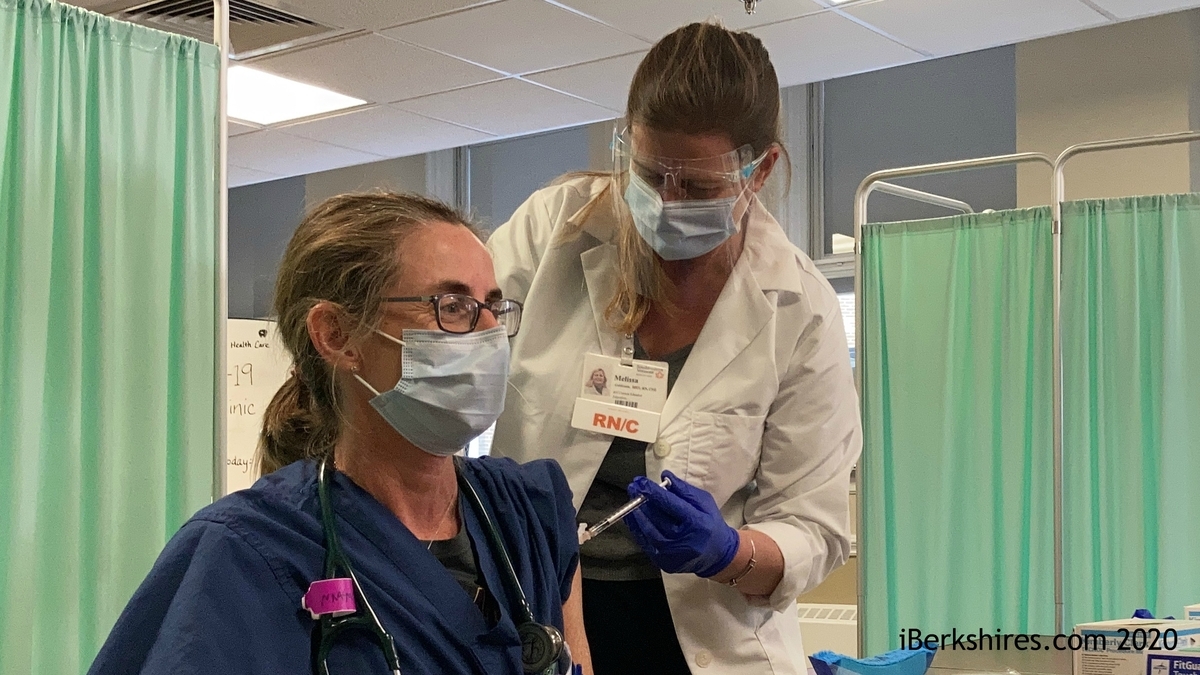
Dr. Anne Marie Swann of Williamstown, Mass., a hospitalist at Southwestern Vermont Medical Center, receives the first vaccination administered at the Bennington hospital on Wednesday morning.
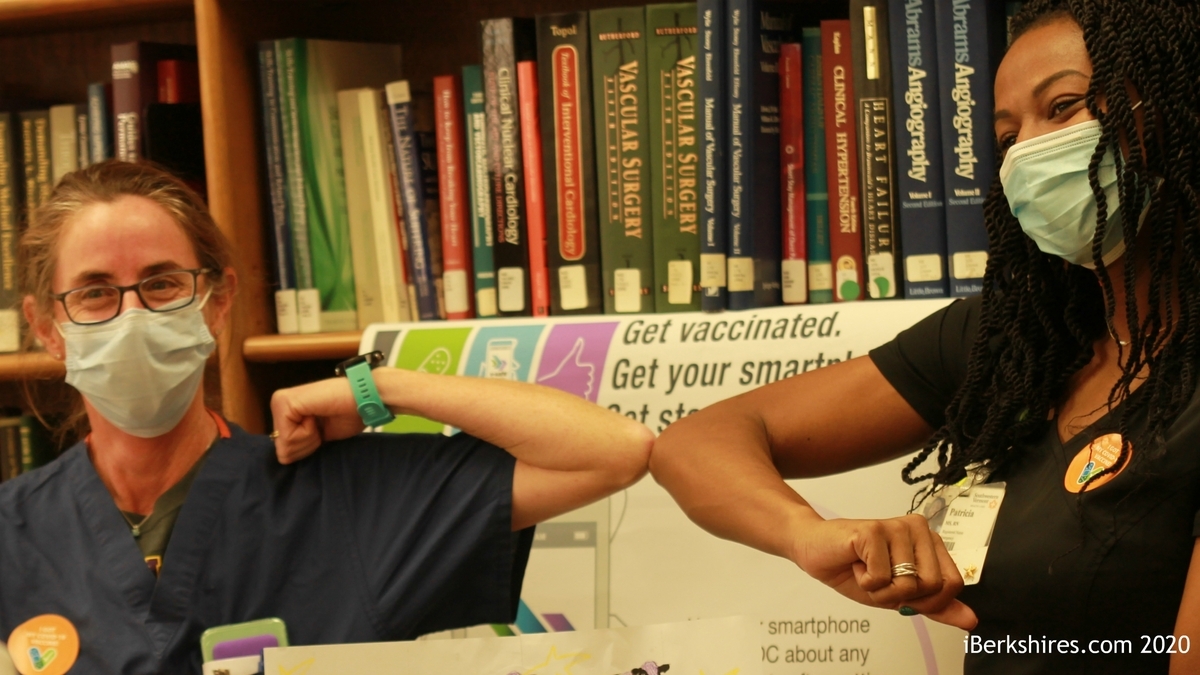
Dr. Anne Marie Swann, left, and nurse Patricia Johnson celebrate after receiving their COVID-19 vaccinations on Wednesday morning.
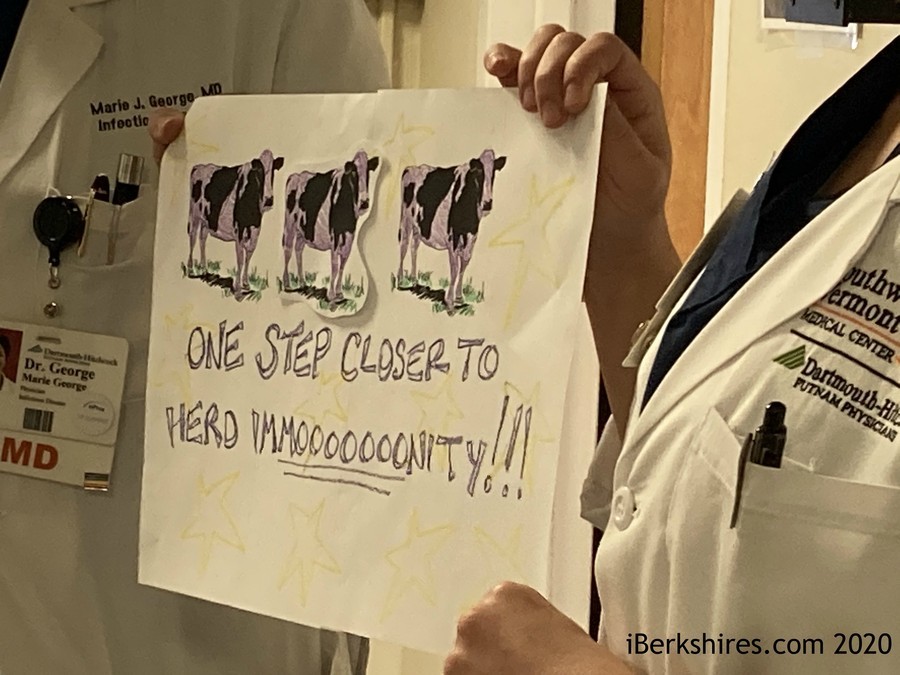
Physicians at Southwestern Vermont Medical Center hold up a homemade sign celebrating Wednesday's start of staff vaccinations.
Nurse Patricia Johnson receives the Pfizer/BioNTech vaccine.
BENNINGTON, Vt. — After getting her first round of the COVID-19 vaccine on Wednesday morning, Dr. Anne Marie Swann got a Band-Aid, a sticker, a round of applause and a place in local history.
The hospitalist from Williamstown, Mass., was the first member of the staff at Southwestern Vermont Medical Center to receive the Pfizer/BioNTech vaccine as the region officially began the next stage of society's battle against the global pandemic.
But moments later, Swann was quick to point out that the battle is far from over.
"Having this as a protective layer is encouraging and exciting for us because the more people who get vaccinated, the closer we get to that herd immunity," Swann said. "We'll still see this for a long time, but I think we'll hopefully see less of it.
"You know, this isn't the end. We are not out of the woods, here. We are still having COVID patients in our hospital. And we know we will have them for a while. So we need to keep up the mitigation measures with the masking and social-distancing which, fortunately, so many people in the Berkshires and Vermont have done really well."
That said, Swann was excited to be among the first frontline health workers in the Green Mountain State to be vaccinated against the novel coronavirus.
Emergency room nurse Patricia Johnson, who followed Swann in the hot seat moments later, went through a number of emotions when she learned Tuesday that she would be at the vanguard.
"I was very honored, emotional and happy to be a part of the change that has been so desperately needed for our country," Johnson said. "For my own health and well being, for my family, for essential workers.
"It's a huge relief. I feel very hopeful and very grateful for this opportunity."
On Wednesday morning at 9:30, SVMC received 245 doses of the vaccine from the supply of 5,850 that the state anticipates receiving by the end of the week. The hospital's pharmacy director said the shipment actually arrived a little ahead of schedule from the state's distribution center.
Although this delivery came through the Vermont Department of Health, SVMC expects to receive its subsequent deliveries directly from Pfizer, and the hospital has an ultra-cold freezer ready to take delivery, said Robert Sherman.
The 245 doses in the initial shipment covers just less than 2 percent of the 1,400 staff at the hospital, Sherman said.
"We have an ethics committee and a vaccine committee that ended up taking the staff, looking at high-risk, frontline nurses, frontline physician providers, and they divided it up appropriately," Sherman said.
He said he expected about 75 doses to be administered on Wednesday with the rest distributed seven days a week until the initial supply was exhausted. The Pfizer vaccine requires a booster in several weeks for better prevention.
The vaccines arrive at a time when Vermont has the nation's lowest COVID-19 test positivity rate, 2.1 percent, according to the VDH (Massachusetts' is 5.7 percent with more tests per capita).
Although Southwestern Vermont does not currently have a high COVID-19 patient count, the staff works hard to be ready if and when a surge does hit.
"A lot of our time is spent thinking about it and planning and preparing," Swann said. "You can't overestimate the amount of time that Dr. [Trey] Dobson, Dr. [Marie] George, all the people you saw in that room giving the vaccines have spent preparing us and helping us care for these patients. Fortunately, we haven't been overwhelmed with COVID. We talk about that a lot. I think that's a testament to our communities.
"But it does take up a lot of our time. All day, we are wearing masks, face shields and respirators in a lot of the rooms, gowning, gloving. It's exhausting in that way. But it's also emotionally exhausting coming in and facing this every day."
Johnson, who has worked at the Bennington facility for nearly four years, agreed that the staff at SVMC is ready if and when another surge comes.
"There's a lot of mentorship, teamwork and collaboration between the doctors and nurses here," she said. "I feel that I'm always kept abreast on what needs to happen and how it needs to happen. We're definitely prepared."
If you would like to contribute information on this article, contact us at info@iberkshires.com.
Your Comments
iBerkshires.com welcomes critical, respectful dialogue. Name-calling, personal attacks, libel, slander or foul language is not allowed. All comments are reviewed before posting and will be deleted or edited as necessary.
No Comments
Puppets Teach Resilience at Lanesborough Elementary School
By Breanna SteeleiBerkshires Staff
The kids learned from puppets Ollie and a hermit crab.
LANESBOROUGH, Mass. — Vermont Family Network's Puppets in Education visited the elementary school recently to teach kids about being resilient.
Puppets in Education has been engaging with young students with interactive puppets for 45 years.
Classes filtered through the music class Thursday to learn about how to be resilient and kind, deal with change and anxiety, and more.
"This program is this beautiful blending of other programs we have, which is our anxiety program, our bullying prevention and friendship program, but is teaching children the power of yet and how to be able to feel empowered and strong when times are challenging and tough," said program manager Sarah Vogelsang-Card.
The kids got to engage with a "bounce back" song, move around, and listen to a hermit crab deal with the change of needing a new shell.
"A crab that is too small or too big for its shell, so trying to problem solve, having a plan A, B and C, because it's a really tough time," Vogelsang-Card said. "It's like moving, it's like divorce of parents, it's changing schools. It's things that children would be going through, even on a day to day basis, that are just things they need to be resilient, that they feel strong and they feel empowered to be able to make these choices for themselves."
The resiliency program is new and formatted little differently to each of the age groups.
"For the older kids. We age it up a bit, so we talk about harassment and bullying and even setting the scene with the beach is a little bit different kind of language, something that they feel like they can buy into," she said. "For the younger kids, it's a little bit more playful, and we don't touch about harassment. We just talk about making friends and being kind. So that's where we're learning as we're growing this program, is to find the different kinds of messaging that's appropriate for each development level."
This programming affirms themes that are already being discussed in the elementary school, said school psychologist Christy Viall. She thinks this is a fun way for the children to continue learning.
"We have programs here at the school called community building, and that's really good. So they go through all of these strategies already," she said. "But having that repetition is really important, and finding it in a different way, like the puppets coming in and sharing it with them is a fun way that they can really connect to, I think, and it might, get in a little more deeply for them.
Vogelsang-Card said its another space for them to be safe and discuss what's going on in their life. Some children are afraid because maybe their parents are getting divorced, or they're being bullied, but with the puppets, they might open up and disclose what's bothering them because they feel safe, even in a larger crowd.
"When we do sexual abuse awareness that program alone, over five years, we had 87 disclosures of abuse that were followed up and reported," she said. "And children feel safe with the puppets. It makes them feel valued, heard, and we hope that in our short time that we're together, that they at least leave knowing that they're not alone."
Bedard Brothers also gave the school five new puppets to use. Viall said the puppets are a great help for the students in her classroom, especially in the younger grades.
"Every year, I've been giving the puppets to the students. And I also have a few of the puppets in my classroom, and the students use them in small groups to practice out the strategies with each other, which is really helpful," she said. "Sometimes the older students, like sixth graders, will put on a puppet show. They'll come up with a whole theme and a whole little situation, and they'll act it out with the strategies for the younger students. It's really cute, they've done it with kindergarteners, and the kids really like it."
Vogelsang-Card said there are 130 schools in Vermont that are on the waiting list for them to come in. Lanesborough Elementary has been the only Massachusetts school they have visited, thanks to Bedard Brothers.
"These programs are so critical and life-changing for children in such a short amount of time, and we are the only program in the United States that does what we do, which is create this content in this enjoyable, fun, engaging way with oftentimes difficult subjects," she said. "Vermont is our home base, but we would love to be able to bring this to more schools, and we can't do this without the support of community, business funders or donors, and it really makes a difference for children."
The fourth-grade students were the first class to engage with the puppets and a lot of them really connected with the show.
"I learned to never give-up and if you have to move houses, be nervous, but it still helps," said William Larios.
"I learned to always add the word 'yet' at the end," said Sierra Kellogg, because even if she can't do something now, she will be able to at some point.
Samuel Casucci was struck by what one of the puppets talked about. "He said some people make fun of him if he dresses different, come from different place, brings home lunch, it doesn't matter," Samuel continued. "We're all kind of the same. We're all kind of different, like we have different hairstyles, different clothes. We're all the same because we're all human."
"I learned how to be more positive about myself and like, say, I can't do this yet, it's positive and helpful," said Liam Flaherty.
The students got to take home stickers at the end of the day with contact information of the organization.
Students got to showcase their art at the Clark Art Institute depicting their relationship with the Earth in the time of climate change. click for more
The 100th annual meeting will be held on March 10, 2027, the Community Chest's birthday (there will be cake, he promised) and a gala will be held at the Clark Art Institute on Sept. 25, 2027.
click for more