State Program Will Allow Schools to Conduct 'Pool Testing' for COVID-19
BOSTON — Massachusetts schools will have the ability to conduct "pool" testing of staff and students for the novel coronavirus under a program announced Friday on Beacon Hill.
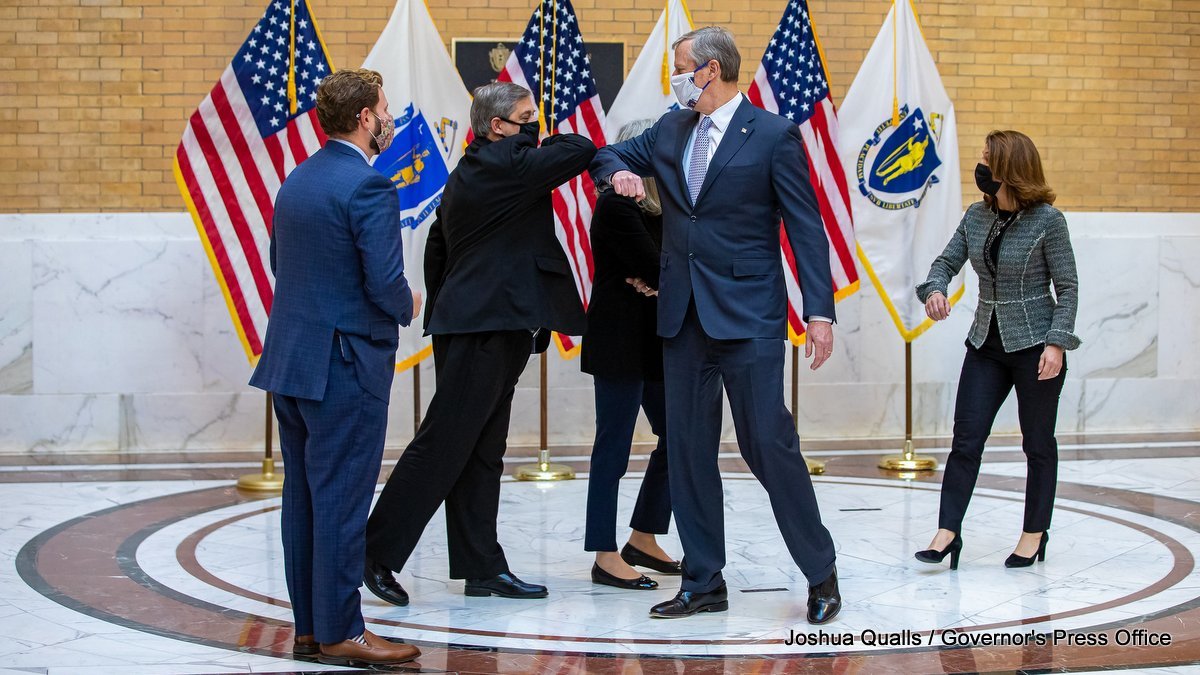
Gov. Charlie Baker was joined by his secretary of education and commissioner of elementary and secondary education to roll out the latest in the administration's continuing effort to push for in-person education in the commonwealth.
"As schools across the commonwealth and around the world are demonstrating and as the medical experts have confirmed, when the standard protocols are followed, schools can be very safe places for children and staff, even without universal testing," Secretary of Education James Peyser said. "Nevertheless, we recognize the anxiety that many people feel — parents and teachers alike — about returning to classrooms in the context of the current levels of COVID we're experiencing this winter.
"Today's announcement is intended to directly address those concerns in order to keep schools open and to help reopen those schools that have been closed."
Past state efforts at school-related COVID-19 testing have included distribution of the Abbott BinaxNOW rapid diagnostic tests for school occupants who are symptomatic and rapid response testing when suspected clusters have arisen.
Friday's announcement takes public school testing to the next level, allowing widespread, inexpensive testing of asymptomatic populations to monitor for COVID-19.
Secretary of Health and Human Services Marylou Sudders explained that under the new program, schools will be supplied with testing kits that involve a short swab sampling at the front of the nose that gives no discomfort to the test subject. Test samples in a "cohort" of 10 to 20 subjects then will be combined into a single tube and sent to a local testing facility for rapid tests.
"If a pooled test result is negative, then all individuals within that pool are presumed negative, and they remain in school," Sudders said. "If a pooled test result is positive, then all the individuals in that pool are retested using the Abbott BinaxNOW. And the positive individual and any close contact are isolated and quarantined.
"This allows classrooms to stay open."
Sudders said the pool testing can be conducted for "at least 75 percent less than the cost of an individual test."
Commissioner of Elementary and Secondary Education Jeffrey Riley said pilot pool testing programs are underway in several school districts in the commonwealth with positive results.
"Watertown Superintendent Deanne Galdston said that it has allowed them to stay open despite the rising virus in their community," Riley said. "They have not had to think about closing their schools, she said.
"Since recently starting this initiative, Watertown schools have tested more than 6,400 individuals, including students and staff members and seen a positivity rate of .21 percent. This is compared to a community rate of 4.4 percent as of Dec. 31. The superintendent told us that what the testing is really helping to see is that the core mitigation strategies used in the schools — masking in particular — are working."
That is a message that Baker and his education officials have been driving home since the summer.
"There's now an overwhelming body of scientific research that shows in-person learning can be done without spreading the virus regardless of the community transmission rate," Baker said on Friday. "One needs to look no farther than the parochial schools here in the commonwealth. Thirty thousand students, 4,000 staff that opened for in-person learning since August with very little impact associated with COVID. Most of those schools are located within communities with high transmission rates.
"It's a great success story, and I applaud them for it."
In answer to a reporter's question on Friday, Riley acknowledged that there has been pushback to in-person instruction from teachers' unions (parochial schools are non-unionized).
"We have been in discussions with the American Federation of Teachers the last few weeks," Riley said. "And there's a meeting that's going to take place next week where we plan to partner with them on this pool testing. We do think it's important to their membership."
In other COVID-19 developments on Friday:
• Sudders announced that the commonwealth now has 119 test sites established for the distribution of vaccines to first responders that is set to begin on Monday. According to the state's website, the number of test sites in Berkshire County remains at three, where it stood this past Monday, Jan. 4, when the first responder program was announced.
• Sudders responded to published reports of criticism from nurses about Thursday's announcement that the state will relax nurse-to-patient ratios in ICUs under certain circumstances in order to address capacity issues during the current wave of the pandemic.
"In the spring, we did an across the board relaxation of ICU nurse staffing ratio for all hospitals," Sudders said. "This time it is much more tactical. Only hospitals that hit certain constraints and have capacity of less than 20 percent for a seven-day period and have eliminated all elective procedures that are on their hospital license — then they may temporarily suspend ICU staffing.
"We do this with the understanding that it does stretch our nurses, and I have been back and forth with the [Massachusetts Nurses Association]. And as we said yesterday, we know it is our health care workers … who are bearing the burden of the disease in hospitals. That's why what we announced yesterday is much narrower than what we announced in the springtime."
• Baker said the commonwealth continues to monitor its COVID-19 tests to see whether the more virulent variant of the virus is present in Massachusetts. While no evidence has emerged, Baker reiterated that he believes it probably has arrived, and he used the question as an opportunity to say that the strategy of face covering, social distancing and hand washing is the best way to prevent the spread of any strains of the novel coronavirus.
Tags: COVID-19,
More Coronavirus Updates