Pittsfield City Council Agrees to Time Limit, Earlier Start
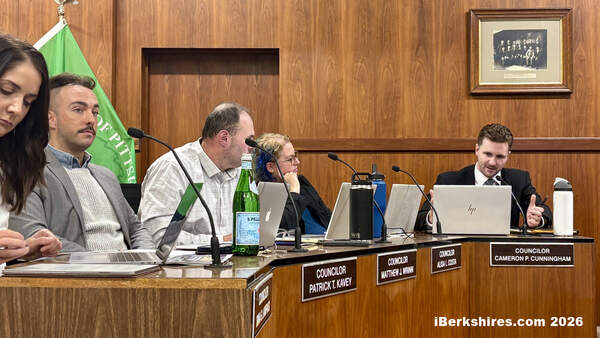
PITTSFIELD, Mass. — City councilors made some meeting changes on Tuesday that won't leave them bleary-eyed in the morning or keep residents up past their bedtimes.
The City Council voted 7-4 to cap meetings at four hours and to start an hour earlier. The votes followed about an hour of debate and a number of amendments.
Ward 2 Councilor Kevin Morandi, Ward 4 Councilor Chris Connell, Ward 5 Councilor Patrick Kavey, and Ward 7 Councilor Anthony Maffuccio voted against the time limit. Council President Peter Marchetti, Morandi, Connell, and Ward 1 Councilor Helen Moon voted against starting meetings at 6 p.m.
The four-hour limit will go into effect at the next meeting on Feb. 23 and 6 p.m. schedule will begin April 1 to give the public and council members time to prepare for the modification.
The Ordinance and Rules committee last week had rejected recommending City Clerk Michele Benjamin's amended petition to adjourn City Council meetings after four hours of deliberation.
Benjamin's amended petition states that the council meetings shall adjourn no later than four hours after the meeting is called to order but that the meeting can continue if two-thirds of the councilors present vote to extend it for one hour. In this case, each subsequent extension of one hour shall require a two-thirds vote.
The already amended petition was amended again on Tuesday by Councilor at Large Peter White to state that the vote to continue for an additional hour occurs after an item being debated is decided on and that the vote to extend the meeting is non-debatable.
These amendments were voted on separately and also passed 7-4 with Morandi, Connell, Kavey, and Maffuccio apposing.
Some councilors believe the time limit is a form of censorship, while others say having a structured time limit will make for more meaningful, streamlined conversation.
Over the past three years and 68 meetings, 18 have gone past 10:30, and out of those meetings, there were five that went past 11:30, four that went past midnight, and one that went to 1:12 in the morning.
The other 50 meetings ended before 10:30 and some of them adjourned by 9 p.m. On a rare occasion, one meeting adjourned at 8. Tuesday's meeting clocked in at 3 hours and 48 minutes.
Kavey first made a motion to accept O&R's committee report and place it on file which failed 6-5. Councilor at Large Earl Persip III then made the motion to accept the report and approve.
Morandi and Maffuccio stated that lengthy council meetings are part of the job description that they signed up for as city councilors and that long debates are essential to the position.
"We all signed up for this, we all know what the job entails," Maffuccio said, adding that limiting their time is "absurd."
Morandi said they are elected to listen, debate, and get things accomplished no matter how much time it takes because councilors are elected to ask the hard questions that constituents don't want to ask.
"We got elected to do a job and, I gotta agree with Councilor Maffuccio who mentioned that it's part of the job, you signed up for it, and if you can't do it, don't run again," Morandi conquered. "There needs to be debate, there's 11 of us on this City Council and we're all going to have different viewpoints and ideas and that's great, that's fine."
These comments prompted Persip to speak about inclusivity and accessibility, saying the demands of councilors only make a certain population able to run for office.
"Only a certain person can sign up and do this and run for office because we have certain advantages others don't," he said. "So think about that, some people can't afford to stay up until midnight and 1 o'clock and then go to their day job the next day."
According to Persip, the four-hour meeting limit will help solve that issue and people who wouldn't usually run will feel more empowered to, bringing a different voice to the council.
Persip also reported that residents have spoken to him about the length of City Council meetings, claiming they are a "joke" and that they would never run for office because of it.
Moon echoed Persip's sentiments.
"We're literally in a position right now to change those rules," she said referring to the charter rules. "We have the capacity and the authority to change those rules and to help encourage participation for future people who are running for office."
Moon added that there should not be 1 1/2 debates on one agenda item as they should be referred to subcommittees. To a certain extent, she said, some of the council's discussions are more prohibitive and flat out repetitive.
"We need to be better as a body, as professionals, as servants of our ward and of Pittsfield to stay on focus and stay on the item in front of us," Ward 6 Councilor Dina Guiel Lampiasi said, feeling that the council often gets off-topic.
She believes that there are times when debates just shouldn't go on either because councilors are too heated about a previous agenda item, are exhausted, or an item is just too lofty to tackle late at night. Providing the option to simply vote "yes" or "no" on an extension of the meeting just seems responsible, Guiel Lampiasi said.
At the same Feb. 1 meeting, the Ordinances and Rules committee passed Persip and White's petition to begin meetings an hour earlier at 6 p.m. The councilors believe that an earlier meeting time will allow more debate without going late into the evening and will make running for office more accessible to Pittsfield residents.
When Persip and White submitted this petition, they were not aware of Benjamin's four-hour limit petition, but Persip believes that they work well together.
Morandi was also against the 6 p.m. time change.
"For myself and two other colleagues that are leaving, I think it would be a courtesy to us, speaking for myself, that we finish the year out the time that we signed up for when we ran two years ago and got in," he said, adding that this time change takes the public out of the equation because a lot of people work until 5 or 6 p.m. and will have difficulty making it to the open microphone segment of council meetings.
Tags: Pittsfield city council ,