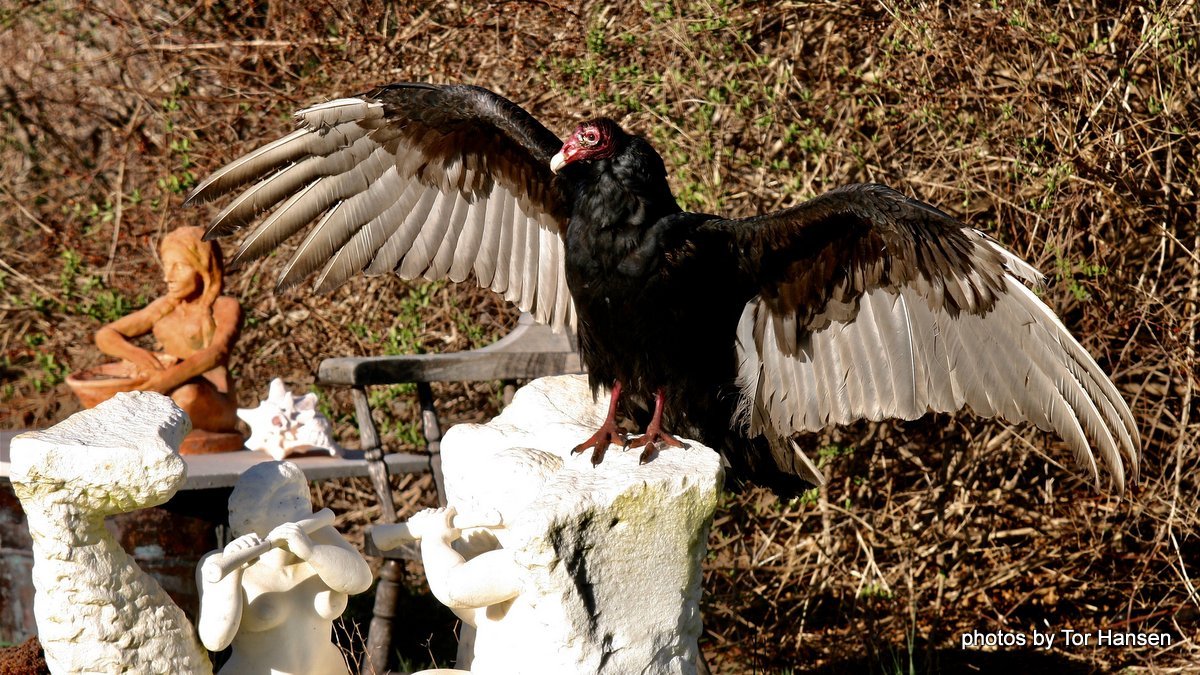
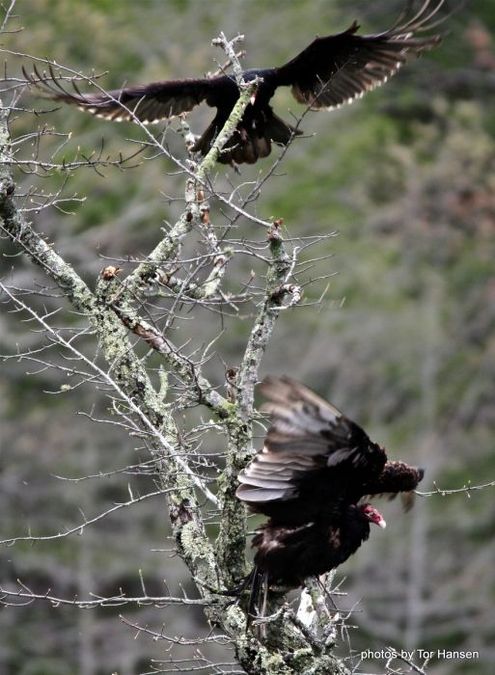
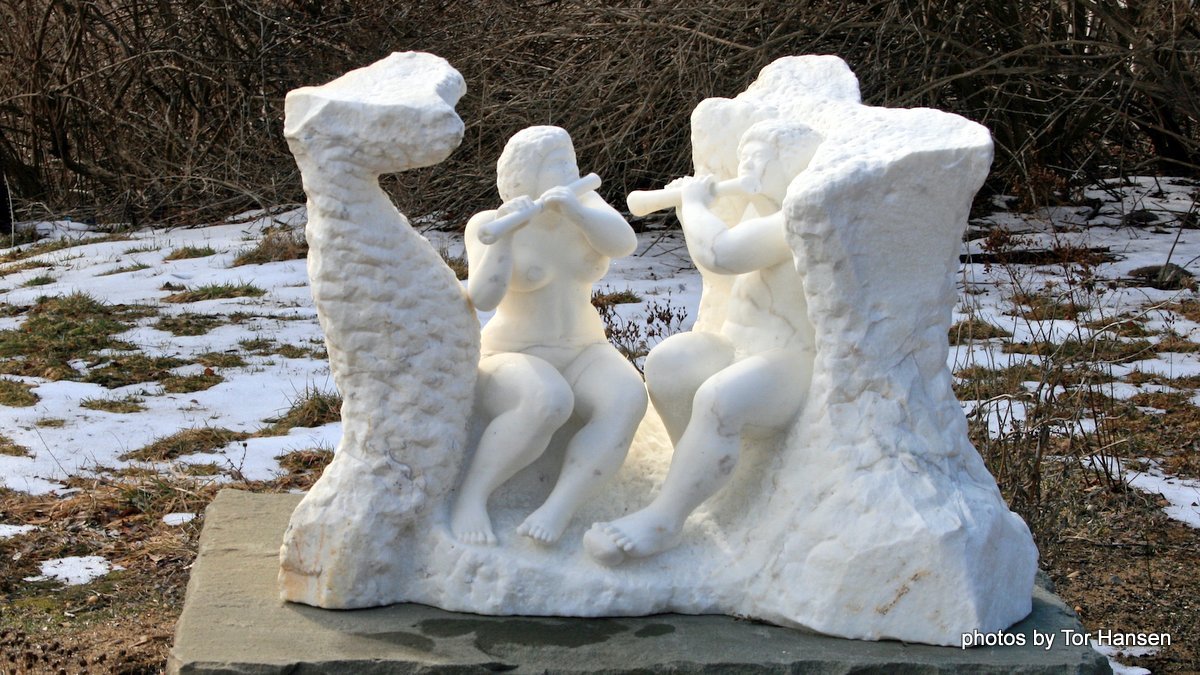
Turkey vulture grooms its wings by spreading as if drying feathers in sunlight. The large bird landed on a marble garden sculpture, 'Two Flautists,' created by writer and photographer Tor Hansen.
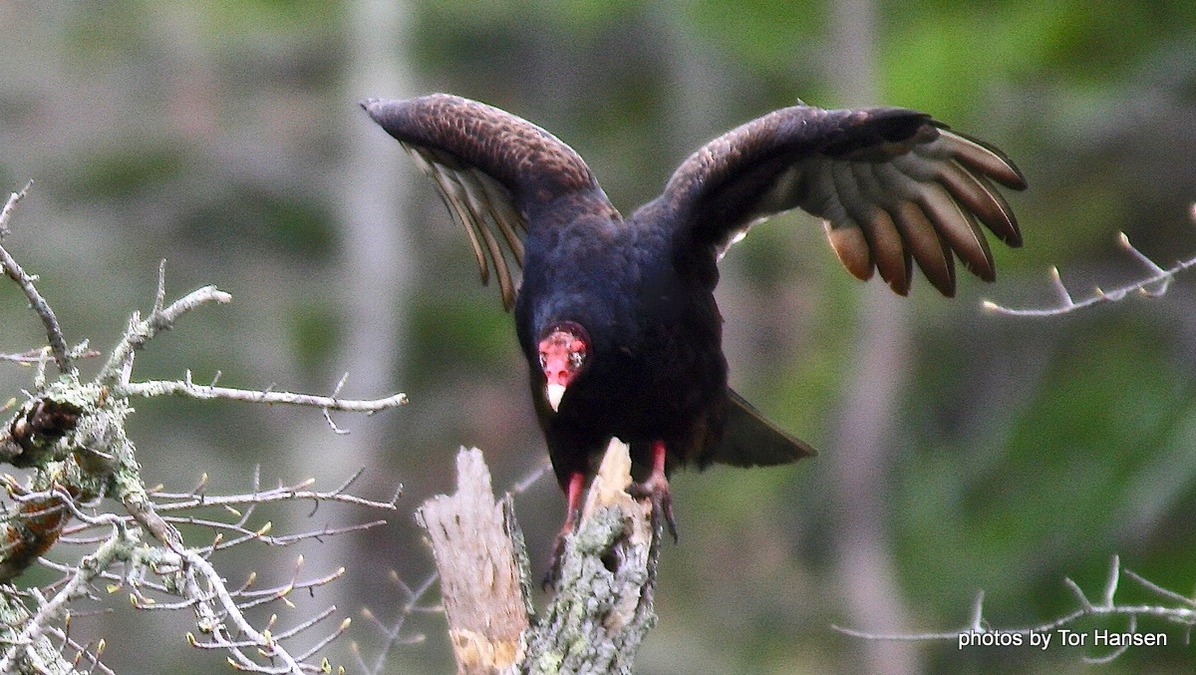
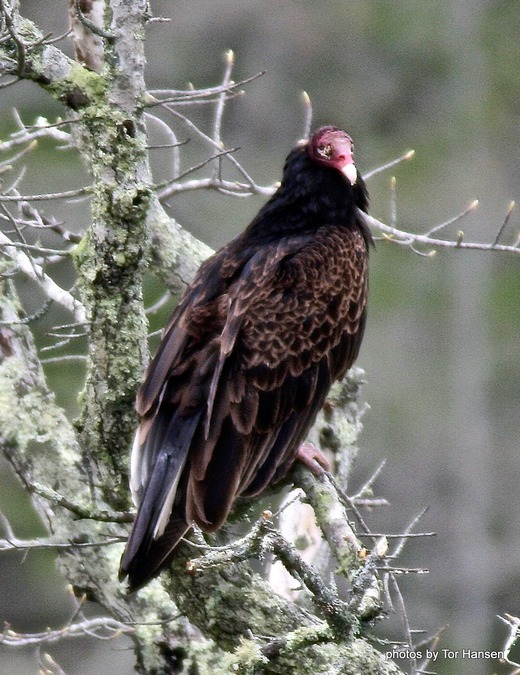
Old dead trees become important roosting sites for birds of prey. Here in the Berkshires, the vultures are seen daily in the mountain retreats.
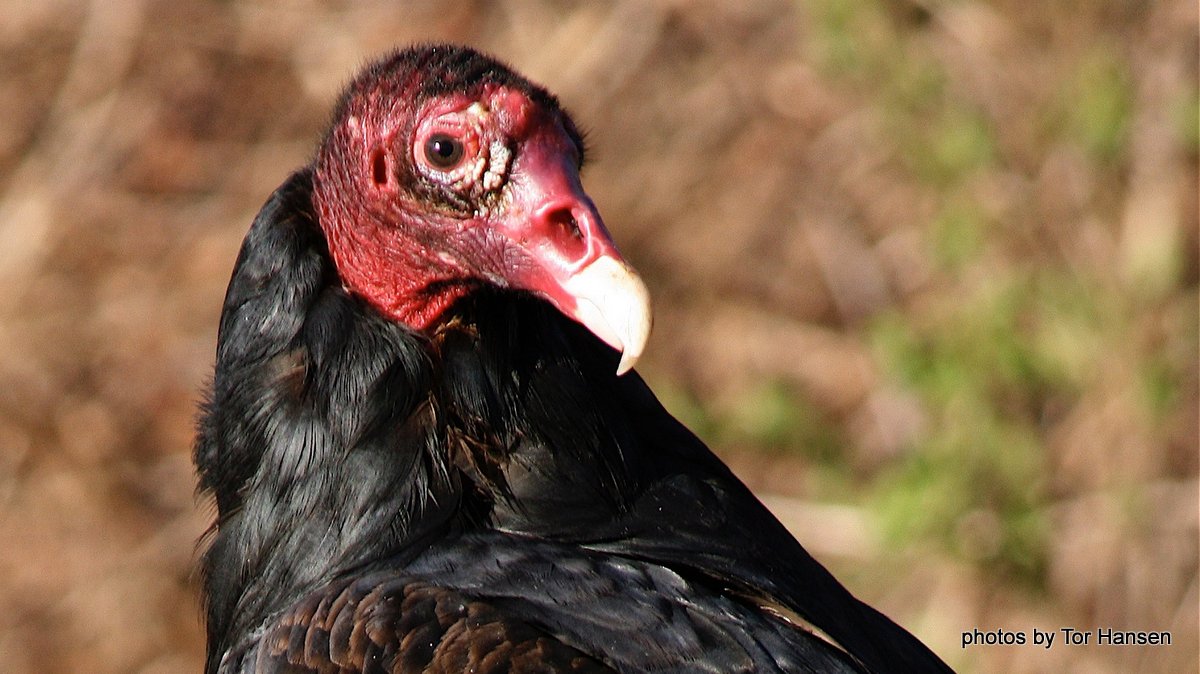
Field marks of turkey vultures include white primary and secondary wing feathers and pinkish-red skin where black vultures have only white wing tips and black heads.
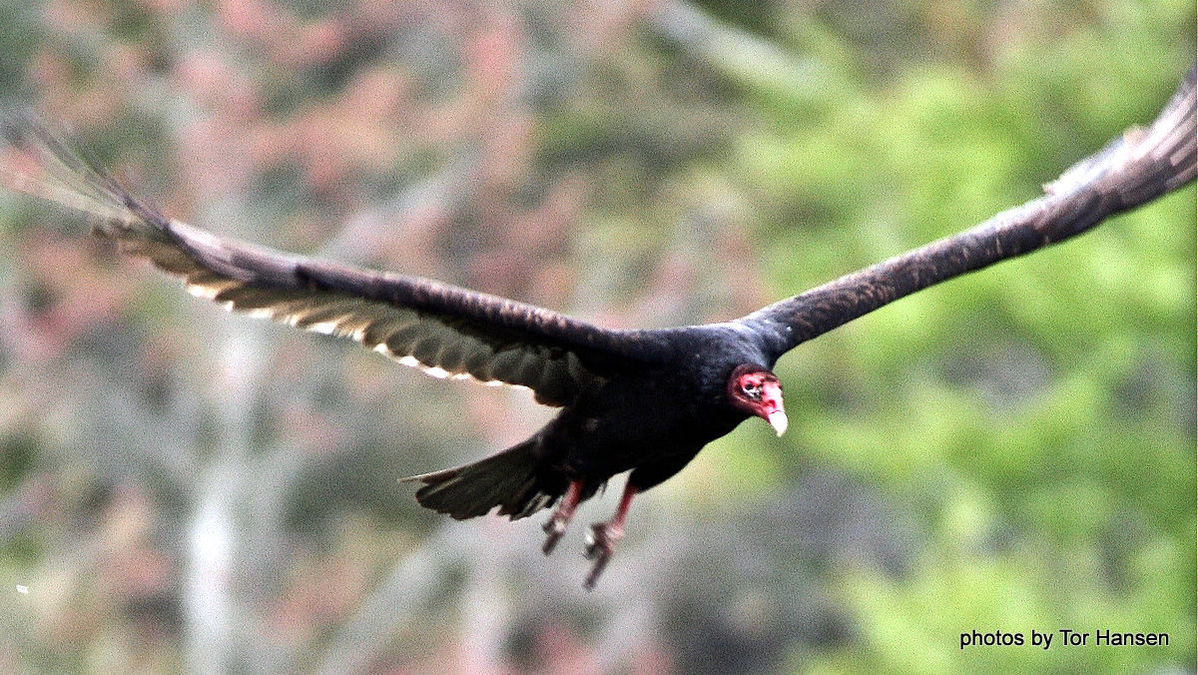
Vultures have long wingspans and can utilize the thermals gliding while searching the ground.
Turkey vultures often hunt together for carrion, using a keen sense of smell well as sight.
Tor Hansen's 'Two Flautists in a Mountain Grotto,' carved from Italian marble.
Turkey vultures have no feathers on their pink-skinned heads.
NORTH ADAMS, Mass. — Of all things that happened! Low and behold as I looked out on my back yard, what did I see roosting on my marble sculpture, but one very curious turkey vulture, apparently quite pleased about sitting on a large stone carving.
It brought to mind World War II, when the Third Reich launched its Operation Eagle Attack against Britain's air force. Germany had the advantage for the early part of the war, when it showed off its air supremacy in fighter planes and long-range bombers. Even at Dunkirk, the British were backed up against the North Sea and only had to wait to be slaughtered. But later on, the 1975 fictional story "The Eagle Has Landed" turns it to a means to kidnap Winston Churchill.
But this occasion was different. My marble carving was initially made in Carrara, Italy, in 1970. I went to Italy specifically to learn the fine arts and techniques to marble carving, so I apprenticed myself to Studio Carlo Nicoli, and learned a great deal to finesse "Two Flautists in a Mountain Grotto." I was amazed how evenly and structurally the Carrara statuary met the demands of my intricate piece.
When almost done, I had the sculpture shipped to the United States and for years it rested in the Hansen family garden in Englewood, N.J. Later when the estate had to be sold, we brothers moved it to our summer home in North Truro on Cape Cod. There it rested under a grape arbor, without stain from the grapes. When we had to settle the Cape estate after Leonard's death, the sculpture was moved to Marshside on Pond Road and there it rested in all its wild nature until it was moved to another location in Cape Cod. In the fall, I planted chrysanthemums and asters around it, because it represented quite a degree of difficulty and intricate undercutting the flutes. Eyeing the carving, I am reminded "What are the first flutes made of, back in anthropological time?"
Not only did the vulture savor the time on the rock, but it opened its wings, did a small dance of sorts, and turned about 180 degrees, held out its wings full stretch, as if wings were drying in the breeze. Roosting on the larger landscape of the sculpture, not on the delicate figures and flutes, the bird posed no problem. Meanwhile I was getting good pictures with my Canon Xti.
In terms of nesting sites, vultures prefer rocky cliffs, caves, grottos, and crevices. Visit Wikipedia and check their data on nesting places that included abandoned buildings, open fields, and old logs. On Cape Cod very few rocks and boulders exist. Mostly the Cape is drifted sand, clay, and protected oak, beech, and red maple woodlands. Large windswept area like downs of Truro are matted with hog cranberry, bayberry, broom crowberry. One may expect a turkey vulture to roost on Doane Rock in Eastham, Cape Cod National Seashore, a sizable boulder (glacial erratics were left by the transient Ice Ages). More numerous rocks punctuate the spine of Cape Cod, the highlands in Falmouth, and glacial boulders rise out of the sand from time to time in the shallows of Cape Cod Bay.
Here in the Berkshires, the vultures (Cathartes aura) are seen daily in the mountain retreats.
Almost all turkey vultures thrive here; seldom a black vulture. They ride the circular thermals with effortless gliding, searching for carrion or dead meat. Eggs in the partial nest number two to three and gestation is 24-40 days, a long time to be sitting. There is no shortage of rocky outcrops here, and I have yet to see an egg snatcher like a fox, or fisher cat, or raccoon, go up against an angry vulture. On further review, I noticed that this turkey vulture did alight here at Marshside in Truro because it was attracted by some carrion, not just the rock sculpture.
I had pulled a flattened fox off the road and placed it in my back yard! Before too long the bird had finished its sun bath, dried its wing feathers, and hopped down to the ground to feed on the fox near by. Thus the overwhelming purpose was confirmed. Yet the surprise of landing on the white rock must have made a stirring impression on the turkey buzzard. It liked to roost on the marble long enough to take its time, feel welcome, and dried its wings without the slightest tremor or hasty take off. Oh yes ... the vulture enjoyed its stay and may even pay a return visit some day. After all, the "Turkey Vulture Has Landed," and appeared to claim the roosting site.
Just what impression did the marble flutists make on such a vanguard?
Tor Hansen is a naturalist writer, photographer, and musician. His column Berkshire Wild looks at especially butterflies, birds and other small creatures at home in the Berkshires and Massachusetts. He does talks and presentations and can be contacted at torhansen46@gmail.com,
If you would like to contribute information on this article, contact us at info@iberkshires.com.
Your Comments
iBerkshires.com welcomes critical, respectful dialogue. Name-calling, personal attacks, libel, slander or foul language is not allowed. All comments are reviewed before posting and will be deleted or edited as necessary.
No Comments
Boutique General Store Opens on Holden Street in North Adams
By Breanna SteeleiBerkshires Staff
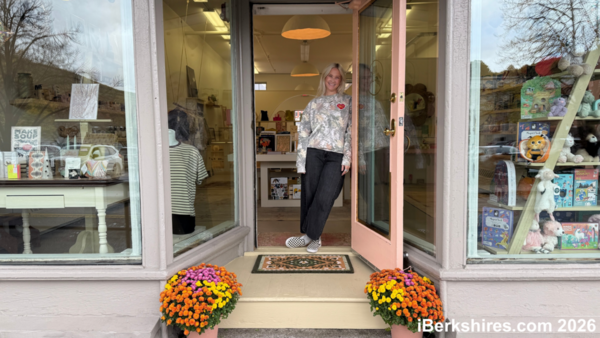
NORTH ADAMS, Mass. — A newly opened boutique general store on Holden Street offers local and regional products along with a curated selection of gifts, wines and artwork.
"It's just a lot of my favorite makers and small brands that I've, in my mind, collected over the years because I've wanted to do this for I don't even know since forever," owner Hannah Blazejewski said. "I'm trying to keep as much of the product at least local to New England as I can."
The name for the Diving Horse at 26 Holden St. was inspired by one of her favorite movies, "Wild Hearts Can't Be Broken," the story of a girl who joins a diving horse stunt show during the Depression.
Blazejewski found the current space earlier this year before moving back to the county in March. It was formerly North Adams Yoga, so when she moved in she repainted the place and also worked with Outlook Builders to build the shelving and her dream "mousehole" wall.
The store showcases local goods from throughout New England, and she described it as a general store and gift boutique built around a personal collection of favorite makers, small brands, and hard-to-find products.
Her shop also includes children's items, artwork, stickers, home decor, cheeses, non-perishable items, wines and a selection of Scandinavian candy.
She said she hopes to contribute to the local economy, connect with other businesses and artists, and respect the city's history and culture.
A newly opened boutique general store on Holden Street offers local and regional products along with a curated selection of gifts, wines and artwork. click for more
In addition to the contests between candidates and the battle for control among political parties, Massachusetts voters will also be deciding on nine ballot questions in November, the highest number since 1994.
click for more
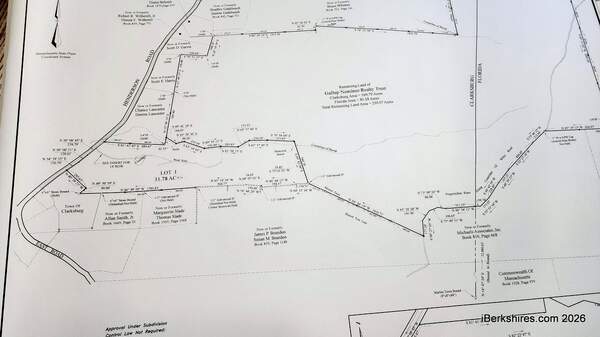
The state Department of Conservation and Recreation is planning to purchase a total of 250 abutting acres in Clarksburg and the town of Florida. The purchase was on the Florida Select Board's agenda on Wednesday night.
click for more
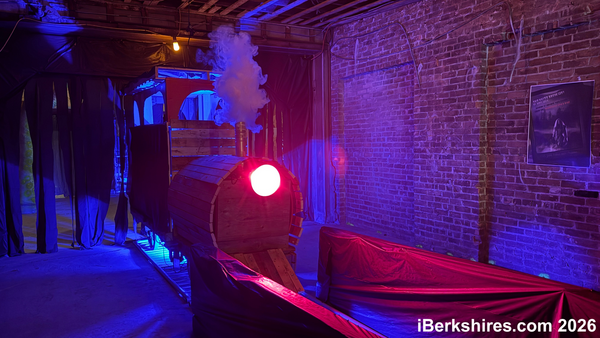
Local officials, schools, and community organizations unite to offer a free Halloween walkthrough featuring local lore, concessions, and family fun. click for more