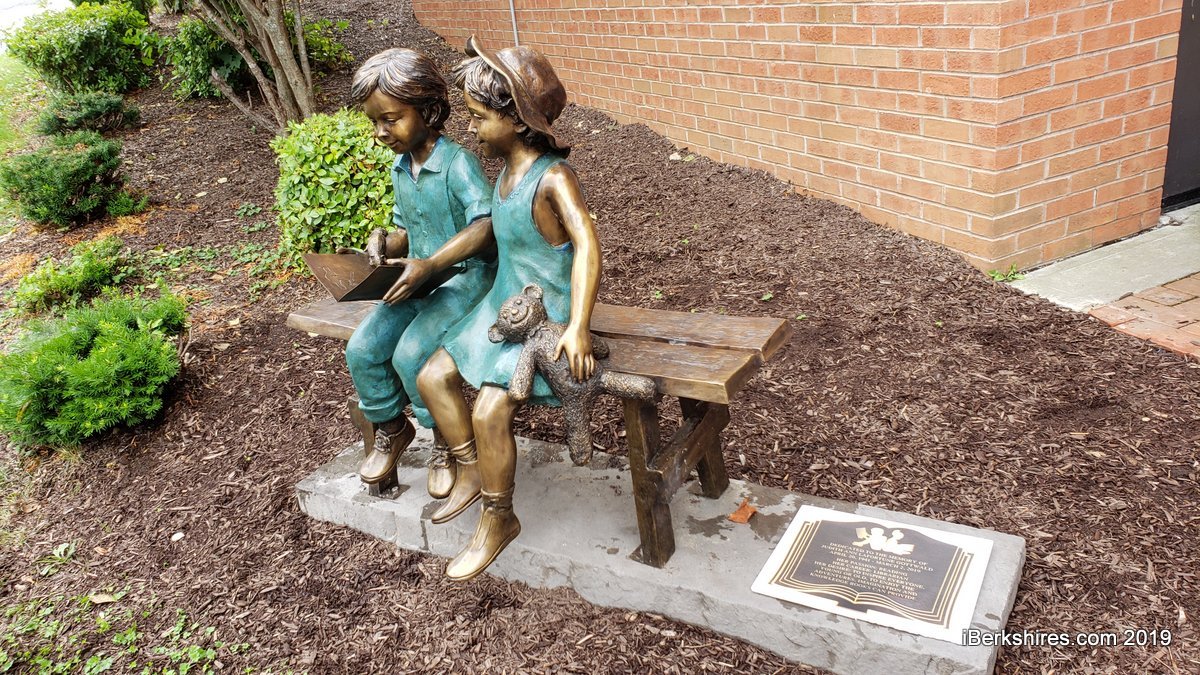
'Read to Me,' a bronze statue donated to the library in 2019.
NORTH ADAMS, Mass. — The Public Arts Commission is seeking comment on its public art master plan that will identify and set goals for the location and management of public artworks within the city limits.
The plan has been nearly two years in the making — with some disruption from the pandemic — and the draft plan is now available for review on the city's website.
The draft sets out guidelines for reviewing and selecting public art projects; aspects of commissioning works of art; accepting donated pieces; developing community outreach and input in choosing art projects; and the necessary applications, forms and contracts. The commission also would encourage discussions on how new construction projects can integrate artwork and how those works connect culturally, geographically and historically to North Adams.
"The City should track major Capital Building and Infrastructure Projects to ensure that public art is considered early in the planning process for these projects, and if a Capital Project is a high priority for art, that an allowance for art is included in the budgetary planning," the draft states.
The transformation of North Adams into a haven for art had been slow at first but has accelerated over the past decade or so largely through the influence of Massachusetts Museum of Contemporary Art. The Public Arts Commission was created to review and approve artworks on public property. The master plan offers an administrative guide for approving art with the mayor as the final vote in line with the city charter.
The plan includes an inventory of current public art and has a section dealing with expectations for how different types of art will last. "Permanency" has been an issue with works created prior to the commission along with who is responsible for maintenance and/or removal. The draft plan states that the appropriate departments, including the Office of Community Development, will be provided with maintenance plans for works solicited and maintained by the city.
Goals in the plan include developing public art activities, supporting lectures and master classes, and coordinating and supporting public art projects. These would be funded by applying for grants and soliciting gifts and donations.
"PAC would rely on contributions from individuals, corporations, and foundations to make public art available and accessible to audiences of all ages and backgrounds – at no charge. Gifts at every level would make a difference and would be 100 percent tax-deductible," the plan states.
The PAC would also work with private developers to incorporate art in their projects: "Placement of publicly viewable art on private property can have an effect the surrounding neighborhood and businesses. The Public Arts Commission should be considered a resource for private owners and developers seeking to place publicly viewable art on their buildings or property."
The plan looks at three types of art: artist initiated (an artist asks to place a work on public property, these are often temporary); works commissioned by the city; art that is donated (such as statues, murals, plaques, etc.).
The PAC will also develop a catalog of current and former works of art and city-owned sites where artworks could be installed with a digital or print format to be kept in the city clerk's office.
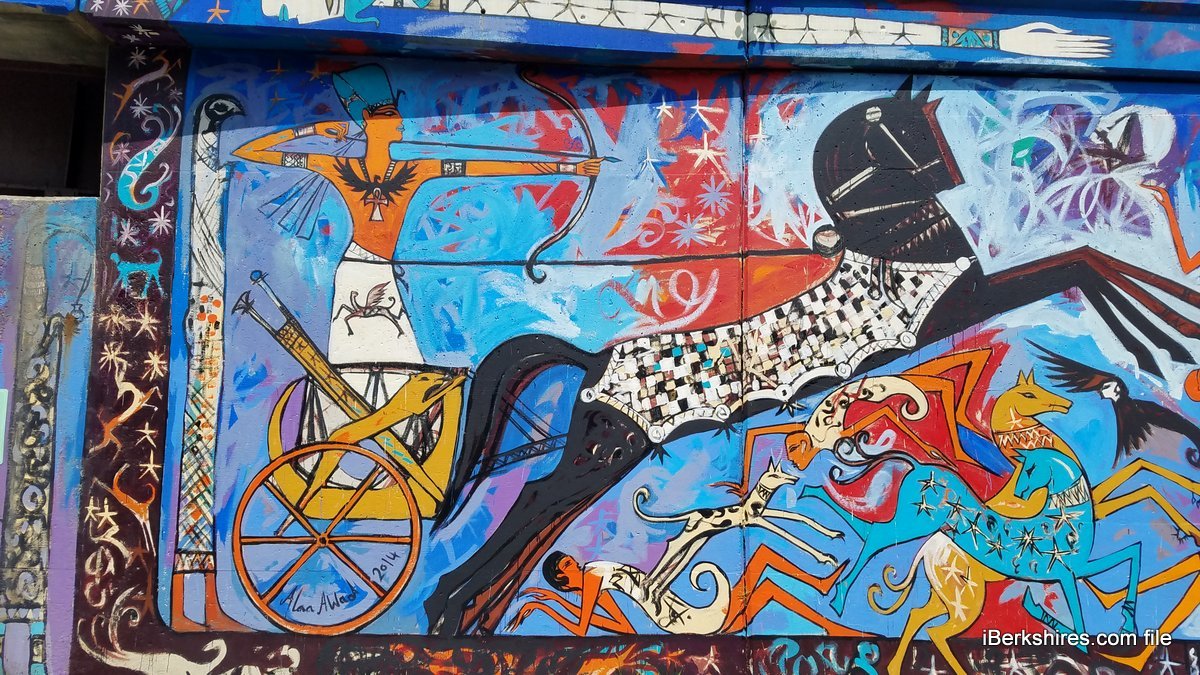
The current inventory includes the Civil War Monument, "Read to Me" at the library, "Harmonic Bridge," Victoria Palermo's "Bus Stand," the "Art on Fire" callboxes in the downtown, and murals on the Mohawk Theater, St. Anthony's Parking Lot and Center Street.
Priority locations for art are the city's three gateways: both north and south on Route 2, north on Route 8/State Street, and north on Ashland Street. Placemaking connections would be largely in the downtown area of Marshall, River, Main and Church, with the farthest out being the Phelps Avenue footbridge. Priority gathering places are Windsor Lake, Noel Field Athletic Complex, City Hall and Heritage State Park.
Comments on the draft plan can be sent to publicarts@northadams-ma.gov. The PAC will be taking comments through July 31 and they will be discussed at the commission's August meeting.
If you would like to contribute information on this article, contact us at info@iberkshires.com.
Your Comments
iBerkshires.com welcomes critical, respectful dialogue. Name-calling, personal attacks, libel, slander or foul language is not allowed. All comments are reviewed before posting and will be deleted or edited as necessary.
No Comments
Why the Massachusetts Art Community Is Worth Continued Investment
By James BirgeGuest Column
How do we quantify the value of art on society and culture? Even eye-popping figures, like the $100 million estimate for the jewels stolen from the Louvre, or the record auction last fall that saw a piece by Gustav Klimt sell for more than $236 million can't fully account for the value of the history, stories, and emotions behind the creations themselves. But beyond that, there is a measurable financial, cultural and social benefit of the arts that is often taken for granted.
Despite the obvious impact, these figures are under threat. A recent survey by MassCreative compiled recent federal cuts to the National Endowment for the Arts, the National Endowment for the Humanities and the Institute of Museum and Library Services and identified 63 grants canceled and $4.2 million in grant funding rescinded across New England so far this year.
The dollars, of course, are important. But they also only scratch the surface on what they bring to the community. Today, we risk losing part of the culture and identity many now take for granted.
While others choose to look past these less tangible, but just as vital benefits, we're doing the opposite. Massachusetts College of Liberal Arts is all in to ensure the next generation retains their access to works of art, while also being empowered to create themselves.
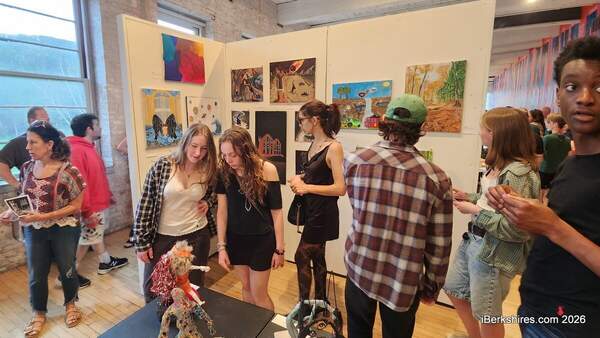
Last fall, MCLA officially broke ground on the new Campagna Kleefeld Center for Creativity in the Arts, which will serve as a new hub for the campus and the local community for arts programming. When complete in fall of 2027, our students will benefit, but so will all of Berkshire County and artists in the surrounding area.
This exciting new facility is just one of the many forthcomings our region can enjoy in the coming years. Just a few miles away, anticipation builds for the Fall 2027 anticipated opening for the Williams College Museum of Art. Years in the making, the museum likewise grows from an enduring commitment to the arts, both in curriculum and in practice. Exciting times are also underway for the Clark Art Institute with the construction of a new facility to house a collection of 331 works of art, including paintings, sculptures, drawings and other works. Their wing is scheduled for completion in 2028. And listeners will no doubt enjoy the sounds and melodies from Mass MoCA Records, the latest endeavor to foster creativity and artistic pursuits through music launched in October as well. Of course, many are also awaiting the reopening of the Berkshire Museum anticipated this summer, after a tremendous renovation process to rejuvenate the experience for visitors.
So much time, energy, and yes, dollars, have already been invested in taking these facilities from ideas and sketches and making them reality. But they represent much more than new buildings. They represent new opportunities to cultivate and accelerate the thriving arts community in Massachusetts and the northern Berkshires.
Art, regardless of the medium, is a reflection of who we are, where we've been, and what we aspire to be. It can be inspired by hopes or fears and chronicle collective triumphs as well as tribulations. The goal of art is not only to document history, but to inspire those positioned to change it and to feel something new or even to provoke us to revisit our own assumptions or misconceptions.
As unfathomable of a number as $30 billion can seem, boiling down the impact to any number inherently discounts the unknowable downstream effects our graduates will bring to the community and the broader world after they leave our institutions. Likewise, rescinding $4.2 million now removes a huge chunk of that growth potential.
Justification for making these investments today when simply boiled down to dollars and cents still places us on solid ground strictly from a financial perspective that forgoes all of the intangible, but no less valuable, benefits as well.
The arts are still worth our support. And our community will be richer for it.
James Birge, PhD, is president of Massachusetts College of Liberal Arts in North Adams.
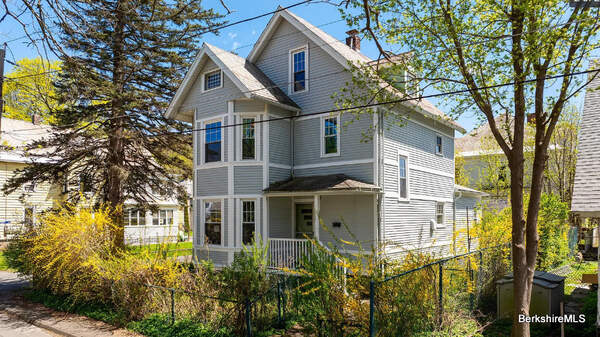
Our Friday Front Porch is a weekly feature spotlighting attractive homes for sale in Berkshire County. This week, we are showcasing 74 Washington Ave.
click for more
On Monday, developer Benjamin Crespi of 196 Marine LLC, was back before the Planning Board with a dramatically different proposal: 49 two-bedroom tourists cabins with a restaurant and recreational amenities.
click for more
The City Council on Tuesday approved an appropriation of $256,635 from the Land Sales Account for easements and takings related to the Ashland Street project. click for more