Berkshire Botanical Garden Hosts 'Shimmer' Art Exhibit
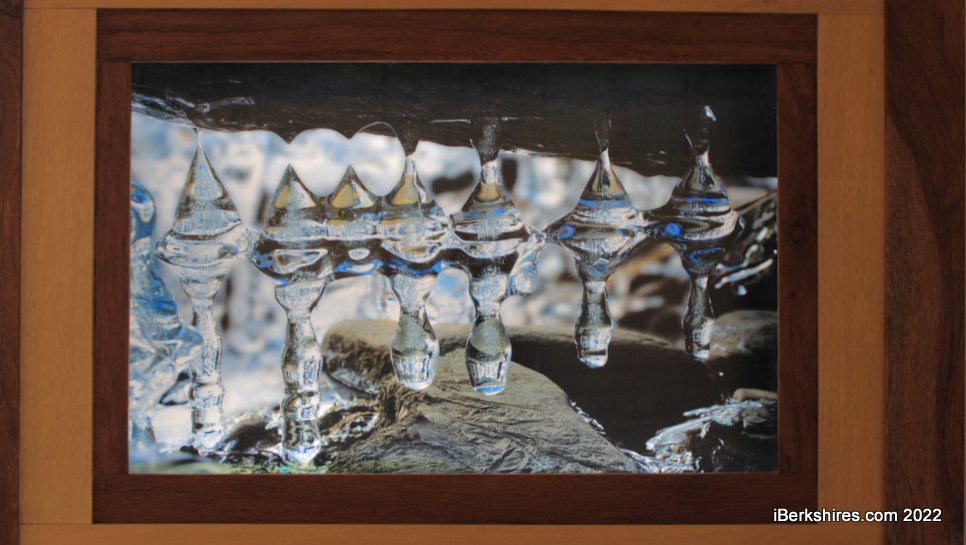
'Frozen in Time' by Art Evans, one of two works on display.
Curated by Sue Muskat and Phil Knoll, it brings together drawings, paintings, prints, photographs, and sculptures from 38 artists in an attempt to encourage "being in the present" while also recording the condition of life.
Each artwork and artist provides a different conversation to encourage viewers to be open to new perspectives and challenges the viewer to contemplate the complexities of light in the darkness.
COVID-19 and the War in Ukraine has painted a dark cloud over the world and this art couple wanted to provide comfort and understanding.
"We've really gone through a lot. I mean, the division, social division, the inability to come to a conclusion as a people. And then everything else that's been going on — the war, the pandemic, the environmental disaster that is looming heavily above us," Muskat said.
"We look to art for solace, we look to art for a deeper understanding of what it means to live in our time, to connect to the past, and artists have this ability to perceive the future and to communicate that and that that can ground you and really help you have a deeper understanding."
They believe that anyone can appreciate art, including those who are not trained in it. In their opinion, what is important is the impact a piece has on an individual, and that they don't have to be taught to experience this impact.
"What makes a great artwork is an artwork that communicates to you if. If you stand here and look at a painting and you feel something from it then great," Muskat said. "It's what lights the flame in you to give you a new understanding and something that you had no idea about, to appreciate the fact that these artists deeply consider what they're doing in a historical context as well."
Each piece in the exhibit provides a different perspective due to the varying artistic backgrounds. These diverse experiences provide the viewers with an eclectic group topic and opinions on our shared world.
"The other thing that's nice in a big group show is that all of these works stand individually. Yet they need to be in conversation with their neighboring paintings," Muskat said.

'Place' by Michael St. John is a condemnation of violence.
"What you are interested in is not necessarily going to be what I'm interested in. So the more diverse the show, the more possibility that a viewer is going to come in and connect with at least one artwork," Muskat said.
The pieces "Water Impressionism" and "Frozen in Time" by Art Evans are prime examples, she said. Evans creates photodioramas using digital prints lit in handmade frames built out of local wood. Both of these pieces made it feel like you were looking into a frozen scene in nature.
Muskat said, referring to "Frozen in Time," said, "I love that you can see the texture of the rock. And then the blurring out of the history. The more that the more time you spend with these photographs, the more in awe you will be of all of the information that's in them."
During the guided tour, Muskat and Knoll presented this reporter with a variety of art pieces that gave a reflection of our world and, at times, criticized it. Muskat noted the piece "Place" by Michael St. John, which condemned violence in America through the use of bullet holes and spray paint.
St. John's artistic statement reads that "With a dedication to recognize and commemorate the time we live in, St. John's work reflects on notions of violence, tragedy, narcissism, racism, and indifference, drawing stimulating connections that kindle new and compassionate perspectives on contemporary culture."
The exhibit will close at 3 p.m. on Sunday, May 1, and will be open Tuesday through Sunday from 11 until 3 p.m. The exhibit is free with admission.
More information on the exhibit and artists involved can be found here.
Tags: art exhibit, botanical garden,