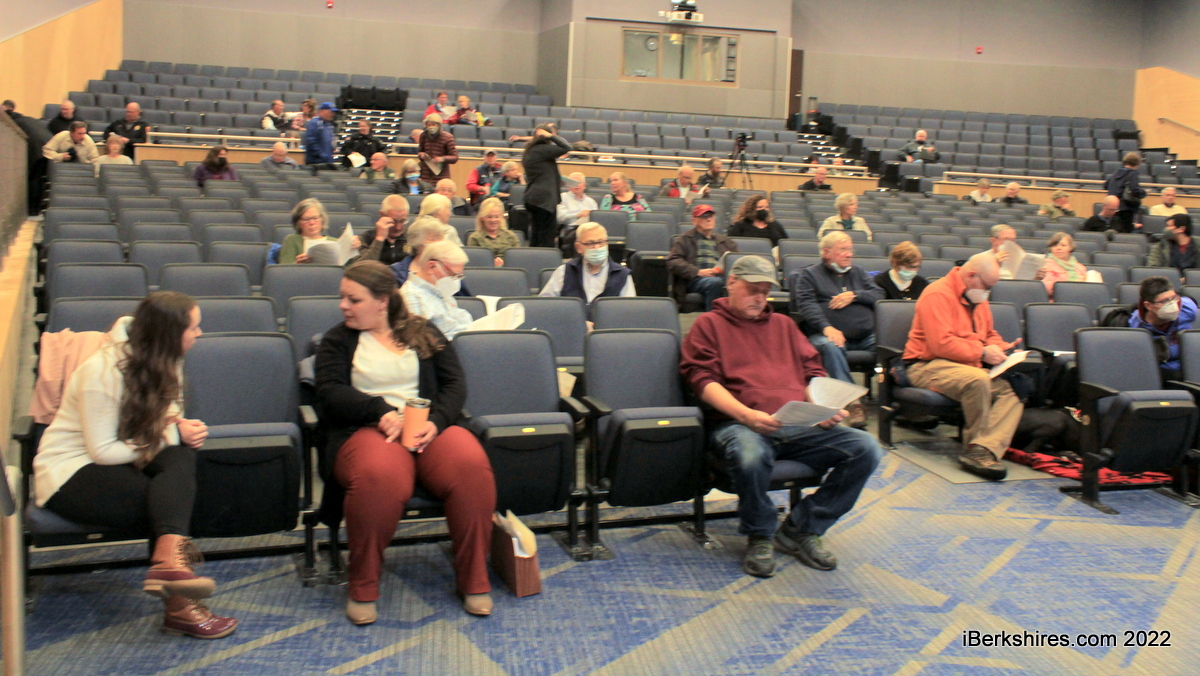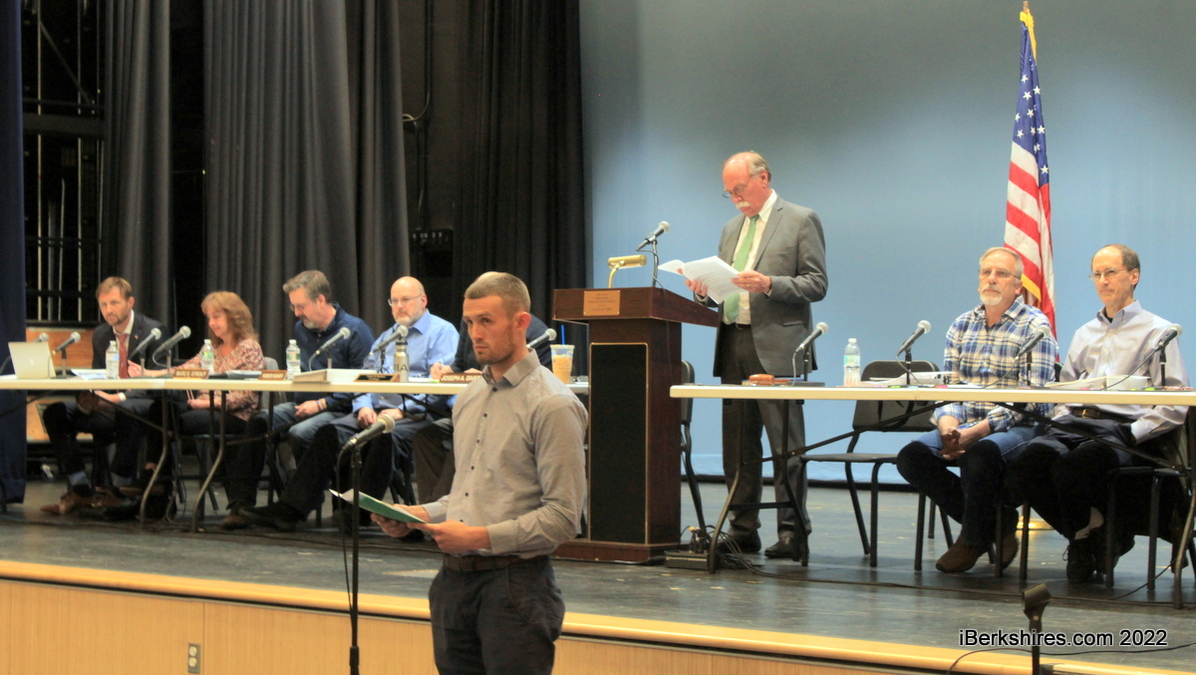
The 3 1/2-hour town meeting was sparsely attended, with barely 100 voters showing up.
DALTON, Mass. — An amended accessory dwelling bylaw passed narrowly at Monday's town meeting but a measure to allow more drive-throughs failed.
Fewer than 100 voters attended the nearly 3 1/2 hour annual town meeting at Wahconah Regional High School.
Approved with little discussion was a town budget of $19,963,774, an increase of 2.2 percent over this year, and an assessment to the Central Berkshire Regional School District of $10,183,947, up 2.3 percent, that includes operating costs of $8,521,913, transportation at $363,721, and capital costs of $1,298,313.
A petition to support the Fair Share Amendment, a ballot initiative to impose a 4 percent surtax on earned income above $1 million, generated some discussion but was endorsed.
The ADU bylaw had been in process since October 2020 and developed in part as a way to increase affordable housing. There were, however, concerns that the bylaw would allow investors to lock up units for short-term rentals and that it only required a simple majority to pass.
"My neighbor, a close member of my community, down in our neighborhood who just recently sold her home, the three highest bidders included two who are rental agencies," said resident Al Nadeau. "She chose to sell to the individual who was buying a home and is now living there. But then all this opens up the opportunity for companies outside of our area that come in and buys a single-family home goes through this process and has at least two rents coming off of it."
A motion was made to amend the bylaw to only allow ADUs in owner-occupied properties. Timothy Zessin, of town counsel KP Law, said it could pass constitutional muster if phrased correctly but that it may be difficult to enforce.
"In my opinion, if it was phrased correctly, it's enforceable," Zessin said. "It may be difficult to enforce, to ensure that somebody is a resident of the town of Dalton is living there, but in my opinion, it would be constitutional if worded correctly."
Zack R. McCain III, Planning Board vice chairman, argued that the town should approve the bylaw as written because the amendment is not practical to enforce especially, when it comes to a resident selling their home to a company.
He believed that the ADU bylaw would not clutter the town because of the limitations in the number of houses and property setbacks.
"As far as cluttering up the neighborhood. If it's a detached ADU it has to have all the same setbacks that you currently have on a lot," McCain said. "So a lot of lots, especially in the center of town, that are the small 60 by 100, or whatever lots, you're not going to be able to build an ADU because you don't have the room for setbacks."
Despite his arguments, voters passed the amendment 46-42 and then the bylaw by 56-31.
The drive-through bylaw failed 44-32 because it required a two-thirds vote to pass.
The current bylaw passed in 2008 allows for drive-throughs at banks, financial institutions, and car washes only.
The updated bylaw would have allowed them for other primary business uses for the purpose of economic development but not in residential districts.
Many of the voters present were concerned that this bylaw would effect the design and integrity of the town and open the way for fast-food chains.
Historical Commissioner Debora D.S. Kovacs was concerned that the absence of stipulation to prevent drive-throughs in two proposed historic districts would risk tampering with their integrity.
"The reason that we're trying to do this is not to limit anything in town it is more to protect and preserve our historic buildings and places and having things like commercial drive throughs would really interfere with with Dalton center," said Kovacs.
McCain said the bylaw only effects a small portion of the town and that a drive-through in a business/industrial area would not effect the traffic patterns because if it did, it would not be approved for permitting.
Voters were not convinced and the bylaw did not draw enough votes for its passage.
Voters approved Article 17 to transfer the former Bardin property from the tax title custodian to the Select Board so that it can decide to sell or lease the land. But they rejected authorizing $20,000 to implement a forest stewardship plan for the property 38-14.
The land is in both Dalton and Windsor, which led to issues on ownership and an agricultural preservation restriction violation.
Some residents argued that the only way to resolve the APR violation would be to sell the land in Dalton and Windors to the same person making it whole.
However, town officials cannot guarantee that the Dalton parcel be sold to the same person as the Windsor parcel because they have to put the land up for bid.
Town Manager Thomas Hutcheson argued that the best way to get the land to agricultural production would be to lease it.
Article 16 passed with a simple majority vote to extend the jurisdiction of the Conservation Commission over water resource areas.
Also approved were articles to remove the Police Department from Civil Service, an action taken by a number of communities to increase their ability to hire police officers; to raise and appropriate equipment funds for the Forest Wardens; to provide matching grants for establishing the two remaining historic districts; to revoke the establishment of the Development and Industrial Commission; to borrow $200,000 for the fiber optic system; and to accept River Street Extension as a public way.
If you would like to contribute information on this article, contact us at info@iberkshires.com.
Your Comments
iBerkshires.com welcomes critical, respectful dialogue. Name-calling, personal attacks, libel, slander or foul language is not allowed. All comments are reviewed before posting and will be deleted or edited as necessary.
No Comments
BRTA Focuses on a New Run Schedule
By Breanna SteeleiBerkshires Staff
PITTSFIELD, Mass. — The Berkshire Regional Transit Authority is still working on maintaining its run schedules after dropping the route realignment proposal.
Last Thursday's meeting was Administrator Kathleen Lambert's first official meeting taking over the reins; retiring director Robert Malnati stayed during a transition period that ended last month.
Lambert is trying to create a schedule that will lessen cancellations. There was a two-hour meeting the week before with the drivers union to negotiate run bids and Lambert is working with the new operating company Keolis, which is taking over from Transdev.
The board spoke about anonymous emails from drivers, which Lambert said she has not seen. iBerkshires was not able to see those letters, but has received some.
"They were lengthy emails from someone describing themselves as concerning BRTA employee, and there was a signed letter from a whole group of employees basically stating their concerns. So, you know, to me, it was a set of whistleblowers, and that, what my understanding is that this really triggers a need for some type of process to review the merits of these whistleblowers, not going to call them accusations, but basically expressions of concern," said member Stephen Bannon.
A letter iBerkshires received spoke of unhappy drivers who were considering quitting because of decisions being made without "input from frontline staff," frustration and falling morale, and the removal of the former general manager shortly after Lambert came in.
Lambert said it's difficult to navigate a new change. She also noted many drivers don't want to do Saturday runs and it has been hard negotiating with drivers on the new runs.
"I would like you all to keep in mind that the process of change is super difficult. Transdev has been here for 20 years, and some of these drivers have never known any other operating company, the way some of the operations have been handled has been archaic," she said. "So getting folks up to speed on how a modern transit system works is going to be painful for them. So I don't want to say that I'm unsympathetic, because I am sympathetic, but I am trying to coax people along with a system that's going to seem very strange to them."
The board spoke about better communication between them and Lambert, citing cooperation will be best moving forward.
"There's just a lot of stuff in the air right now, and there are a lot of fires to put out to make this a coordinated effort. And if we don't keep our communications open and be straightforward, then you get blindsided about how you know the input that you could get from us about your position, and how you know what's going on in your direction, and we get blindsided. And I think that we have to make sure that this is a collaboration," said member Sherry Youngkin.
"Both sides have responsibilities, because in the long run, this advisory board is going to have to make decisions as to how we brought forward and if we've gone forward in a fair and helpful way. And I think that's hopefully what everybody is looking for also."
Transdev and Keolis held a three-day recruiting event interviewing almost 40 candidates and offering jobs to eight, but only three stayed on to start training. Lambert said it was disappointing but she will keep trying to retain more people.
In her first report to the board, she noted that ridership dipped a little over 10 percent, but still remains higher than last year, adding that was because of cancellations of services because of the lack of drivers.
Like the last meeting, some of the advisory board members were torn over the start of the Link413 service, worried that the start of the service took drivers away and the numbers of riders are low.
Lambert, however, said the ridership has doubled from last month.
"As I've spoken before, we have, generally, a six-month adoption for brand-new service before you can really go in and evaluate, are you being successful based on the grant that my predecessor wrote along with the team for PBTA and RTA, we are ahead of schedule, which is pretty good, so I'm hoping that will continue to improve," she said.
Member Renee Wood said the board never approved the service, adding the only thing she could find in the minutes was a vote to accept the equipment. She said it was supposed to be put on the agenda to discuss.
"The Link413 service has been three years in the making. It's been a grant that was accepted and has been working with our partners, PVTA and FRTA, to put into place. So I don't have the entire history of how that process worked, but it's been three years in the making, and did we not understand that once we accept that grant that we were going to put in new service?" Lambert said.
The board discussed if Title VI, the Civil Rights Act, was followed with an accurate review and accurate amount of time for public comment period on the service changes and if its attorney should review if the grant conditions were properly followed.
Lambert said changes had the 60-day comment period included in the proposed route realignment packet, giving the opportunity for the community to respond to that as well but will look into the legality of the situation with their attorney.
The Berkshire Regional Transit Authority is still working on maintaining its run schedules after dropping the route realignment proposal. click for more
The town election is less than a month away and, unlike recent ones, all open seats are uncontested, with even a vacancy remaining on the Planning Board.
click for more