Pittsfield Police Advisory Board Wants Voice in Use of Body Cameras
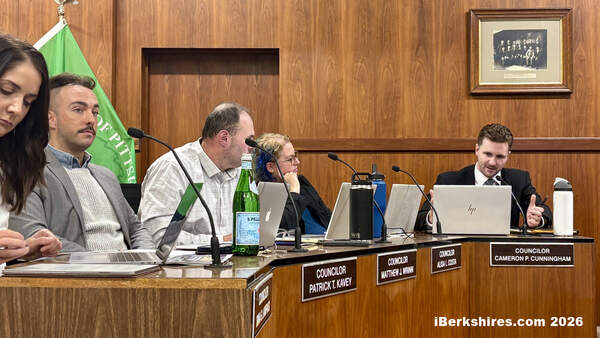
PITTSFIELD, Mass. — Following the City Council's endorsement of dashboard and body cameras on Pittsfield Police, the Police Advisory Review Board would like to review the equipment's policy before anything is implemented.
Chair Ellen Maxon this week asked the board members if they would like to take a vote to support body cameras but some were unsure of their stance. Instead, the panel motioned Tuesday to request that in the event that the Police Department adopts such a program, PARB reviews the governing policies before implementation.
The conversation is in response to the death of Miguel Estrella at the hands of a police officer in late March, which has sparked a significant community response along with conversations about police accountability and the lack of mental health support.
"I still have a pretty mixed opinion because I feel like something like body cameras, people think that's going to be the end all, be all and we don't have to do any more work," board member Erin Sullivan said, adding that there is a bigger problem beyond video surveillance.
Board member Dennis Powell, who is also president of the Berkshire NAACP, wished not to share his thoughts on body cameras at the moment.
He did report that the national NAACP and the New England Area Conference (NEAC) are in support of body cameras and that he understands their support because they likely did a lot of research leading up to it.
Powell did emphasize that he doesn't believe that the program should be funded by grants because they are unsustainable and run out.
"This is a responsibility that the city has to bear as far as the expense and whatnot and this can't be a grant-funded project," he said. "That's just my opinion."
There was originally a motion on the table to make that part of the recommendation but Powell withdrew it and the board will discuss the topic at a later time.
There were voices of support for body cameras on the panel, one being from Lt. Col. Thomas Grady of the Berkshire County Sheriff's Office.
"I have no issue with body cameras at all," he said. "I work in an environment where I'm in cameras from the time that I entered the property till the time I go home at night and I have no concerns at all with the body cameras."
Grady did say he understands concerns that have been raised about the cameras, pointing to Sullivan's about increased surveillance that she gathered from the American Civil Liberties Union.
The organization has also come up with a model body-worn camera policy, ordinance, or bylaw that the City Council petition was modeled after.
"But I do understand [Sullivan's] point, the ACLU. I know that they have concerns about surveilling the public with the by cameras," Grady said.
"And probably more concerning is people get very nervous when we use automatic license plate readers where we can automatically run information, get information, send tickets, do all those kinds of things so I think that we have to have, again, a measured approach and how we do this and that we have to have a solid policy behind the use of the cameras when it's appropriate when it's not but in general, I favor them."
Vice Chair Michael Feldberg also spoke in favor of body cameras.
"I'm in favor of them, I think that with all of their flaws and imperfections, on balance, they do more good than harm," he said.
"And as [Grady] pointed out, you're on camera when you walk into Market 32, you're on a camera when you walk down the street, you're on camera when your neighbor is watching you through his or her iPhone,"
"So I have looked into the issue and for the most part, most offices think that it's to their advantage to have a camera, if they were planning to do something that they weren't willing to have recorded they probably are in the wrong business so I'm in favor."
During public comment, resident Kamaar Taliaferro said he feels body cameras are a red herring.
"They are something that we feel we can vote on, something that we feel we can do as a city," He said.
"It feels manageable when we approach this problem, but ultimately, it's ineffective, it is not going to change outcomes and that is why we're having this conversation as a city."
Last month, PARB heard from community members about Estrella's death and addressed those concerns at this meeting.
Powell explained the NAACP's position was that the city needs to provide mental health personnel to people in crisis and take law enforcement out of it.
"And we took that position because when you really look at it they're two separate professions, lifetime professions that require a lot of training and that you get better at through doing," he said.
"And so people that deal with that on a daily basis and understand principles around mental health issues are better in a position to deal with that than police officers are."
He suggested looking into models from other communities and seeing if those would work in Pittsfield.
"I think that [Powell] is onto something with the model that he's talking about as well, I said at the last meeting, I think what we need to look at is a tiered approach. Where can we start today? And where can we get to? Which is maybe the ultimate model that [Powell] is talking about,"
"But I also you know, I heard loud and clear at the last meeting that people didn't necessarily think that this board was a good cross representation of the community as a whole and I think when we start talking about mental wellness, I think we're stepping into a territory that we may not be the person to be the expert on."
He suggested bringing National Alliance on Mental Illness Director Melissa Helm to a PARB meeting to get some perspective on mental health in the community.
Board member Marie Richardson, who is a social worker herself, said she has worked with officers who have great de-escalation skills and others who do not. She believes that crisis intervention training for police is essential and is not incentivized enough.
"I don't think there's any real incentive to continue on with your training," Richardson added.
"I mean, the police have to learn all the legal and that line of work and they don't necessarily get the mental health training that they need, so I would certainly put that is a very essential part of it is to offer and make more training mandatory for the police."
Grady reported that the city has made efforts to implement crisis intervention training and referenced a recent training sponsored by NAMI.
"I think it's unfair to say that the city has not made efforts to do something," he said.
"We just maybe have not been as successful as we would like to be. And I think that there's a lot of mitigating factors in that."
The board concluded that more mental health responders are needed for crisis situations and that it would be helpful to look at surrounding areas that have favorable co-responder models for reference.
Members are contacting the police departments of Lynn, Northampton, and Amherst to hear of their models at a future meeting. Powell requested that they also look into communities that have alternate policing models.
Grady will also be contacting NAMI and the Brien Center to incorporate them into the conversation.
Tags: police advisory,