Williamstown Fire Station Committee Defends Size, Cost of Project
WILLIAMSTOWN, Mass. — Two members of the Select Board on Wednesday urged the Fire District's Building Committee to use the next month to find cost savings in an estimated $25 million building project.
Committee members responded by repeating that the district is committed to delivering the town the fire station it needs for the lowest possible cost and said the "value engineering" process would continue even after a planned Feb. 28 bond authorization vote if residents approve the project.
But the Building Committee also presented data that shows the project it is planning is in line with comparable fire stations from several dozen facilities recently built in the Northeast.
James Kolesar pointed attendees to a study done by district designer Bob Mitchell, who analyzed recent projects based on cost per square foot, square feet per resident and square fee per mile coverage.
"To me, it says our project is pretty close to the middle or, on some measures, significantly lower [cost]," Kolesar said.
According to Mitchell's data, the average construction cost per square foot for stations he analyzed was $705 per square foot when adjusted for inflation. Williamstown's project currently is projected to cost $706 per square foot.
In terms of size, Mitchell found the stations he looked at averaged 3.3 square feet per resident served. Williamstown's planned station would be 3.9 square feet per resident served. When the question is how many square feet per square mile covered (i.e., the area of the community), Williamstown's checks in at 579 square feet per square mile covered compared to 2,279 square feet per square mile covered for the comparison group.
Kolesar noted Mitchell's cost analysis included removing four projects at the higher end of cost per square foot because elements of the project were "idiosyncratic" and could skew the data. When "idiosyncratic" elements of the Williamstown project – site issues and a commitment to net-zero construction – are factored out, the construction cost of the district's planned building drops to $661 per square foot, lower than all but 10 of the 37 stations included in Mitchell's analysis.
Two members of the Select Board, which the week before was asked to consider contributing town American Rescue Plan Act funds to the Fire District's project, attended Wednesday's meeting to advocate for cutting the cost of the initiative.
Andrew Hogeland told the committee he hesitated before attending because he did not want to be perceived as not supporting the firefighters or the need to replace their aging, undersized station on Water Street.
"The problem is the cost of the project and the lack of sharp pencil processes," Hogeland said. "I urge you to do that now."
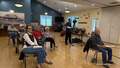
Hugh Daley joined his Select Board colleague in the multi-purpose room at the fire station.
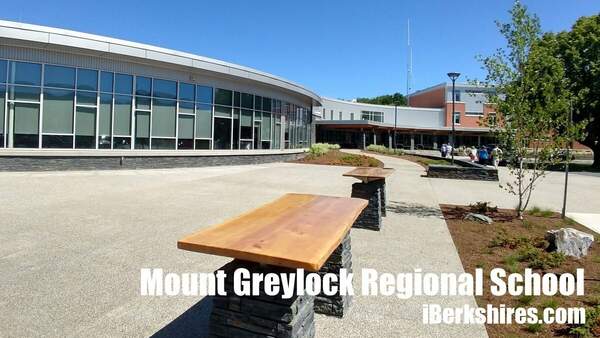
Daley told the members of the Building Committee that the Fire District was "patient" and waited its turn to pursue a building project after the town dealt with the addition/renovation project at Mount Greylock Regional School and the new police station on Simonds Road.
"It is time to build a new fire station," Daley said. "But it has to be done in scale with the community – based on the ability to pay.
"On the school project, we had $85 million plans. We brought it in for $64 million."
Daley said that in his mind, the new fire station would make sense with a price tag of $18 or $19 million – roughly 25 percent less than the current cost estimate.
He recommended that the district and its designers go back to the drawing board to find ways they can repurpose square footage as "flexible spaces" that could serve multiple needs.
Daley told the board that during a period of inflation, the district was running the risk of voters saying "no" to the project if they believe it is too expensive.
"Inflationary stress is hitting everyone," Daley said. "[The voter] can't say no to Stop & Shop. They can say no to this project. So we have to make it palatable. We are relying on you to do that."
Kolesar said the district does not have time to design a new building and obtain new cost estimates in advance of the Feb. 28 special district meeting.
"People who seem to know more about the construction business than I do feel that a little less than six weeks from now is not enough to design a smaller building and get estimates," Kolesar said.
"I disagree," Hogeland responded. "I think doing nothing before the vote is bad for the vote. Any way you can take the next five or six weeks to show you tried or failed – or better yet tried and succeeded – is better for the vote."
A former member of the Select Board who also chaired a community outreach committee for the Fire District suggested that the special meeting itself could be delayed while the district goes back to the drawing board.
"The obvious question for me is what's the consequence of postponing the vote to give yourselves time to do this," Jeffrey Thomas asked the committee. "We're talking about 25 years of debt. If you add a couple of more months to the process to make sure we're bringing the most economical design to the community, that seems to me to be worth it."
David Moresi, who represents the Prudential Committee on the Building Committee, rejected that notion. But he reiterated his commitment to finding ways to bring down the cost of the building as it moves through the design document phase.
"The vote will proceed with the date it's set for," Moresi said. "Doing any more delay on this is just monkeying things up more. I will say, for myself, these comments are very well heard, and this [pencil sharpening] will begin."
Tags: fire station,