Healey Announces Executive Order Creating Housing Working Group

Print Story | Email Story
BOSTON — At the Massachusetts Municipal Association's annual meeting last weekend, Gov. Maura T. Healey said she has filed an Executive Order creating a Housing Working Group. 
 
The group will be chaired by Lt. Gov. Kimberley Driscoll and comprised of stakeholders, including housing developers, advocates, municipal leaders and others to be named at a later date.
 
The group is charged with guiding the structure of Healey's new housing secretariat and informing the process of filing an Article 87 to create the position. The governor has pledged to file legislation creating this new secretariat within her first 100 days. 
 
"One of the single biggest problems facing our state – and the most important point of collaboration between the Governor and municipal leaders – is housing affordability," Healey said in her remarks before 1,000 municipal leaders from across Massachusetts. "Every community will have a role to play in meeting our housing goals, which will have real economic benefits. We cannot do this alone. We want to make this a win-win for municipalities who partner with us in this effort, so that your communities can realize the benefits of a flourishing housing market." 
 
In her address, Healey also outlined her administration's priorities on a number of key challenges facing municipal leaders and state government and emphasized the need for collaboration.
 
"As we look ahead, I want you to know you will always have a partner in Kim and me – we will listen, we will learn, we will reach out, and we will be there to confront our biggest challenges together," said Healey. "Because we know Massachusetts can only move forward if all our cities and towns are strong, our students and families are supported, and our main streets are vibrant." 
 
Chief among those challenges is addressing the impacts COVID-19 has had on students and closing opportunity gaps in education. To do this, the governor committed to: 
  • Fully funding the Student Opportunity Act and meeting the needs of charter school reimbursement funds in her FY24 budget. 
  • Assisting school districts with the cost of transporting students and fully funding the McKinney-Vento program to ensure that homeless students can enroll in, attend and have the opportunity to succeed at school.  
  • Supporting the special education circuit breaker program to help maintain funding to assist all school districts with the cost of these critical services. 
  • Filing supplemental funding to ensure migrant children have access to the education and support they need to learn and thrive, and that communities have the resources to make it happen.   
Pointing to the need for predictability, transparency and open communication between the state and municipalities, Healey committed to early notification of local aid funding levels, including Chapter 70 and unrestricted government aid, in advance of her FY24 budget. She also highlighted her administration's recently filed a $987 million immediate needs bond bill and $400 million Chapter 90 authorization bill, and the positive impacts they will have on housing, job creation, economic development, roads and bridges in cities and towns.   

Tags: healey,   
If you would like to contribute information on this article, contact us at info@iberkshires.com.

Crane Park's Mini-Pitch is Open for Fun

By Breanna SteeleiBerkshires Staff

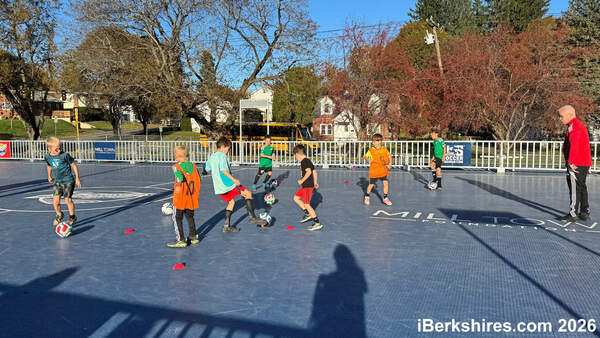
PITTSFIELD, Mass. — City officials celebrated the opening of the new Crane Parks mini-pitch on Tuesday.

Players from several local soccer programs, community leaders, and project partners gathered to kick the ceremonial first pitch into the goal on the new facility.

Back in May, the Parks Commission endorsed a project to place a mini-pitch over the aging, cracked concrete surface of Crane Park's former rink. A mini-pitch is a compact, modular field typically used for soccer, and it can also accommodate inline skates.  

"The mini-pitch system will create a space that encourages physical activity and welcomes play through teamwork. The space will serve as a location for the community to gather for outdoor fun and recreation for many years ahead. They'll be able to put their cell phones down for a few minutes and actually engage in some great outdoor entertainment," Mayor Peter Marchetti said.

The project was funded entirely by grants. In June, the City Council accepted the gift of the mini-pitch facility, valued at over $100,000, and $10,000 from the Mill Town Foundation to ready the site. 

The facility has a galvanized steel border with built-in goals and a rubber plastic surface that is clicked together. Cleats are not allowed on the surface, but sneakers and other sports shoes are.

The mini-pitch system came with a light tower and two LED lamps, but Crane Park does not have power, so it won't be illuminated. That could change in the future, officials said.

The pitch is open for the community every day, but Parks, Open Space, and Natural Resources Manager James McGrath reminded users to be mindful as they play as well as to respect the pitch and the neighborhood it resides in.

McGrath said the idea grew out of conversations with Andy Wrba, program director for the Mill Town Foundation.

"There's been a deep, deep soccer community in Pittsfield and throughout the Berkshires for a long time. I've seen it as a multi-generational way for communities to connect and pass down lessons and connect families and everyone. And a big part of that has been the West State Soccer League," Wrba said. 

He said the goal is to keep the space active and encourage outdoor recreation and youth engagement. 

McGrath said that with the partnership from Mill Town and the city's park commission they were able to bring the pitch to the finish line.

"It's a testament to our ability to bring new and unique facilities into our city that accommodate youth sports. And it really, at the end of the day, is about promotion of soccer. And we are just so pleased that our partners all came together and that we were able to get this mini-pitch completed," McGrath said.

Other contributors as well were the U.S. Soccer Foundation, who provided the mini-pitch system, surface materials, and installation assistance at no cost to the city, as well as Massachusetts Youth Soccer who partnered with Pittsfield to bring the system to the city.

"All these contributions made this project possible, and highlights how our community continues through public and private partnerships to provide new facilities and amenities for all to enjoy," Marchetti said.

View Full Story

More Pittsfield Stories