Adams Aggie Commission Recommends Town Adopt Farmland Program
 |
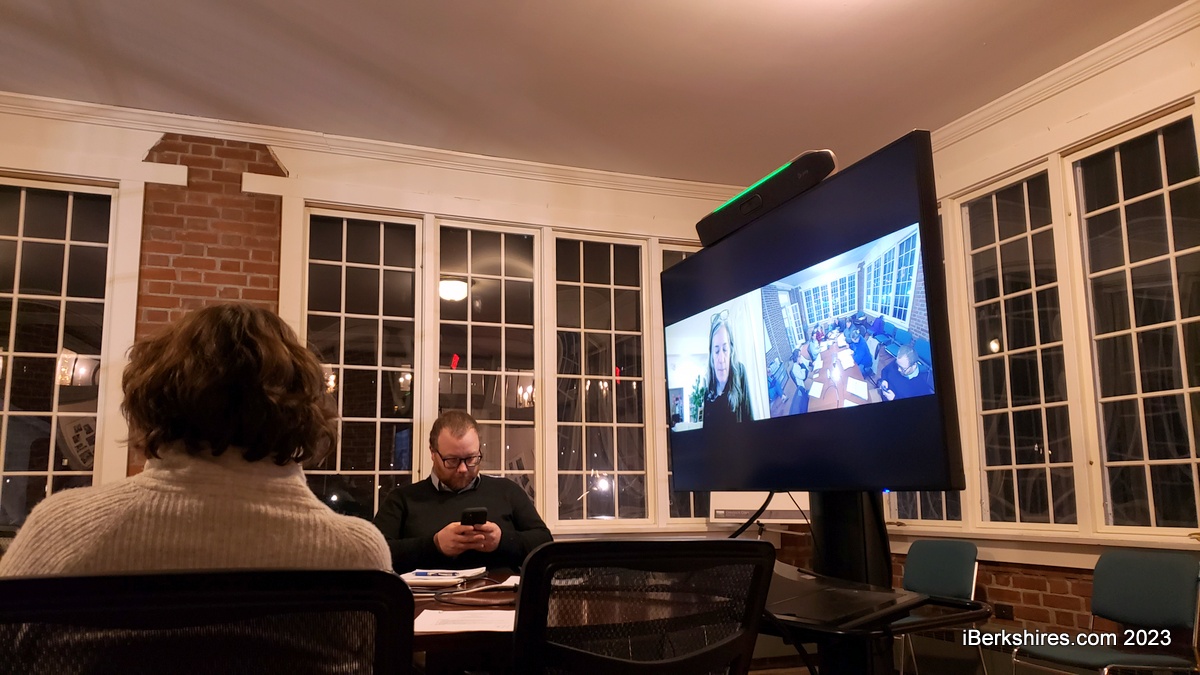
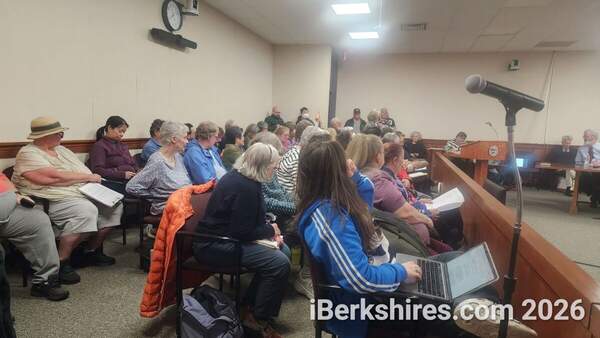
Williamstown Agricultural Commissioner Sarah Gardner, via Zoom, speaks with the Adams Agricultural Commission about the upcoming 'Planning for the Future of Your Farmland' workshop to be held at the Bounti-Fare.
The U.S. Department of Agriculture initiative partners with state preservation programs and builds on the century-old National Cooperative Soil Survey that identified farmlands as prime, unique or of state importance.
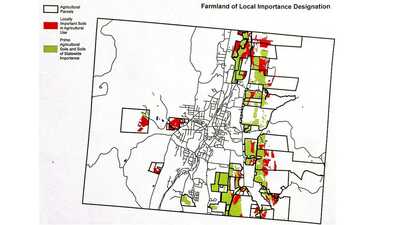
These lands may not be on the soil survey but are being used for agriculture and, under the federal program, it would be up to towns to designate they are of "local importance" for preservation.
"So, we already have a soil survey and you get an idea of what the suitability and the limitations on the soil are," said Alan Averill, a state soil scientist with the USDA's National Resources Conservation Services. "These are lands in addition to those that are identified as prime farmland and of statewide importance."
He and Sarah Gardner, a member of the Williamstown Agricultural Commission and associate director for Williams College's Center For Environmental Studies, gave the presentation over Zoom on Tuesday.
Averill said they are reaching out to towns to advise them of the opportunity to "acknowledge these additional lands that are suitable for crop production."
He offered up some examples, including an area in Hatfield that had once been swampy but drained many years ago and is now being used for growing vegetables — but is not on the soil survey as farmland. Another is a parcel in Adams of which more than half is not designated as important farmland but "certainly looks like it's well suited for hay production."
"This particular parcel has no important farmland indicated by the soils map," he said, showing another map. "Yet it's obvious that it's being grown, it's being used for a food crop. This is an orchard. So this could qualify as farmland as local importance because it's important for the production of food crops."
The program is several years old in Massachusetts and more than 40 communities are participating, about half of those in Berkshire County. If Adams wanted to participate, it would review its land use and the soil mapping for evidence of suitability for crop production not currently identified as important farmland. It would be up to landowner to apply for the designation.
The land would have to comply with the conditions set forth in the Food Security Act of 1985 (no more draining land) and provide evidence of crop production. A designee of the town, likely the Select Board, and a NRCS state conservationist for Massachusetts would have to sign off.
"It's qualified to distinguish those areas that are suited for propagation from those that are not and it is important to point out that when the soil types are recognize it doesn't change the land use, it doesn't imply that the land use should be one thing or another," Averill said. "The other alternative is redoing the soil survey, making it more intensive. And that's just not going to happen."
The landowner doesn't have to designate their entire property, but just those areas that are being used for agriculture as long as it has 50 percent important farmland soils, including any already noted on the soil survey.
"I think this is especially important in North Berkshire because a lot of the land in farming is not prime farmland soil," said Gardner. "We have a lot of rocky, hilly land with not great soil that is productive farmland."
The program has been presented to the Select Board, which raised some concerns on the amount of land already in preservation. Community Development Director Eammon Coughlin said the Berkshire Regional Planning Commission had done some analysis and found about 1,100 acres being actively farmed out of about 3,000 acres of farmland. About 835 acres are protected by a state agricultural preservation restriction and another 1,700 are enrolled in Chapter 61, which assesses property a lower rate for its open space, forestry or agricultural use.
"They tried to do a little bit of analysis related to the impact of the designation and tried to see what parcels might be pushed above the 50 percent threshold," said Coughlin. "What they found was about 562 acres in 15 parcels would kind of meet that criteria with this new designation."
Select Board member Joseph Nowak, who attended the meeting, said the board member were worried that this acreage would reduce the amount of developable land.
"But the realization is that a person that owns property, if they want to sell their property, they can sell it," he said. "We're just wanting to designate the land of local importance so that they have that option. I just think that it was just misconstrued."
Gardner said people who aren't involved in farming sometimes forget that "farms are local businesses and employ people and buy a lot of local services and produce critical products."
Averill and Gardner pointed out that everyone's taxes have helped pay for the program and it would behoove Adams to get some of that money back.
"It doesn't do any harm to recognize the farmland of local importance if all it does is maybe open the door for a few parcels to be able to see farmland preservation through this federal funding," said Averill.
Tags: agricultural commission, agriculture,