image description
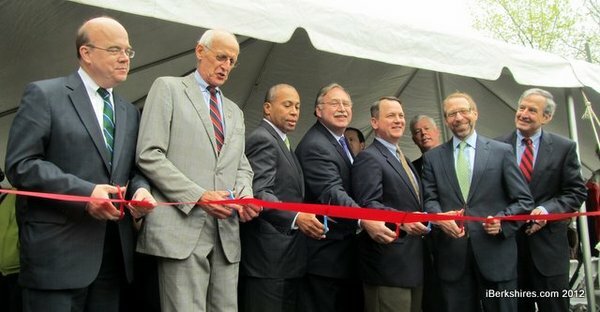
Congressman Olver, often the tallest in any group, at the ribbon cutting of the $15 million, copper-clad John W. Olver Transit Center in Greenfield in 2012.
image description
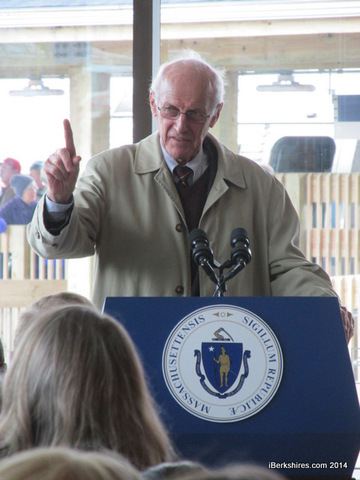
Olver urging people to ride the train in 2014.
image description
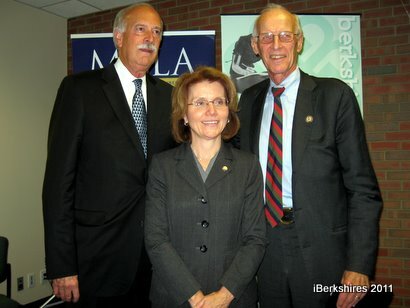
With then BCC President Paul Raverta and MCLA President Mary Grant in 2011.
image description
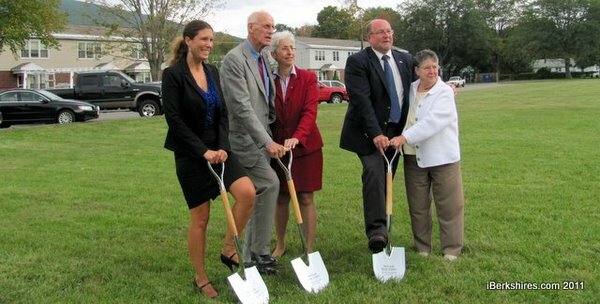
Olver with NAHA Director Jennifer Hohn, the late state Rep. Gailanne Cariddi, then North Adams Mayor Richard Alcombright and then City Councilor Marie Harpin at a groundbreaking in 2011.

John Olver, Champion for Rural Mass and Passenger Rail, Dies at 86
Staff ReportsPrint Story | Email Story

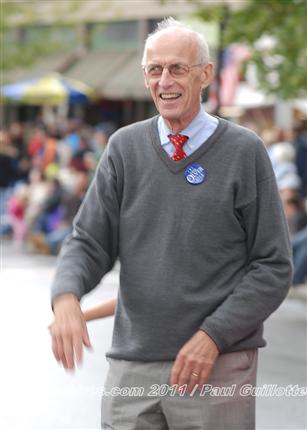
John Olver as grand marshal of the Fall Foliage Parade in 2011. He was a regular marcher in the annual event. 
AMHERST, Mass. — Former Congressman John Olver died Thursday at age 86 at his Amherst home. 
 
Gov. Maura T. Healey has ordered flags to be lowered to half-staff at all state buildings.
 
Olver represented the 1st Massachusetts District for 22 years until his retirement in 2012. Prior to that, he spent 22 years in the Legislature.
 
His successor and one-time colleague U.S. Rep. Richard Neal said the Amherst Democrat had dedicated his life to public service. 
 
"Over the course of his 22 years in the U.S. House of Representatives, John was an effective leader and steadfast advocate for the people of Western and central Massachusetts," he wrote in a statement. "His approach to policymaking was a good lesson for those in public life. He lacked any malice and had the purest of intentions, focusing solely on delivering for the people he felt privileged to represent."
 
The former University of Massachusetts chemistry professor was the ranking Democrat on the Appropriations Subcommittee on Transportation, Housing and Urban Development and the only member of the delegation on the House Appropriations Committee at the time of his retirement. 
 
He was first elected to the State House in 1969 from Hampshire County and four years later began an 18-year stint in the state Senate. He won a special election in June 1991 to fill the seat of longtime Congressman Silvio O. Conte, a Pittsfield Republican who died in office. It would make Olver the first Democrat to represent Western Massachusetts since the Spanish-American War.
 
The outspoken liberal had funneled federal money into his mostly rural district, and advocated for housing, community block grants, bike paths, technology, education and, especially, passenger rail. 
 
He was thrilled to "have my hand on the throttle while it was sitting very still ... " he said after a ride on a Pan Am train engine through the Hoosac Tunnel in 2012. 
 
Olver, instrumental in reviving passenger rail in the Pioneer Valley, boarded Amtrak's Vermonter in Holyoke during its inaugural run up the "Knowledge Corridor" in 2014.
 
"Use it. Use it," he urged the crowd waiting at the transit center in Greenfield named for him. "The possibility of really seeing the benefits and economic development come from the use of this facility."
 
In 2011, he was the grand marshal of the 56th Fall Foliage Parade, of which he has been a regular marcher, had celebrated a collaboration of local colleges in Pittsfield and was at the groundbreaking of an energy-efficiency project for the North Adams Housing Authority.
 
Olver had planned for a 12th run but said, at the time, that changing circumstances had lead to his decision to step down. Because of redistricting, he would have had to face off against Neal, then representing the 2nd Mass, in a newly configured 1st District and his wife, the former Rose Richardson, was ill. 
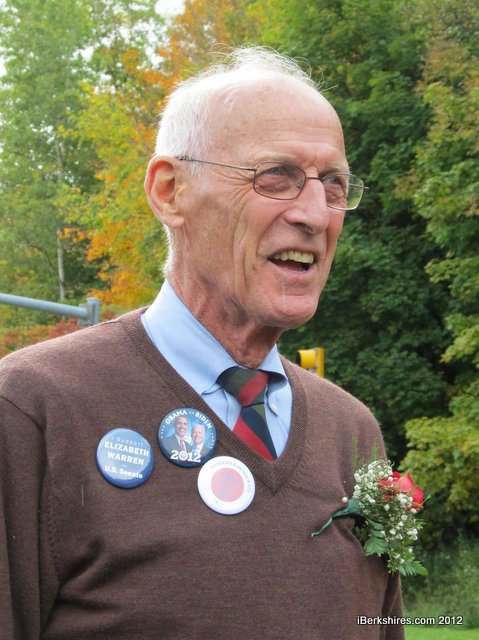
 

Olver at his last Fall Foliage Parade appearance in 2012. 
In his goodbye letter to his constituents in 2012, he wrote: "When I arrived in Washington in 1991, I never expected to be in office for 21 years but there were many important issues to fight for and many things to change. The priorities that I fought for over the years were the ones that you brought to me in meetings in my offices, in letters that you sent and in phone calls that you made. Your thoughts and opinions guided my efforts in Washington.

"I am proud of my work to protect human rights, expand energy efficiency measures and advance renewable energy technology, conserve our natural resources, expand community health centers, defend and promote affordable housing, increase access to rail and advocate for the effective use of transportation dollars."
 
His obituary in the Hampshire Gazette, posted Friday, said he continued to work with local land trusts and advocated for UMass to building its high rise out of wood, making it "the largest academic contemporary wood structure in the country" that was named the John W. Olver Design Building in 2017. UMass at Amherst also presented him an honorary degree for public service in 2014.
 
Born in Beach Lake, Pa., on Sept. 3, 1936, he tended cows on his parents farm and graduated high school at 15 and from Rensselaer (N.Y.) Polytechnic Institute at 18. He would complete his master's degree in chemistry from Tufts and his doctorate from the Massachusetts Institute of Technology by the time he was 24. 
 
His wife of 55 years predeceased him in 2014.
 
He leaves two daughters, Martha Jane Olver, of Amherst and Cary Plumer Frye of Virginia; a son, Douglas Plumer of New York City; a grandson, Marshall Plumer of New York City, and several nieces and nephews.
 
A memorial service will be held at the John W. Olver Design Building at UMass on Sunday afternoon, April 16. See the obituary for more details.
 
Congressman John Olver dedicated his life to serving the people of Western and Central Massachusetts and always stayed true to his values. He was a strong advocate for affordable health care, abortion access, public transportation and rural communities. I will always be grateful for his kindness and his friendship. He will be dearly missed, and my heart goes out to his loved ones.  
— Gov. Maura Healey


Tags: Olver,   
If you would like to contribute information on this article, contact us at info@iberkshires.com.

Why the Massachusetts Art Community Is Worth Continued Investment

By James BirgeGuest Column
How do we quantify the value of art on society and culture? Even eye-popping figures, like the $100 million estimate for the jewels stolen from the Louvre, or the record auction last fall that saw a piece by Gustav Klimt sell for more than $236 million can't fully account for the value of the history, stories, and emotions behind the creations themselves. But beyond that, there is a measurable financial, cultural and social benefit of the arts that is often taken for granted. 

Closer to home, arts and cultural production in the Commonwealth of Massachusetts totals nearly $30 billion annually, representing more than 4 percent of the state's economic output, according to the Mass Cultural Council. All told, more than 130,000 jobs are spread across the commonwealth creating a vibrant and thriving artistic community for us all to enjoy. 

Despite the obvious impact, these figures are under threat. A recent survey by MassCreative compiled recent federal cuts to the National Endowment for the Arts, the National Endowment for the Humanities and the Institute of Museum and Library Services and identified 63 grants canceled and $4.2 million in grant funding rescinded across New England so far this year. 

The dollars, of course, are important. But they also only scratch the surface on what they bring to the community. Today, we risk losing part of the culture and identity many now take for granted. 

While others choose to look past these less tangible, but just as vital benefits, we're doing the opposite. Massachusetts College of Liberal Arts is all in to ensure the next generation retains their access to works of art, while also being empowered to create themselves. 

Last fall, MCLA officially broke ground on the new Campagna Kleefeld Center for Creativity in the Arts, which will serve as a new hub for the campus and the local community for arts programming. When complete in fall of 2027, our students will benefit, but so will all of Berkshire County and artists in the surrounding area. 

This exciting new facility is just one of the many forthcomings our region can enjoy in the coming years. Just a few miles away, anticipation builds for the Fall 2027 anticipated opening for the Williams College Museum of Art. Years in the making, the museum likewise grows from an enduring commitment to the arts, both in curriculum and in practice. Exciting times are also underway for the Clark Art Institute with the construction of a new facility to house a collection of 331 works of art, including paintings, sculptures, drawings and other works. Their wing is scheduled for completion in 2028. And listeners will no doubt enjoy the sounds and melodies from Mass MoCA Records, the latest endeavor to foster creativity and artistic pursuits through music launched in October as well. Of course, many are also awaiting the reopening of the Berkshire Museum anticipated this summer, after a tremendous renovation process to rejuvenate the experience for visitors. 

So much time, energy, and yes, dollars, have already been invested in taking these facilities from ideas and sketches and making them reality. But they represent much more than new buildings. They represent new opportunities to cultivate and accelerate the thriving arts community in Massachusetts and the northern Berkshires. 

Art, regardless of the medium, is a reflection of who we are, where we've been, and what we aspire to be. It can be inspired by hopes or fears and chronicle collective triumphs as well as tribulations. The goal of art is not only to document history, but to inspire those positioned to change it and to feel something new or even to provoke us to revisit our own assumptions or misconceptions. 

As unfathomable of a number as $30 billion can seem, boiling down the impact to any number inherently discounts the unknowable downstream effects our graduates will bring to the community and the broader world after they leave our institutions. Likewise, rescinding $4.2 million now removes a huge chunk of that growth potential.  

Justification for making these investments today when simply boiled down to dollars and cents still places us on solid ground strictly from a financial perspective that forgoes all of the intangible, but no less valuable, benefits as well.  

The arts are still worth our support. And our community will be richer for it. 

James Birge, PhD, is president of Massachusetts College of Liberal Arts in North Adams.  


View Full Story

More North Adams Stories