Countywide Digital Equity Project Studies Pittsfield First
 |
PITTSFIELD, Mass. — A countywide project aims to bridge the "digital divide" between populations.
Pittsfield is the first of 14 local communities to participate in the digital equity planning project through the Massachusetts Broadband Institute and the Berkshire Regional Planning Commission.
The focus is on digital equity, inclusion, and literacy with the hopeful outcome of equal access to technology that is essential for everyday life.
"Digital equity is something we should all take seriously and take a step back and see what we can do to help out our community," Chief Information Officer Kevin Zawistowski said to the City Council on Tuesday.
A grant was awarded from the MBI earlier this year and BRPC was contracted to help identify barriers that limit folks' access.
Members of the city's Department of Diversity, Equity, and Inclusion, IT department, Department of Community Development, and the Berkshire Atheneum meet weekly to examine ways to bridge the digital divide.
"So making sure we are reaching community populations, and I like to call them our primary population, of our community who has historically been at a disadvantage for resources, specifically here access to the internet," Chief Diversity Officer Michael Obasohan explained.
He pointed out that the internet is no longer a luxury and is now a necessity, as people access many everyday services through the web for healthcare, bill payments, and important emergency notifications.
Zawistowski said that a large part of the conversation is broadband but there are many other components.
"We want to know what the barriers are to each community member," he said. "Is it security? Is it trust? Is it speed? Is it affordability? Whatever your barrier is preventing you from having equitable access to technology, let us know."
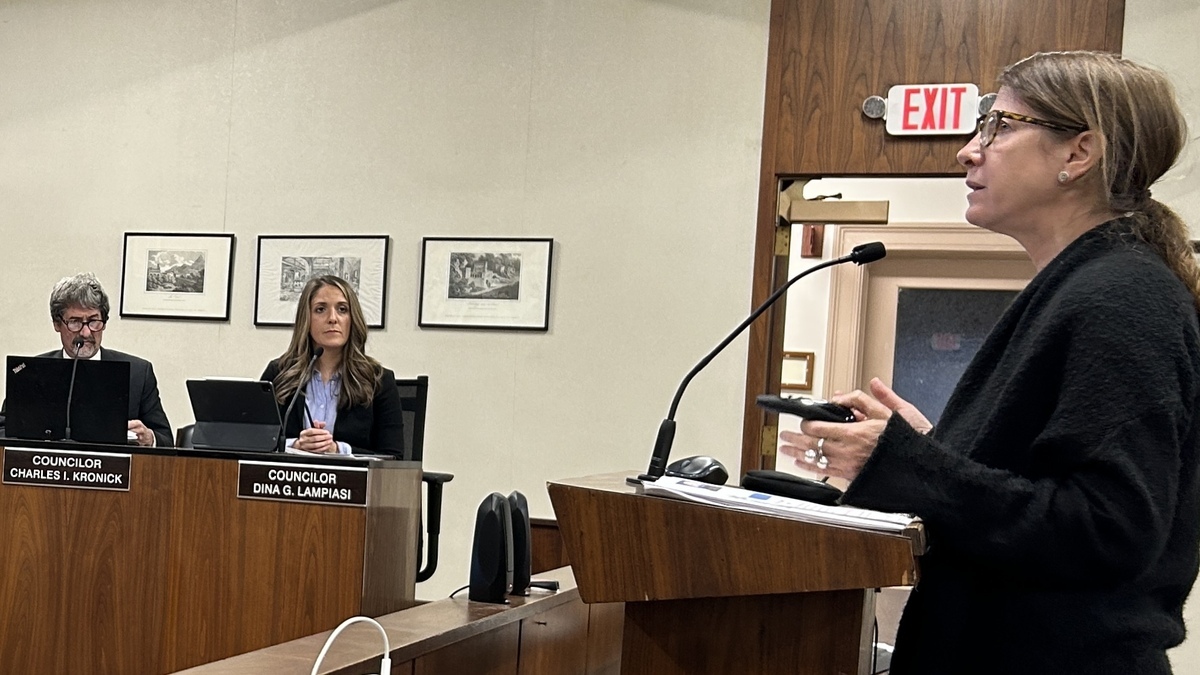
BRPC's Senior Economic Development Planner Wylie Goodman presented data that has been collected through outreach, a statewide survey, and census data.
Data collection focuses on target populations including seniors, people with disabilities, rural residents, low-income residents, people who have been incarcerated, people of color, and English language learners.
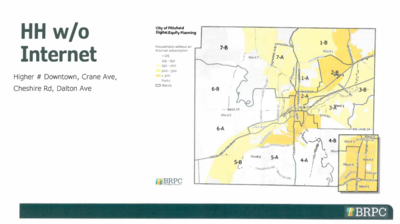
The downtown, Crane Ave., Cheshire Rd., and Dalton Ave. areas reported higher numbers of households without internet, and downtown, Morningside, Westside, Merril Rd. and East St., and Crane Ave., Cheshire Rd., and Dalton Ave. areas reported a higher number of households with no computer.
A study on the relationship between housing authority properties and community anchor institutions, or public buildings, found that most were concentrated in the center of the city. One of the grants that the city is potentially pursuing would provide free internet in all Pittsfield Housing Authority buildings.
The team has done tabling events throughout the city to collect more data.
"I don't have internet. Too much money, it's useless, need to get rid of it," one person wrote on a response card.
Goodman pointed out that not every person in the city is digitally literate and that there are homeless populations who go to the library to access it for resources.
Around 400 people have responded to a statewide survey, the majority of respondents saying that the internet is enough to meet household needs and that the bill is somewhat hard to pay.
"Its' been a great learning experience having our largest city be the first participant in this work," she said.
Ward 5 Councilor Patrick Kavey felt that the survey response could have been larger, as the city has over 19,000 households, and asked what the council could do to get a broader picture of the city.
Berkshire County has about 1,000 responses Boston has about 1,000 responses.
Goodman would be happy with 1,000 responses from Pittsfield and said there is a lot of demographic information to examine from there. Anyone with input is encouraged to contact her.
Zawistowski said that there are still a lot of outreach efforts. One of which is a resource fair on October 20 and October 21 from 1 p.m. to 4 p.m. at the Berkshire Athenaeum.
This will include a variety of resources that provide community members with opportunities to learn more about lowering their internet bill, computer literacy programs for adults and children, technology tools for people with disabilities, how to navigate the internet securely, how and where to buy low-cost computers and how to find remote work.
"I think everything you're doing is incredible," Kavey said. "I think internet is infrastructure. It is."
Tags: Internet,