U.S. Census figures released last week indicate that Williamstown has the largest gap between rich and poor, a gap which grew by 18 percent between 1990 and 2000.
Those figures show Williamstown, with a population of 8,100, with the greatest differences in wealth of town’s with populations greater than 5,000, followed by Boston, second, and Cambridge, third.
Berkshire County itself ranks third in income disparity among the state’s 13 counties, a gap that has grown 7.5 percent during the 1990s.
The gap has been noted anecdotally, mostly by residents at the lower end of the income scale who say they are priced out of the housing market, or cannot afford their property taxes, or cannot refuse high prices offered by developers wanting to turn family farms into condominiums or subdivisions. Others have complained that in their desire to keep views and stave off housing developments, those residents who stress retaining the town’s character are helping to keep housing prices high.
The rising gap locally is but a pale reflection, of course, of the income distribution picture nationally, in which rich people have become prodigiously, stratospherically richer.
And while Berkshire County has long been a magnet for magnates — think Gilded Age — the pricey, gigantic mansions that have risen in Williamstown seem strikingly visible. It may not stretch the imagination too much to liken them to Norman castles, viewed by a restive Saxon population.
In their vast size and prominent location these multi-million-dollar houses change exponentially the simple difference between the town’s high-rent and low-rent districts.
Williamstown also, like much of New England, has a working class whose once reasonably well-paying mill jobs have vanished, removing their financial underpinnings.
Recently, three Williams professors, a former candidate for Selectman, an outreach counselor and a longtime food pantry organizer explored some of the implications of the statistical inequality.
Economics professor Ralph Bradburd said the data requires closer scrutiny, for example, by attaching ages to income levels .
“Suppose, for example, many of the population are elderly. They may have substantial assets but a low income, and those low incomes we might consider in a different manner than we do the young who have low incomes and no assets.
“Another point, and an interesting one, is that people I’ve overheard seem to be talking about unequal income distribution as a bad thing, but it reflects the kind of socioeconomic diversity that many people say is desirable.
“There’s been a lot of discussion about housing values, but I’m curious about the extent to which people who own expensive homes here are counted in the census income data. They may not be if this is not their primary residence.
“Nobody wants the poor to be poor, but if the alternative is to have no poor, our situation is better, and if the alternative is to have nobody with any resources, town services would be limited.
“Perhaps another issue might be to ask if the job situation in Northern Berkshire is such that the incomes of relatively unskilled workers are much lower than we would like to see them, and clearly the answer is yes, we’d like to see better opportunities,†said Bradburd.
Stephen Shappard, whose specialty is urban economics, also a faculty member at Williams College, said “One of the first comments I made was, well, Williamstown and Cambridge don’t do what a lot of suburbs do which is to run low income people out.â€
“Williamstown has expensive housing and housing affordability problems, but there are things some suburbs do to keep poor people out that it could do but doesn’t do.
“In a sense, the housing problem is a separate but related issue. Part of the problem is that it is very difficult to build. Building requires a lot of oversight and consideration and hearings. That works to keep housing expensive
“We could make housing a lot more affordable by allowing more development, but there’s a trade-off between preserving community character and making housing affordable.
“The housing issue is not unrelated, I just see it as tangential,†said Sheppard. The gap in incomes, he said, “makes income inequality somewhat more poignant, in that lower income people feel increased frustration when they see their neighbors living in a nice house.
“I think it’s good for a community to be open,†he said. “There are things that many communities do, to reduce income inequality through exclusion, and it’s good that Williamstown doesn’t do that, even if the cost is measured inequality in the community.â€
“One has to be very careful in distinguishing between the overall picture of inequality in the United States from what’s going on in a tiny town,†he said. “A very common and serious mistake is the desire to correct the distribution of income through town policy, and that’s incredibly misguided. It’s not going to correct inequality by, for example, not charging library fines. It’s just going to deprive the library of resources.â€
“One tremendous problem (with the statistics)†he said, is “How are they counting students? 20 percent of the population in Williamstown is students.â€
David Zimmerman, who also teaches economics at Williams, said “It’s certainly true that the wealthy provide tax dollars to provide services that benefit everyone.â€
“If differences in income create dissension, or cause poor people not to have a basic level of human dignity, that depends on whether people with high incomes are in town very often, interacting with people.
“I guess I think economic equality is less crucial than equal opportunity,†said Zimmerman. “I’m personally more interested in making sure that the race is a fair one, and that people have a fair chance to strive for the unequal prizes that are offered.â€
Eric Yarter of North Street has been a candidate for the board of Selectmen and, in his campaign, stressed his concern for working class issues.
“Working class people are being priced out of town,†said Yarter.
A U.S. Postal Service mail carrier, Yarter said “I make close to $50,000 a year and I feel that I’m one of the poorer people in town. I will never be able to afford a home here.â€
“The town is looking better and better, and it’s more and more expensive,†he said. “Houses on Cole Avenue used to be dilapidated, but you could afford to live there. Now they rent for $800, $900, $1,000.â€
“Look at the real estate ads. People will sell at those prices because that’s what the market will bear,†he said. “I’m a capitalist like everybody else. But when it keeps going, somebody gets stepped on.â€
“The town just isn’t a town anymore,†he said. Yarter pinpoints the tipping point as the closing of the Grand Union small supermarket on State Road. “When I was a kid, there was a shoe store and a grocery on Spring Street, small markets in the neighborhoods. Now there are high end coffee shops and specialty toy stores. Luxuries, not necessities. Lower end working class people can’t afford to buy at the specialty dress shops or outdoor gear shops.â€
The retail progression to upscale that Yarter describes creates a feeling of not belonging among poorer people, he said.
“And Williamstown is becoming a retreat for people that don’t live here,†he said.
Tensions are not likely to lessen, he said. Yarter finds the source of much antagonism is Williams College whose growth, he said, threatens to engulf the town. He finds the dust and inconvenience of construction across from his North Street home emblematic of the effects of college growth on townspeople. And, he said, college students and their parents can behave with arrogance toward town residents.
“I would rather live in a middle class community than in a place where people look down their noses at you,†he said.
Deborah Cole-Duffy, a clinical social worker with extensive experience in the mental health field, has been an outreach counselor at Mount Greylock Regional High School for the past year. In her counseling of students there, she said, that reflections of their income levels are “woven into other kinds of issues.â€
“It’s more subtle,†said Cole-Duffy.
“There’s a notion that Williamstown is quite wealthy,†she said, “But obviously not everyone from Williamstown is of great means.â€
“It isn’t ‘I want,’ or ‘I wish I had,’†she said. “It’s more not feeling like they belong or are accepted by their peers, subtle forms of subtle interactions.â€
“I do think that kids really want very much to feel accepted by their peers and their teachers, and they may, internally, believe they are not. In these more culturally elite towns such as Williamstown, Stockbridge, or Lenox, we tend to expect a greater number of people with more means. What happens for those folks with lesser means? Does that notion of culturally elite affect them? Yes, but in subtle ways.â€
Carol DeMayo, who has long been active in the Williamstown Food Pantry at St. Patrick’s Church, said the neediness she finds most striking is among people who live in nice houses but have lost their jobs and, most drastically, their health and health insurance.
“Now we have Ecu-Care that can step in (with health insurance) — if they aren’t too proud to ask, and if they’re aware,†said DeMayo. “People who have lived the upscale life don’t know how to get in touch with services.â€
“A lot of the elderly either don’t know how to get services or won’t get them. Many feel they should just struggle, and it never dawns on them that they could get help, so they’ll do without,†she said. “Some retirement and pension funds have not kept up with the times.â€
DeMayo also sees people whose great-grandparents farmed, whose parents and grandparents worked in the mills, and who now work as housecleaners and handymen to make ends meet.
“Boy, are they having a hard time,†she said.
DeMayo said the schools do “a marvelous job†seeing that children get services. And, she added that St. Patrick’s food pantry has a back to school package for Williamstown youngsters to ease the financial impact on parents.
“In such a community, kids do suffer, if they’re wearing the wrong brand of jeans or sneakers,†she said. For information on the back-to-school package, call DeMayo at 458-3149.
If you would like to contribute information on this article, contact us at info@iberkshires.com.
Your Comments
iBerkshires.com welcomes critical, respectful dialogue. Name-calling, personal attacks, libel, slander or foul language is not allowed. All comments are reviewed before posting and will be deleted or edited as necessary.
No Comments
RFP Ready for North County High School Study
By Tammy Daniels iBerkshires Staff
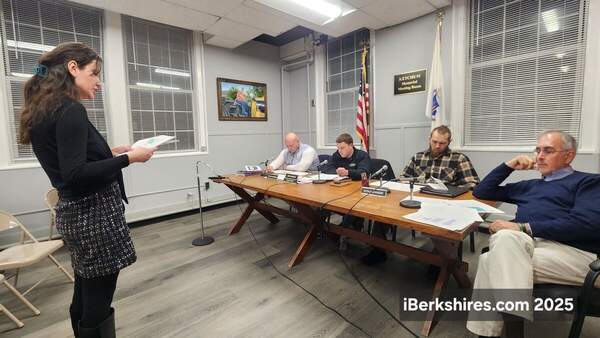
NORTH ADAMS, Mass. — The working group for the Northern Berkshire Educational Collaborative last week approved a request for proposals to study secondary education regional models.
The members on Tuesday fine-tuned the RFP and set a date of Tuesday, Jan. 20, at 4 p.m. to submit bids. The bids must be paper documents and will be accepted at the Northern Berkshire School Union offices on Union Street.
Some members had penned in the first week of January but Timothy Callahan, superintendent for the North Adams schools, thought that wasn't enough time, especially over the holidays.
"I think that's too short of a window if you really want bids," he said. "This is a pretty substantial topic."
That topic is to look at the high school education models in North County and make recommendations to a collaboration between Hoosac Valley Regional and Mount Greylock Regional School Districts, the North Adams Public Schools and the town school districts making up the Northern Berkshire School Union.
The study is being driven by rising costs and dropping enrollment among the three high schools. NBSU's elementary schools go up to Grade 6 or 8 and tuition their students into the local high schools.
The feasibility study of a possible consolidation or collaboration in Grades 7 through 12 is being funded through a $100,000 earmark from the Fair Share Act and is expected to look at academics, faculty, transportation, legal and governance issues, and finances, among other areas.
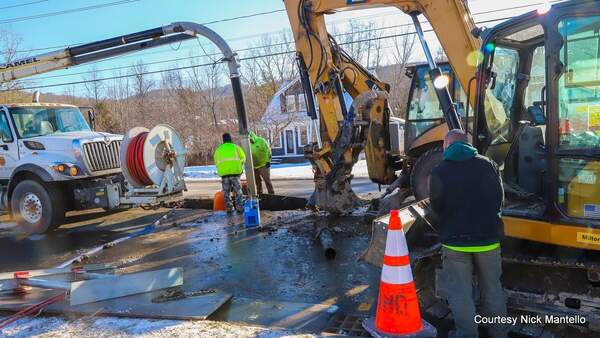
The city has lifted a boil water order — with several exceptions — that was issued late Monday morning following several water line breaks over the weekend. click for more
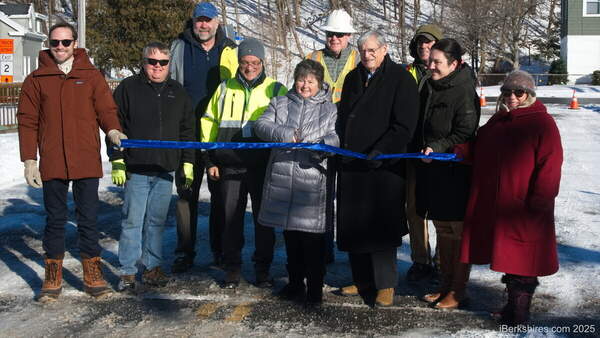
The bridge had been closed to all vehicle traffic since March 2023 after being deemed structurally deficient by the state Department of Transportation. click for more
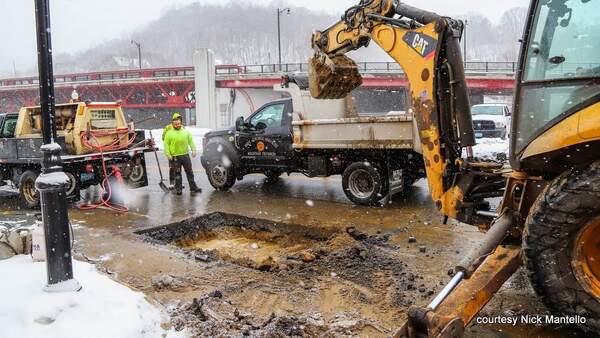
The Water Department has been responding to multiple water line breaks throughout the city since Friday, causing temporary loss of water in some areas. click for more
Nearly a year of study and community input about the deteriorating Veterans Memorial Bridge has resulted in one recommendation: Take it down. click for more