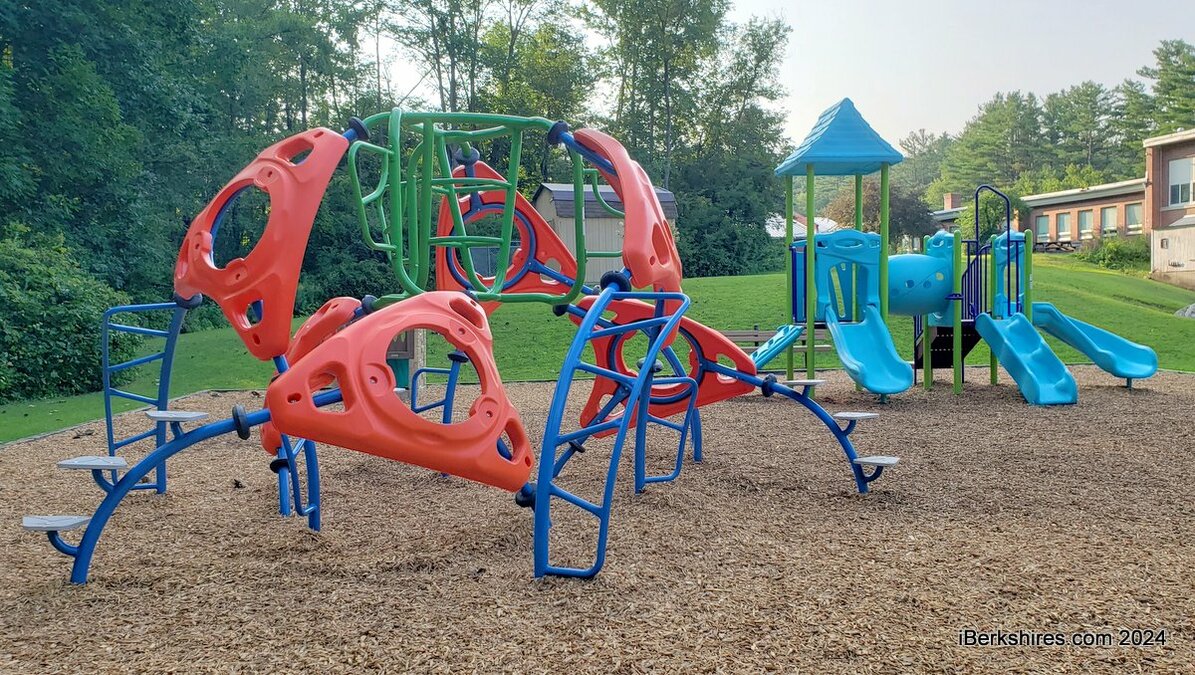
image description
The equipment was installed earlier this summer.

Clarksburg School Gets New Playground Equipment, Awaits Stairlift

By Tammy DanielsiBerkshires Staff
Print Story | Email Story

The school has an existing playground for the older children. 
CLARKSBURG, Mass. — Brand-new playground equipment will welcome children returning to Clarksburg School this fall. 
 
The school received a $64,000 Feigenbaum Foundation grant a couple years ago, but because of supply and shipping delays from the pandemic, the equipment was not delivered until this past winter. Cascades had stored the playground until it could be installed.  
 
"The two main pieces that are actually concreted into the ground were $37,000 just to purchase and $16,000 to install," Jordan Rennell told the School Committee on Thursday. "Then there's a couple thousand worth of woodchips and a couple of thousand to take the old playground down that was there."
 
Rennell, a speech pathologist and director of summer programming for the Northern Berkshire School Union, said the 30-year-old wooden structure had to be discarded because it was decaying from dry rot, splintering the children's hands and the plastic pieces were all cracked. 
 
"We cut it up and threw it away," she said. School Committee member Mary Giron commented that the old playground was "an accident waiting to happen."
 
The Parent-Teacher Group had helped with the extra funds to have the new equipment installed and Whitney's Garden Center had offered a "good price" on the wood chips. 
 
Rennell thought the funds would be enough for one large fixture but the prices were quite high. 
 
"The one 29 years ago ... the school purchased that playground for $29,000 and today to repurchase it, it's $165,000," she said. "The little playground is for our preschool-age students, so 3 to 6; the climber is for 5 to 12 and then the big playground is from 5 to 12. So we tried to pick something that was for the littles and the bigs."
 
The school could have relied on volunteers to install the structures but Rennell said the company contracted was licensed and insured to do the work. 
 
Another project in the school is expected to finally be done this week. A chair lift in the back stairwell to connect the upper classrooms to the cafeteria/gymnasium has been in the works for more than a year. A number of delays pushed the installation into the summer, where it ran into the summer camp program. 
 
Superintendent John Franzoni said the company didn't want to go through the state's Criminal Offender Record Information (CORI) check for the few days of work while students were on the school grounds. 
 
Tom Bona, who has volunteered as the liaison with the company, said everything is ready to go with the exception of a handrail that has to be taken off to accommodate the equipment. He would be contacting the company to confirm the Aug. 7 date before that is done. Franzoni thought it a good idea since "we've had several dates that have not been met."
 
School officials are hoping to have the lift in time for the start of school. Currently, anyone with mobility issues has to be taken outside and around the back of the building to get to the cafeteria. The lift is being funded through the American Rescue Plan Act. 
 
In other business, the School Committee declined to open up any school choice slots this year because of lack of space. Franzoni noted that kindergarten is already at 16 children. 
 
"We've talked about the trend going up," he said, of families moving into Clarksburg. "While school choice is nice ... you get a lot more money when they're living in town."
 
Principal Sandy Cote said the school has been getting a lot of calls about school-choice slots. 
 
• The committee generally discussed finances, including closing out of the year and amending the warrant system to get bills paid faster. 
 
Rennell reported on the Step Up Summer Program noting that in four years its gone from 40 participating to 148. However, the funding has "dwindled down drastically."
 
"We're not ending the red but we're ending low," she said. 
 
• Franzoni said he attended a superintendents roundtable with Education Secretary Patrick Tutwiler, who was in Pittsfield last week for an early education listening session. There was a lengthy discussion about the school choice directive — which postulates elementary districts that accept school choice students are responsible for their high school education — and how it is a disincentive for sharing. There is also talk of a regional study of Northern Berkshire and future grant funding. 
 
He also said the school is doing better on reducing chronic absenteeism by impressing the importance of school on parents and children and offering incentives such as recognitions to children who have good attendance. 

Tags: Clarksburg School,   playgrounds,   
If you would like to contribute information on this article, contact us at info@iberkshires.com.

Why the Massachusetts Art Community Is Worth Continued Investment

By James BirgeGuest Column
How do we quantify the value of art on society and culture? Even eye-popping figures, like the $100 million estimate for the jewels stolen from the Louvre, or the record auction last fall that saw a piece by Gustav Klimt sell for more than $236 million can't fully account for the value of the history, stories, and emotions behind the creations themselves. But beyond that, there is a measurable financial, cultural and social benefit of the arts that is often taken for granted. 

Closer to home, arts and cultural production in the Commonwealth of Massachusetts totals nearly $30 billion annually, representing more than 4 percent of the state's economic output, according to the Mass Cultural Council. All told, more than 130,000 jobs are spread across the commonwealth creating a vibrant and thriving artistic community for us all to enjoy. 

Despite the obvious impact, these figures are under threat. A recent survey by MassCreative compiled recent federal cuts to the National Endowment for the Arts, the National Endowment for the Humanities and the Institute of Museum and Library Services and identified 63 grants canceled and $4.2 million in grant funding rescinded across New England so far this year. 

The dollars, of course, are important. But they also only scratch the surface on what they bring to the community. Today, we risk losing part of the culture and identity many now take for granted. 

While others choose to look past these less tangible, but just as vital benefits, we're doing the opposite. Massachusetts College of Liberal Arts is all in to ensure the next generation retains their access to works of art, while also being empowered to create themselves. 

Last fall, MCLA officially broke ground on the new Campagna Kleefeld Center for Creativity in the Arts, which will serve as a new hub for the campus and the local community for arts programming. When complete in fall of 2027, our students will benefit, but so will all of Berkshire County and artists in the surrounding area. 

This exciting new facility is just one of the many forthcomings our region can enjoy in the coming years. Just a few miles away, anticipation builds for the Fall 2027 anticipated opening for the Williams College Museum of Art. Years in the making, the museum likewise grows from an enduring commitment to the arts, both in curriculum and in practice. Exciting times are also underway for the Clark Art Institute with the construction of a new facility to house a collection of 331 works of art, including paintings, sculptures, drawings and other works. Their wing is scheduled for completion in 2028. And listeners will no doubt enjoy the sounds and melodies from Mass MoCA Records, the latest endeavor to foster creativity and artistic pursuits through music launched in October as well. Of course, many are also awaiting the reopening of the Berkshire Museum anticipated this summer, after a tremendous renovation process to rejuvenate the experience for visitors. 

So much time, energy, and yes, dollars, have already been invested in taking these facilities from ideas and sketches and making them reality. But they represent much more than new buildings. They represent new opportunities to cultivate and accelerate the thriving arts community in Massachusetts and the northern Berkshires. 

Art, regardless of the medium, is a reflection of who we are, where we've been, and what we aspire to be. It can be inspired by hopes or fears and chronicle collective triumphs as well as tribulations. The goal of art is not only to document history, but to inspire those positioned to change it and to feel something new or even to provoke us to revisit our own assumptions or misconceptions. 

As unfathomable of a number as $30 billion can seem, boiling down the impact to any number inherently discounts the unknowable downstream effects our graduates will bring to the community and the broader world after they leave our institutions. Likewise, rescinding $4.2 million now removes a huge chunk of that growth potential.  

Justification for making these investments today when simply boiled down to dollars and cents still places us on solid ground strictly from a financial perspective that forgoes all of the intangible, but no less valuable, benefits as well.  

The arts are still worth our support. And our community will be richer for it. 

James Birge, PhD, is president of Massachusetts College of Liberal Arts in North Adams.  


View Full Story

More North Adams Stories