Second Round: Dalton Town Meeting Passes Recall, Capital Plan Bylaws
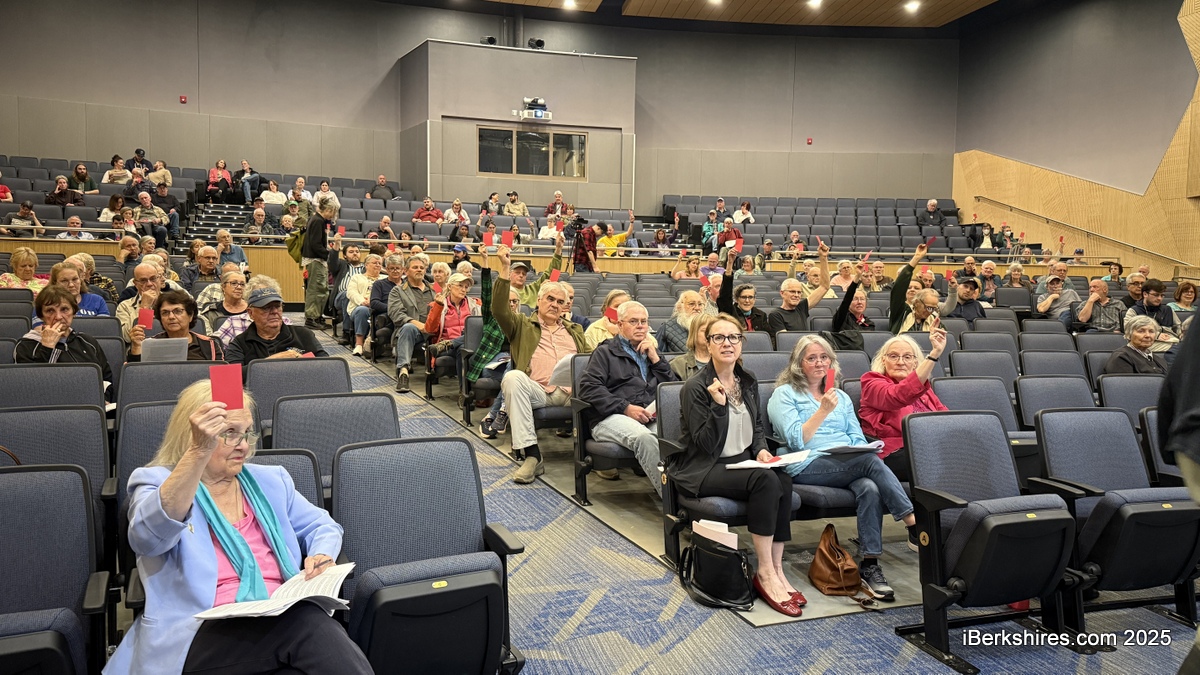
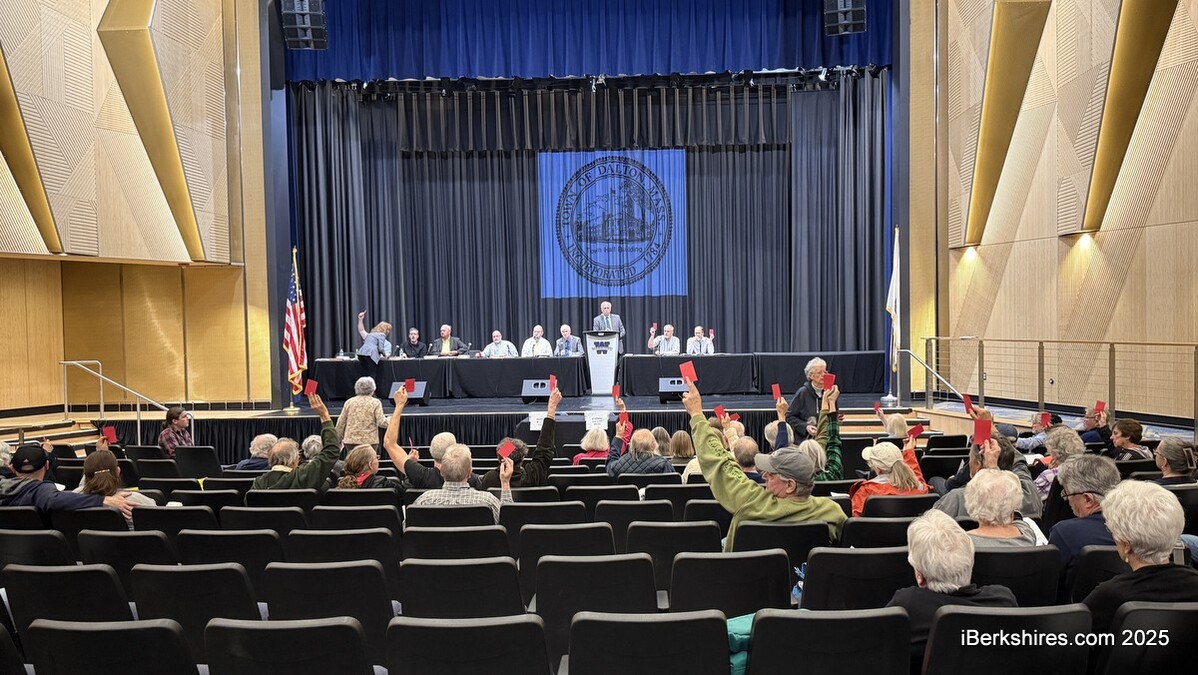
It still took nearly 200 voters 2 1/2 hours to get through a dozen articles on Wednesday.
Some 170 registered voters got through the remaining 19 of 31 articles on the warrant during a meeting that lasted a little more than 2 1/2 hours. Two of the remaining 12 articles were tabled, and one failed.
Voters approved an amended version of the recall petition, Article 29, which creates a process for recalling elected officials before the end of their term.
The citizens' petition originally proposed starting the process with an affidavit of intent signed by at least 50 registered voters to initiate a recall election. Voters amended this to 200 signatures.
The remaining process was unchanged. Once the affidavit is given to the town clerk, voters will be given a blank petition that needs to be returned within 20 working days with signatures from no less than 50 percent of the voters who participated in the last annual town election.
If there are enough certified signatures, the town clerk will submit the petition to the select board, who will notify and order the election within 60 to 90 days.
A majority vote is required to recall an officer, but the recall is only effective if the total votes for and against exceed 80 percent of the votes cast in the most recent annual town election.
The reason for recall must align with the following reasons: lack of fitness, conviction, neglect of duties, and misfeasance.
Voter Henry Rose emphasized that the recall petition is not personal and is like the impeachment process on the federal level.
"We hope we don't have to use it. We are unlikely to use it, but we should have it," he said.
Rose said the recall process outlined is well thought out and more accessible than the existing state-level recall provision.
"With all due respect, Mr. Rose, I do believe this is politically motivated. The reason is I compared the signatures [from] when we did a disciplinary hearing and the people who signed this petition, there are an awful lot of the same signatures [from the people] at that discipline hearing," Select Board Chair Robert Bishop said.
"At that disciplinary hearing, people threatened us, called us names, told us they would vote us out of office, called us assholes. We had to be walked through a side door with the police for doing our jobs."
Select Board member Robert Collins apologized for the language and said he was the only board member to support the recall bylaw
Voter Tony Pagliarulo advocated for creating a town charter as a potential alternative to a recall election bylaw since it could address multiple governance issues.
Rose argued that the process Pagliarulo outlined for creating a charter "sounds like an awful lot of work that we're not going to be able to do."
This is a way residents have more control over the accountability of their elected officials, said voter Rachel Branch, and Peter Hodges said, it "seems like a basic tool. It's not easy to implement. It doesn't seem like you can use it frivolously."
After some debate and explanation from Police Chief Deanna Strout, voters approved by secret ballot 95-69, utilizing $90,000 of free cash for the purchase of a police cruiser.
Strout explained that the department has 13 officers total and nine cruisers: three patrol cruisers, one cruiser for the K9 unit, one spare unit in case one is in the shop, one training or court travel car that is not equipped for patrol, two detail cars that are used for road details, and an administration cruiser.
The two detail cars have more than 100,000 miles, and will be traded in with the purchase of this new cruiser. One has 123,896 miles and another has 107,911 miles.
"When we order a cruiser, we order it in July. It takes 10 months to get it in, so it'll be another year before we see a cruiser. And we've gotten a cruiser every year since 2013, as far as the records that we could get, except for one year when we didn't get a cruiser, we got portable radios instead," Strout said.
The cruisers go through a systematic rotation: active patrol for about four years, then move to spare, then training, and finally to detail, she explained. "We also have less people driving them, so we can save on the mileage, and we take very, very good care of them, so we can drive them longer."
The purchase includes the cost of the lights, sirens, computer, and radio equipment.
Some voters expressed skepticism of the need for a new cruiser and were concerned about the cost. Those in favor emphasized the need and applauded the work Strout has done to defend the police budget.
Daniel Filiault, the former police chief who retired 2004, vouched for the chief's integrity, stating she wouldn't request the cruiser without a genuine need, especially considering the price is small compared to other items.
Voters approved utilizing $250,000 of free cash for the purchase of a truck and trailer with sewer flushing equipment for the Department of Public Works.
The department needs to replace its sewer truck, which is a 1992 International that was an Army surplus. "We use it to tow the trailer, which is a 2007, which has, I think, a little over 3,000 hours on it," said Edward "Bud" Hall, DPW superintendent.
Hall explained during the meeting that he obtained quotes for a truck and trailer, which were closer to $275,000, not $250,000.
The Finance Committee did not get input from Hall when it amended the article to $250,000, Hall said.
Bishop proposed an amendment to request $540,000 for a vacuum truck, equipped with both sewer flushing equipment and catch basin cleaning equipment.
A vac truck would replace the department's two trucks and trailer and would be more versatile, Hall said.
The town currently rents a vac truck to clear the more than 500 catch basins in town. Renting is cheaper, Collins argued. The main concern surrounding this apparatus is the maintenance cost.
The amendment failed, but voters approved the $250,000 for a sewer truck and trailer.
Voters approved the establishment of a Capital Planning Committee, which would prepare a Capital Improvement Plan financing plan with a five-year forecast of revenues and expenses.
Bishop highlighted how the board voted 4-1 not to recommend accepting this article because it does not include having a Select Board member on the committee.
"The other thing that really bothers me about this has been, given the new town manager, I think this would be courteous enough to let him or her decide if they need this committee. It also says the town manager chooses this committee, and the very people that signed this just busted the Select Board for not being open about the town manager search committee, so now they're saying it's OK for one person to do it, and we did it with multiple people on the Select Board," he said.
Finance Committee member Thomas Irwin said this capital planning committee is based on the town of Lee's committee.
Several voters expressed how they did not see an issue with the establishment of the committee and felt it would be beneficial.
"I think that having this capital planning committee would only benefit the town, considering the financial dire straits that we're in right now, and that's landed us into the situation where we're having to ask a zillion questions about every tiny little spending cut that we need to make," voter April Van Deusen said.
She said if voters had been aware of significant upcoming expenses, such as Town Hall repairs and police station costs, it could have influenced decisions regarding the construction of Wahconah Regional High School.
Town Manager Thomas Hutcheson said one of his goals when he first started was the creation of a comprehensive capital plan.
"In four years, I've not been able to do that. I've done many, many things, but the creation of a capital plan is a substantial undertaking. And if you look back at town reports, and this one, and the one that will be coming out next year, you'll see that I've been involved in a variety of projects … that I have simply not been able to get to it," Hutcheson said.
"It was one of my first goals when I got here, so I'm not going to advocate one way or the other. I would just note that I personally was not able to find sufficient time to devote to making a detailed capital plan for the town."
Two of the remaining 12 articles were tabled and one failed.
Voters tabled Article 27, to amend the noise bylaw, and Article 24, to authorize the borrowing of $880,000 for the capital expense of Town Hall improvements.
Voters failed Article 30, to rescind the Stretch Energy Code bylaw in its entirety.
Voter Greg Schnapp expressed that although he supports proactive climate change preparedness and energy conservation building codes, but argued that the code induces obstacles that may limit its effectiveness and accessibility.
Schnapp raised concerns about whether grant funding sufficiently offsets compliance costs relative to the benefits of building affordable homes and emphasized how electrification may not meet the diverse needs of residents, particularly in regions with harsh winters and unreliable energy infrastructure, as Massachusetts relies on electricity from neighboring states.
Several other voters highlighted how 90 percent of Massachusetts communities have already adopted the stretch code, and terminating it would be a step backwards, and it cause Dalton to lose access to $200,000 to $600,000 in annual Green Community grants.
The state's base building code will be equivalent to the current stretch code in two to three years, another voter said.
All other articles passed with no discussion or following clarification.
Tags: annual town meeting, town meeting 2025,