image description
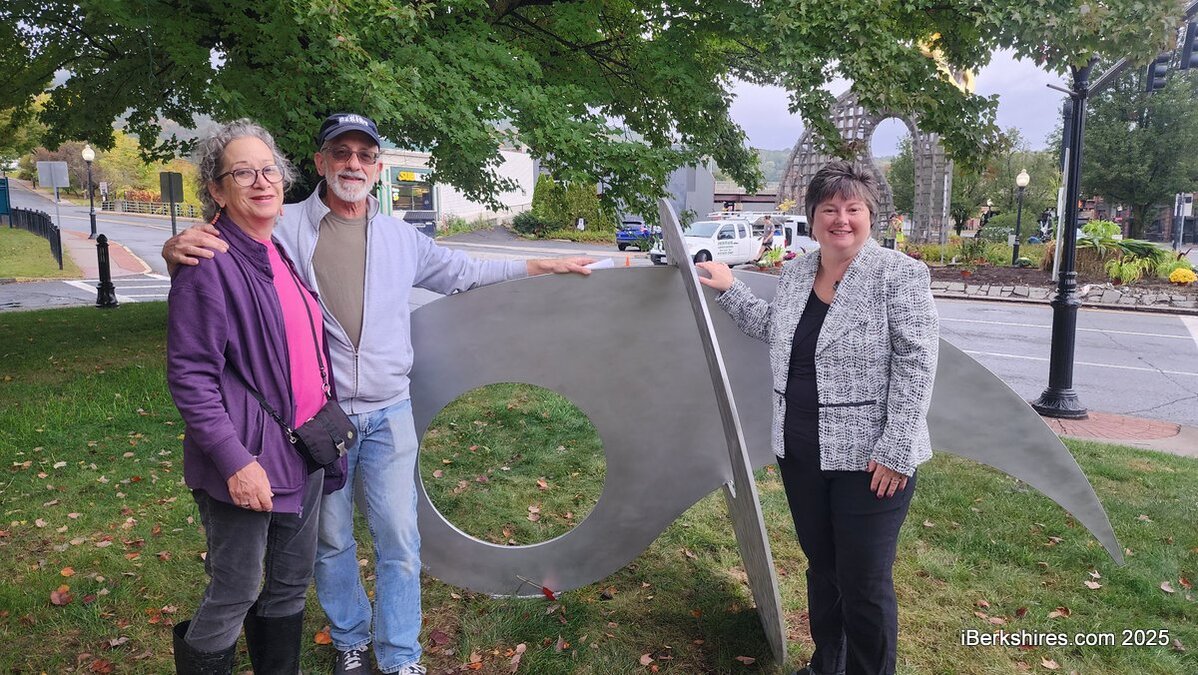
Peter May and his wife, Barbara, pose with Mayor Jennifer Macksey with the formal presentation of his sculpture at City Hall.
image description
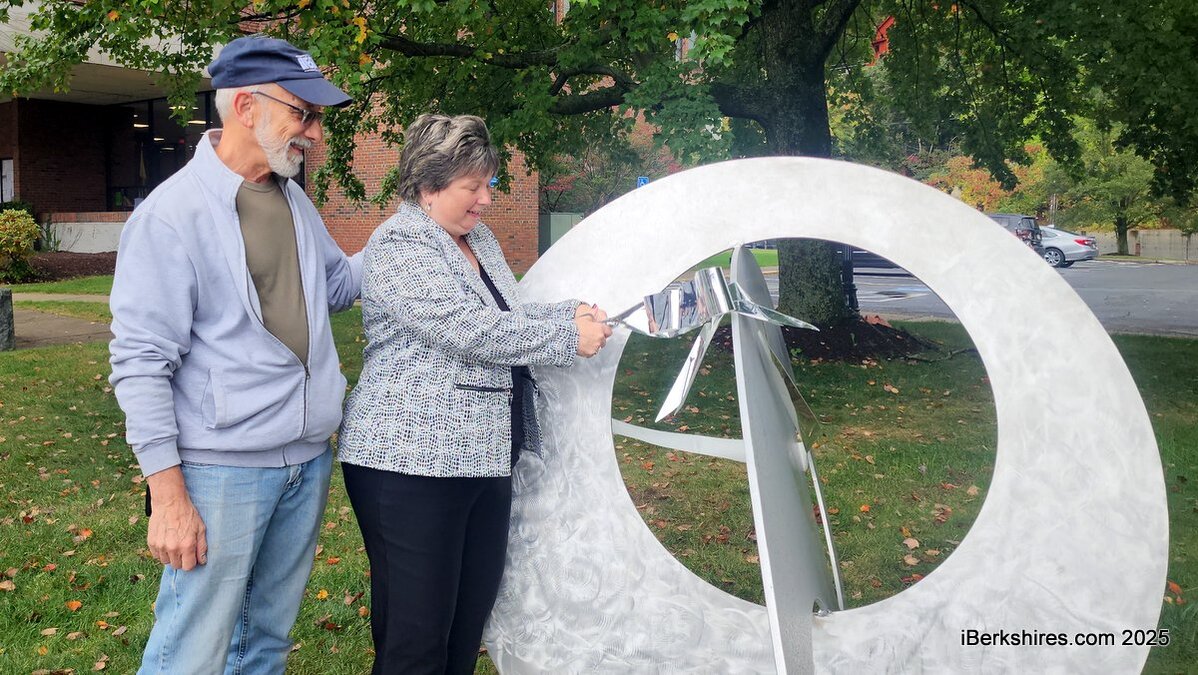
The mayor cuts a silver ribbon to unveil the piece.

North Adams City Hall Hosts 'Daydream' Sculpture

By Tammy DanielsiBerkshires Staff
Print Story | Email Story

The work had initially been envisioned for the Eagle Street pocket park but found a more prominent home at City Hall. 
NORTH ADAMS, Mass. — Peter May had envisioned placing an artwork of his own creation in the Eagle Street pocket park where his building had once stood. 
 
Instead, "Daydream" has a more prominent place of honor on the front lawn at City Hall. 
 
"It's amazing, an incredible honor to have my piece as a permanent installation here at the corner at City Hall," May said Friday morning as his aluminum sculpture was officially recognized with a ribbon cutting. 
 
May had first approached the Public Arts Commission with his concept in 2023, receiving enthusiastic approval to place it in the Eagle Street park or elsewhere on public property. The park, however, is still out sorts after the emergency demolition of the adjacent building which required its gardens and pavers to be moved. It's currently hosting the temporary "Hatchlings" artworks. 
 
"Daydream" needed robust footings to hold its weight steady and these were poured by the city crew. And Mayor Jennifer Macksey was more than happy to have the piece at City Hall.
 
"I always thought it was amazing, and we talked about it for years," she said. "I think it's just an honor and a great tribute to someone who moved here, invested his time, energy and family in our community, and I'm so forever grateful."
 
May and his wife, Barbara, had moved their family to North Adams after he graduated from chiropractic college in Chicago in 1987. He'd read about the nascent plans for Massachusetts Museum of Contemporary Art. 
 
"I thought it'd be interesting moving someplace that was going to use art as its centerpiece for revival," he said. "I thought that I could participate in and contribute to that revival and meet a lot of interesting people along the way." 
 
Coming around the Hairpin Turn to see the foliage on a September day "sealed the deal," he said. 
 
Being around artists and art and "seeing their wonderful creations lit a spark in me that inspired the making of this piece," May said. 
 
The artist whom he'd wanted to produce his concept didn't have the time, so he took metal fabrication courses with Mike Augspurger and Leni Fried at Old Stone Mill in Adams. When considering how to cut the half-inch thick sheets of aluminum, he asked Ed Therrien at Morrison Berkshire, whose crew not only took on the cutting but delivered the pieces to May for the sanding finishes, then picked them up to weld and deliver to City Hall.
 
The piece is in two parts — a curved teardrop shape intersects a offset circle with the tear's tip hovering just above the ground. 
 
"I showed them the angles I wanted. They had to calculate, because there are footings under here," he said. "It was amazing to watch them make it to my specs, where it has this angle, but the front stays off the ground about 6 inches. ...
 
"I can't sing their praises high enough. They are a tremendous asset and resource for our community."
 
The result is about an 8-foot by 5-foot metal sculpture with a finish on the circle that creates a holographic effect when the light hits it. As for what "Daydream" means, May says it's up to the observer. 
 
"What it means to me is the story I just told you of how it came into creation," he said. "People will look at art and see what they see ... the way that I started appreciating art after my college years was that it doesn't have to mean anything if it gets you to think.
 
"If you like it or don't like it, that doesn't even matter if it stirs you away from your everyday reality and make you look at something different and think something different and create a different thought process, an emotional level, or whatever. That's what art is."

Tags: art installation,   sculpture,   
If you would like to contribute information on this article, contact us at info@iberkshires.com.

Why the Massachusetts Art Community Is Worth Continued Investment

By James BirgeGuest Column
How do we quantify the value of art on society and culture? Even eye-popping figures, like the $100 million estimate for the jewels stolen from the Louvre, or the record auction last fall that saw a piece by Gustav Klimt sell for more than $236 million can't fully account for the value of the history, stories, and emotions behind the creations themselves. But beyond that, there is a measurable financial, cultural and social benefit of the arts that is often taken for granted. 

Closer to home, arts and cultural production in the Commonwealth of Massachusetts totals nearly $30 billion annually, representing more than 4 percent of the state's economic output, according to the Mass Cultural Council. All told, more than 130,000 jobs are spread across the commonwealth creating a vibrant and thriving artistic community for us all to enjoy. 

Despite the obvious impact, these figures are under threat. A recent survey by MassCreative compiled recent federal cuts to the National Endowment for the Arts, the National Endowment for the Humanities and the Institute of Museum and Library Services and identified 63 grants canceled and $4.2 million in grant funding rescinded across New England so far this year. 

The dollars, of course, are important. But they also only scratch the surface on what they bring to the community. Today, we risk losing part of the culture and identity many now take for granted. 

While others choose to look past these less tangible, but just as vital benefits, we're doing the opposite. Massachusetts College of Liberal Arts is all in to ensure the next generation retains their access to works of art, while also being empowered to create themselves. 

Last fall, MCLA officially broke ground on the new Campagna Kleefeld Center for Creativity in the Arts, which will serve as a new hub for the campus and the local community for arts programming. When complete in fall of 2027, our students will benefit, but so will all of Berkshire County and artists in the surrounding area. 

This exciting new facility is just one of the many forthcomings our region can enjoy in the coming years. Just a few miles away, anticipation builds for the Fall 2027 anticipated opening for the Williams College Museum of Art. Years in the making, the museum likewise grows from an enduring commitment to the arts, both in curriculum and in practice. Exciting times are also underway for the Clark Art Institute with the construction of a new facility to house a collection of 331 works of art, including paintings, sculptures, drawings and other works. Their wing is scheduled for completion in 2028. And listeners will no doubt enjoy the sounds and melodies from Mass MoCA Records, the latest endeavor to foster creativity and artistic pursuits through music launched in October as well. Of course, many are also awaiting the reopening of the Berkshire Museum anticipated this summer, after a tremendous renovation process to rejuvenate the experience for visitors. 

So much time, energy, and yes, dollars, have already been invested in taking these facilities from ideas and sketches and making them reality. But they represent much more than new buildings. They represent new opportunities to cultivate and accelerate the thriving arts community in Massachusetts and the northern Berkshires. 

Art, regardless of the medium, is a reflection of who we are, where we've been, and what we aspire to be. It can be inspired by hopes or fears and chronicle collective triumphs as well as tribulations. The goal of art is not only to document history, but to inspire those positioned to change it and to feel something new or even to provoke us to revisit our own assumptions or misconceptions. 

As unfathomable of a number as $30 billion can seem, boiling down the impact to any number inherently discounts the unknowable downstream effects our graduates will bring to the community and the broader world after they leave our institutions. Likewise, rescinding $4.2 million now removes a huge chunk of that growth potential.  

Justification for making these investments today when simply boiled down to dollars and cents still places us on solid ground strictly from a financial perspective that forgoes all of the intangible, but no less valuable, benefits as well.  

The arts are still worth our support. And our community will be richer for it. 

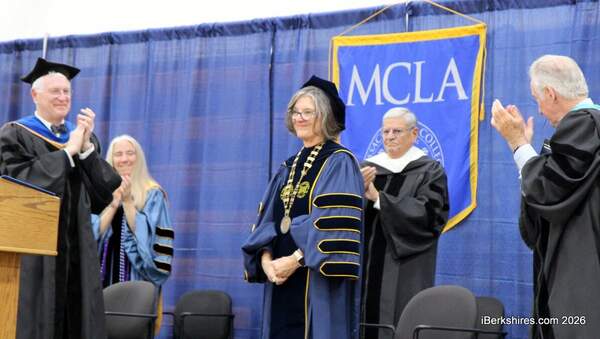
James Birge, PhD, is president of Massachusetts College of Liberal Arts in North Adams.  


View Full Story

More North Adams Stories