Williamstown Planning Board Planning Busy Night for May's Town Meeting
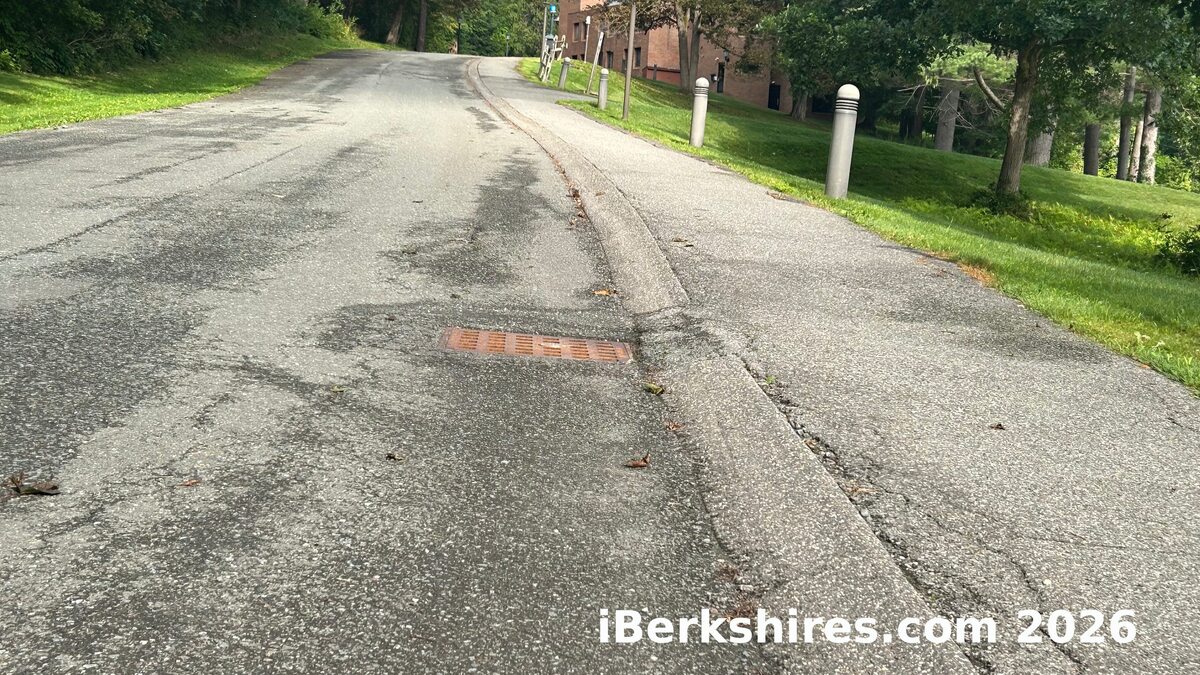
An example of a Cape Cod berm, right, on a Williams College road that was shown to the Planning Board on Tuesday night. New regulations under consideration by the board would allow such berms to be used instead of traditional curbs in new subdivisions.
The Planning Board last Tuesday discussed a raft of zoning bylaw amendments that it plans to bring to residents in May.
Many of the changes are related to the board's efforts to rewrite the town's subdivision control bylaw.
Since last year, the planners have been wrestling with how to modernize the massive Chapter 170 of the town code and make it easier to understand and apply for both developers and future boards. The town used a state grant to bring in planning help from Northampton's Dodson and Flinker Landscape Architecture and Planning and the board is in the home stretch of hammering out the final details for the revision.
And while the board has sole jurisdiction to change the subdivision bylaw — after a public hearing tentatively set for November — the subdivision bylaw dovetails with Chapter 70, the zoning bylaw, which is the purview of town meeting. In addition, changes also are under consideration for Chapter 113, Road Construction Standards, which are set by the Select Board in its capacity as the town's road commission.
"We don't want to have subdivision regulations that don't fully align with our zoning out there for very long," cautioned Town Planner Andrew Groff, who advises the five elected members of the Planning Board.
That means that the changes in Chapter 113 and Chapter 70 — requiring town meeting action — should be made as soon as possible after the subdivision control bylaw changes.
Some of the changes needed for the zoning bylaw could be characterized as routine, like adding definitions or changing terminology. Others are more substantive, like changing how Chapter 70 addresses stormwater management to bring it in line with the low-impact development (LID) and nonstructural best management practices "strongly encouraged" in the proposed new Chapter 170.
"For the rural district, it would require open drainage [for new subdivisions], and for the town center, it would allow closed drainage but encourage opportunities for hybrid systems," Erik Reardon said during Tuesday's meeting.
Groff summarized the principle of low-impact development, a practice espoused by the commonwealth's Executive Office of Energy and Environmental Affairs.
"It's also about [stormwater] treatment," Groff said. "It's about trying to funnel stormwater, not necessarily through hard channels like structures and pipes, but utilizing swales and rain gardens and things that attenuate that [water] before it hits the hard infrastructure. It's a more holistic system."
Groff noted that LID techniques were utilized on the town's most recently approved subdivision, a four-home development by Northern Berkshire Habitat for Humanity off Summer Street. In that case, the non-profit needed Planning Board approval to deviate from the existing town standards; amending the bylaw would make it easier for developers to use LID.
"Habitat is a great small-scale example," Groff said. "They used the wetland that was already there — the small, isolated wetland — to attenuate some of the flows off the roadway. And they knew that it had an overflow, so they built a structure below it to deal with the overflow. But they utilized the natural system in the design."
Stormwater management was one of five areas in the draft subdivision control bylaw that Dodson and Flinker asked the Planning Board to address in a memo to the board.
Although the state grant funding the consultant has expired, Groff explained that the town's last expenditure from the grant was to "pre buy" some hours that Dodson and Flinker will use to make final tweaks based on the board's feedback in preparation to finalize the revised Chapter 170 this fall.
The comprehensive subdivision control bylaw also includes details on the town's requirements for road construction, much of which Groff said he will bring to the Department of Public Works director for his final input before proceeding.
On Tuesday, diagrams outlining the proposed regulations drew the eye of Planning Board member Roger Lawrence, who initiated a conversation by the board about the appropriate width of required greenspace between the road and sidewalk and whether to require sidewalks at all on certain new roads.
"I seem to remember we had a discussion that we would require a sidewalk on at least one side if [that sidewalk] connected to something," Groff said. "Going back to the Habitat example … if Summer Street had sidewalks, we'd have said, ‘Yeah, put sidewalks one one side [of the subdivision's road]."
Chair Kenneth Kuttner, who participated remotely in Tuesday's meeting, offered a different point of view.
"Even if there's not a connecting sidewalk at the time, you might want to have a sidewalk in place in case a sidewalk is built on the connecting street," Kuttner said. "We did have that conversation [as Groff remembered], and I can kind of see the logic of that, too."
Reardon suggested it's tricky to require a developer to build a "sidewalk to nowhere" in the hope that one may be added to an existing cross street.
The road construction conversation also led to a discussion of proposed new curbing requirements.
Included in the draft from Dodson and Flinker is a change that would allow the use of "Cape Cod berms" instead of concrete curbing on public ways.
"My first exposure to that was when the fire chief came and talked to us," Lawrence said. I assumed the berm was soil, so when I looked at the diagram and saw it was asphalt … I thought we were using the berm as a way to reduce the asphalt road width. It does away with the curb, but it doesn't decrease the asphalt on the road."
Kuttner and Groff pointed to an in-town example of a Cape Cod berm on private land, the driveway that leads to a Williams College dormitory off Park Street.
Groff explained that the gently sloping berm — as opposed to a 6-inch curb — allows the road builder to employ the narrower road widths favored by the Planning Board while still creating a hard surface for emergency vehicles, like fire trucks, on the road's edge.
"It's really a question of net," Kuttner said. "You're narrowing the travel lane, so you're reducing impervious road surface there, but you're increasing the ‘curb' width by a little bit. The subtraction of the travel lane plus the additional width of curb — how does that net out? I think it's going to net out in a reduction of impervious surface.
"That's my understanding, based on my inspection of the Cape Cod berm on the Tyler House driveway, the only place I've seen it in town."
Kuttner added that Cape Cod berms have an advantage over traditional concrete curbs in that the latter are subject to damage from snow plows.
Groff said he hopes to bring a further refined subdivision control bylaw and have a Dodson and Flinker representative available to the board at its September meeting. The board could lock down the final draft in October and present it in a state-mandated public hearing in November before, potentially, taking a final vote.
Then the board will need to turn its attention to getting warrant articles together for May's annual town meeting. On Tuesday, it began a conversation about how to present the needed changes in Chapter 70 to the meeting members, including which elements to combine into single article and which to separate out.
Groff reminded the board that by the winter, it will have a better idea of what other issues might require more time at the meeting, including how the FY28 budget is shaping up.
And the board has other initiatives it might want to bring to the next town meeting, including two that are time-sensitive. Last May, the meeting overwhelmingly voted to adopt the provisions of the commonwealth's Seasonal Communities program, but that program comes with required zoning changes that must be made by participating towns within two years of adoption. Plus, the board discussed on Tuesday that it might want to replace the "minor lane" development pattern embedded in the current subdivision control bylaw with a common driveway bylaw; a 2020 common driveway bylaw proposal was withdrawn on the "floor" of the August annual town meeting at Weston Field.
Finally, Planning Board member Cory Campbell told his colleagues on Tuesday that he still wants to finalize his proposal for a zoning change to promote mixed-use development in time for a vote in May 2027.
Tags: Planning Board, subdivisions, town meeting 2027, zoning,