Clark@Mass MoCA Moving Forward
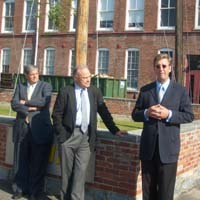 |
| Mayor John Barrett III, Clark Director Michael Conforti, and MoCA Director Joseph Thompson |
NORTH ADAMS, Mass. — It seems an unlikely partnership — refined, classical Clark Art Institute joining forces with brash, cutting-edge Mass MoCA.
But by 2011, the Village Beautiful's scholarly institution will have a permanent presence on the gritty industrial campus of the nation's largest contemporary art museum.
Standing below the now iconic "Tree Logic" on Wednesday, the directors of Northern Berkshire's most famed museums touted the mutual benefits of the Clark's multimillion-dollar investment in three prominent buildings of the former Sprague Electric plant.
"We're tremendously excited," said Joseph C. Thompson, director of the Massachusetts Museum of Contemporary Art, describing the agreement as "the next milestone in what's become a really fruitful, wonderful relationship that we are deeply grateful for."
Described by Thompson as MoCA's "front door," the buildings will be used for storage, but "storage" in the sense that there will be public space for collaborative opportunities for exhibits and programming, including parts of the Williamstown museum's collection.
Clark Director Michael A. Conforti apologized for being vague on specifics. "Who knows what the possibilities are," he said. "If Mass MoCA is truly about the new and the next, who can predict in 2007 what we're going to want to do here in 2011?"
Two years in the making, the Clark@Mass MoCA is just the latest initiative in a long collaboration that began before Mass MoCA itself existed. Mayor John Barrett III recalled how "no one was returning calls" in the early 1990s when he, Thompson and others were trying to get the museum off the ground.
"What gave us credibility was, along with Williams College, the Clark Art. They were key players in making this happen — they gave us credibility when we needed it. ... This gives us some further stability, to have the Clark's name attached and also to be seen by so many others, is going to give us yet another symbol we're here for the long run."
The still-undisclosed investment figure — "It's a lot" according to the mayor — includes a significant contribution to the Mass MoCA endowment along with annual fees. The Clark's endowment is about $300 million; MoCA's, $3 million. Beyond the direct financial help, the 8-year-old MoCA stands to gain in terms of visitors and cultural branding from the close connection to the half-century-old Clark.
A study commissioned by the Clark in 2004 found that it draws more than 175,000 visitors annually, nearly half of whom come to the Berkshires specifically for the museum and who spend more than $20 million in the region. Many of those visitors are even now being drawn to Mass MoCA through cross-promotion.
"Today, probably half our visitors are wearing Clark buttons on their lapels," said Thompson. "The Clark presence here will be a portal to bring more and more people to Mass MoCA."
Sharing the benefits
The benefits go both ways, as Thompson sees patrons of contemporary art being exposed to the Clark's collections of impressionist and 19th century art. When offered at Mass MoCA, most visitors will buy tickets to both museums.
"This will have a huge impact," he said.
The Mass MoCA Commission, which leases the city-owned property to the museum, approved the agreement on Aug. 10; the Clark board gave final approval last week.
The buildings include the gatehouse and the former Sprague personnel office on Marshall Street and Building 12, which fronts the parking lot and carries the well-known Mass MoCA letters on its roof.
The letters will stay there, barring construction complications, said Conforti. He said schematics have been drawn up but there are no design or architectural plans at this time. Construction is expected to be completed no later than 2011.
Conforti said the decision to branch out to North Adams was fueled by the Clark's master plan and its commitment to the local community. Now in the midst of a $25 million construction project that will add 32,000 square feet of exhibition and classroom space, the Clark had to consider the practical need for storage.
The master plan also includes an imperative to see "where the Clark can be most effective in the community," said Conforti.
The vacant buildings at Mass MoCA seemed to be the perfect answer — one that would also allow the Clark to expand beyond its current collection.
"We don't expect to 'Clarkize' the space," said Conforti. "Its ultimate vocabulary is going to in sync with Mass MoCA."
Arts and education
It will also support educational components at both museums; students in the Williams College graduate art history program have been supplied by the Clark to curate exhibits at MoCA for years and Kidspace, which works with local schools, has been a joint project of the Clark, MoCA and the Williams College Museum of Art.
"The museum has gone from being one thing to many things," said Thompson, noting the recent collaboration with Yale University that will bring a permanent exhibit of the late artist Sol LeWitt to the campus. "From a museum, to a museum and performing arts center, now to, in essence, a center and a campus with multiple institutions providing research, scholarship, exhibition programming and educational services all on this campus in downtown North Adams."
Natalie Jeremijenko's "Tree Logic" has become a symbol of the two museums' relationship.
The Clark funded the upside-down trees that line the walkway into Mass MoCA's lobby. No one was sure they would live back then. Not only did the trees live, they thrived and have twice had to be replaced. The old trees — twisted and bent — now grow on the Clark's Stone Hill, where pilgrims occasionally come to see how they are doing.
"They are an example of what can happen when creative and interesting environments get together," said Conforti.