Path Leads to Past at Shaker Village
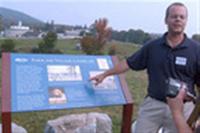 |
| Todd Burdick, director of education at Hancock Shaker Village, talks about a section of the village's new trail. |
HANCOCK, Mass. — Like a silver ribbon curled across the terrain, the trail at Hancock Shaker Village cuts through space and time to weave together the natural and Shaker history of the land.
"Historical preservation just doesn't relate to buildings and artifacts, it also relates to the landscape and the farm," said Todd Burdick, director of education, as he stood on a promontory on the trail overlooking the farm on Thursday.
Few people have seen the lay of the land from this perspective, he said.
That will change Saturday morning as U.S. Rep. John W. Olver, D-Amherst, opens the new Farm and Forest Trail, a one-mile loop designed to expand visitors' understanding of the Shakers and the land they once farmed.
"This trail is part of our inspiration to expand the Shaker story," said Ellen Spear, president and chief executive officer.
The path was a long time in the making she said, dating back its conception in 2001. Built with $210,000 in federal grants and another $75,000 in donations, the 12-foot wide, gently winding pathway is accessible to the wheelchair-bound, as well as strollers, wagons, sleighs, cross-country skiers and snowshoers.
In keeping with the village's historical character, the trail's surface is a hard-packed aggregate mix, used in runways, that was quarried in West Stockbridge. Below the surface, modern landscaping material aids in water runoff and blocking weeds.
It begins northwest of the gardens, in the spot where "Mary Jane," a Shaker dairy cow, once stood 70 years ago. We know because her picture is prominently displayed on the first of many informative signs along the trail.
"Here's an interesting way we try to tie in the natural, cultural, historical and our collection with the visitor's experience," said Burdick, noting that a replica of Mary Jane resides in the village's hands-on activity barn. Behind Mary Jane is what the Shakers called Mount Sinai, now known as Shaker Mountain, and the building that houses one of the Shaker's renewable energy sources — a water-driven wheel.
Little has changed since Mary Jane grazed here. The trail winds up to the promontory and then down into the cool forest and wetlands, from which the Shakers harvested black ash for their famous baskets and medicinal herbs and wildflowers. Farther on are sugar maples and hardwoods used in syrup and furniture making, stone quarries and an overgrown rock orchard.
To the practiced eye, the landscape revealed stone walls that once separated fields, groves of young trees in what had been pastures, and rocks with distinctive markings denoting that they had been split by hand.
Farm manager Bill Mangiardi pointed out the remnants of barbed-wire fencing grown into the trees. Burdick kept up a lively commentary on Shaker and farm history throughout the Thursday's preview tour.
The path exits the forest by the old orchard and an overgrown wild rose and cuts across the pastures, looping around the back of the village's famed Round Stone Barn.
In constructing the path, village officials discovered yet another aspect of the Shaker life, said Burdick. A charcoal pit was found by archaeologists researching the area along the pathway. That forced the path of the trail to curve around the kiln outcropping. The Shakers produced charcoal for the iron industry and blacksmithing.
"We know there were a lot charcoal pits on the hills to the north ... but this is a new find for us," said Burdick.
The trail opens up more of the 1,200 acres that make up the nonprofit Shaker Village. Most activities and buildings are clustered around the village center and only about 50 acres are in use. The museum and working farm offers a wide range of programming year-round. It has some 22,000 examples of Shaker furniture, crafts, tools and clothes and 20 buildings and, for nearly 50 years, has been dedicated to keeping alive the history of the Shakers.
"I am very pleased to see this wonderful project come to fruition," Olver, who was instrumental in obtaining the funding, said in a statement. "For nearly 50 years, the Hancock Shaker Village has brought the history of the region to life. The trail will be a wonderful addition to the village's programming."
The opening of the trail kicks off the village's annual Country Fair weekend, which includes demonstrations, artisans and a farmers' market along with regular programming and activities. That's followed by National Spinning and Weaving Week, with a celebration of textiles daily. The trail will be open year-round and interpretive guided tours will be available beginning Saturday.
"The different wild flowers, herbs and vegetation also changes seasonally. It's going to be a different trail no matter what time of the year you hike — and a different tour," said Burdick.
Tags: Hancock Shaker Village, trails,