Regional Science Fair Brings High School Researchers to MCLA

 |
|
 Tiffany Salvi and Jennifer Petricca.
|
But, admitted Brenna Keogh of Mohawk Trail Regional High School, they may "be an acquired taste."
While mealworm sandwiches may never catch on, Keogh speculates they could be an inexpensive, home-grown, sustainable food — one that wouldn't have a major environmental impact.
Who thinks like that? For Keogh it springs from her interest and concern over ecological matters (and won her a second place). For more than 100 other high school students from around the region, who knows? But they spent the last several months wondering "what if?" from myriad angles.
Their projects filled the gymnasium at the Amsler Campus Center on Friday for the Region 1 Science Fair, an annual event that brings together some of the brightist young scientific and engineering minds in the region. The numbers were opened up from the 70 that entered last year.
The daylong event included lunch and a keynote speech by Kathleen Arcaro, a professor of environmental toxicology at the University of Masschusetts at Amherst who has been doing research on the effects of pollutants on breast milk. Fair winners received cash prizes up to $300 and entrance into the state science fair at Massachusetts Institute of Technology.
Representing 10 high schools, the projects ranged from practical applications to genetic research to killer honey to the truth behind the 5-second rule (Can you handle the truth? We couldn't.).
Taconic and Pittsfield high schools had by far the largest contingents this year. Kristen Pearson, chair of the science department at Taconic, said students participate in the school's Academy of Science and Engineering in their sophomore and senior years.
The school holds its own science fair and the top 20 go on the Region 1 fair. "It's definitely a learning process for them," she said. "They get a lot of things out of it, the really true understanding of the application of science."

 |
|
|
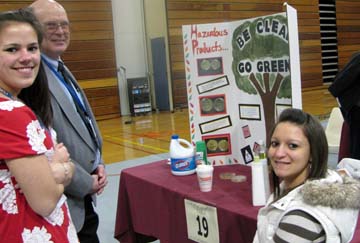
Sometimes the hypothesis doesn't hold up under the research. That was the case with Brittany Salvi and Jennifer Petricca of Taconic, who proved themselves wrong.
They were working with the hypothesis that domesticated mammals — cats and dogs — would be closer to humans as measured by lysozyme, an antibacterial protein found in body secretions such as sweat and tears.
But their survey of amoeba, spiders, rats, mice and other "house pets whether you want them or not," said Jennifer, showed that of all organisms, the lowly amoeba that lives houseplant soil was the closest match.
"There were a lot of things we did not expect on this project," said Tiffany, as Jennifer piped in, "who would expect the amoeba to be that closely related to us?"
If anything, the experiment has piqued their interest in genetics even more. "Both of us want to dabble in genetics," said Jennifer. "I want to be a large animal vet and Tiffany wants to be a genetic counselor."
Drury High School more than doubled the number of projects from last year, with five teams displaying their engineering and research skills. Physics teacher Paul Allen said he made it part of his honors course for this year and got the seniors thinking about the fair last October.
"I was very pleased because all the students really took it to heart," he said. "And they really had fun with it, too."
Seniors Amandia Carr, Tiffany England and Belinda Oliva described their project to pull water from air, from a suggestion by Allen, as a team effort. It also had a real-world application, said Tiffany, "we thought of Third World countries, how they need fresh water and how they could do it if they did it on a bigger scale."
Lauren Moffatt, new coordinator of the college's Berkshire Environmental Resource Center, was a judge for the fair, along with UMass graduate students Kate McCusker and Julian Sosnik.
"I was just floored by the quality of all the proejcts," said Moffatt. "I don't quite remember my high school science fair project being as well developed and as scientifically sound as these are."
It was, said McCusker, a molecular biologist, enough to inspire one to go on to school.
How profound an effect can a school science fair have? For Sosnik, also studying molecular and cellular biology, it would seem significant. The Argentine native eagerly flipped through his phone to show a picture of himself and classmates at his seventh-grade science fair.
Results below:
| First Place | Project | School |
| Cindy Schmelkin Maureen Clark | Carcinogenic Effects on the Regeneration of Planaria |
Monument Mtn. High School |
| Olivia Almeida Rachel Aylward |
Yawn Much? |
Westfield High School |
| Second Place | Project | School |
| Nancy Maleno | Which Antiseptic Works Best on eColi? |
Greenfield High School |
| Steve Reynolds Andrew Ellis |
Effects of Environmental Conditions on the Strain Behaviors |
Westfield High School |
| Terianna Wax Zachary Grobe |
Oil Wells Within Plant Cells | Westfield High School |
| Aiden Barrett | Organic or Inorganic? |
Hopkins Academy |
| Chelsea Villareal Renee Barouxis |
Sugar vs. Splenda |
Westfield High School |
| Jessa Orluk Kaela Poulin |
Go Greenhouse |
Westfield High School |
| Ellen Hutchinson Julie Ogonis |
Gender Under Pressure |
Westfield High School |
| Julie Diamond Rhea Howard Signe Dahlberg-Wright |
Who Cares? |
Monument Mtn. High School |
| Leigh Moffatt Louisa Carman |
The Effectiveness of Honey As An Anti-Bacterial Agent |
Monument Mtn. High School |
| Aliza Majewski | "Is It In You?" Gatorade vs Water on Basil Plant Growth |
Hopkins Academy |
| Adam Daniere Matthew Jacques Joseph Milewski |
3D Scratch Holograms |
Hopkins Academy |
| Brenna Keogh | Entomophagy: Mealworms as a Viable Protein Source for Humans |
Mohawk Trail High School |
| Third Place | Project | School |
| Shannon Aurigemma | Tea Tree Oil: Beneficial or Superficial |
Mohawk Trail High School |
| Yara Tayeh Aline Parnagian | Effect of Enzyme Cleaners on Petroleum Hydrocarbon Spills |
Westfield High School |
| Joanna Janik Lesya Gavrilyuk Alisa Gavrilyuk |
Are You Sure You Know Your Colors? |
Westfield High School |
| Kevin McLaughlin | Memory | Taconic High School |
| William Wannamaker | The Link Between Lightning and Terrestrial Gamma Ray Flashes |
Taconic High School |
| Sarah Tucker | The Application of Chemistry to Produce Natural Ceramic Glaze |
Taconic High School |
| Jacob Mullen Brett Haas |
More Advanced Racing Solutions |
Taconic High School |
| Lauren Avery | Factors of Bacteria Levels in Raw Milk |
Mohawk Trail High School |
| Gabriel Chevalier | Fry Factor Is Your Skin Protected? |
Mohawk Trail High School |
| Stephanie Bacon Katherine Landeck | Assessing the Impact of Development on Stream Biota |
Minnechaug Regional High School |
| Becca Hopkins Jamie McNary Miranda Bona |
Healing Hair Cells Using Natural and Synthetic Oils |
Drury High School |
| Tyler Cowan | The Thermal Guardian |
Taconic High School |