Local Foresters On Lookout For Invasive Beetles
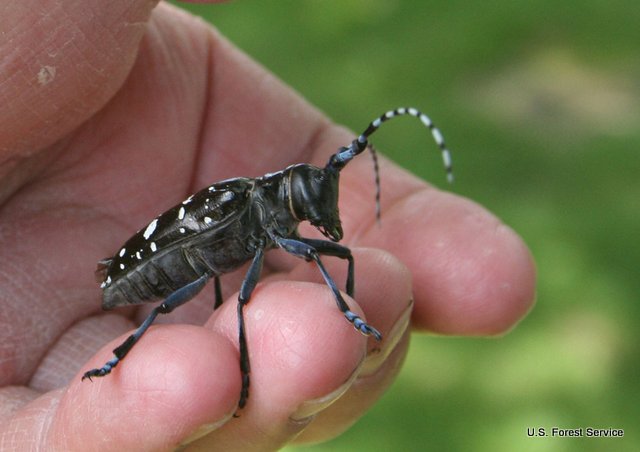 The Asian longhorned beetle can be identified by its bluish legs and white-striped antennae. |
And that is just the way landowner likes it.
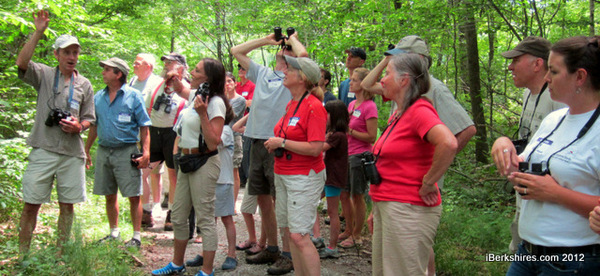
But in case the exotic invasive insect finds its way into the Berkshires, several dozen residents are better prepared to spot the pest after Saturday's workshop presented by Samantha Brady, a forest pest outreach and survey coordinator with the Massachusetts Department of Agricultural Resources.
Brady's talk was titled "Invasive Species: What's Here And What's On The Horizon," and it focused on two invasives that have the region surrounded: the Asian long-horned beetle in Worcester and the emerald ash borer in Albany, N.Y.
Each insect is deadly to its respective host — most hardwoods in the case of the beetle, exclusively ash for the borer.
Brady outlined the threat posed by each pest and explained how to recognize each in the wild.
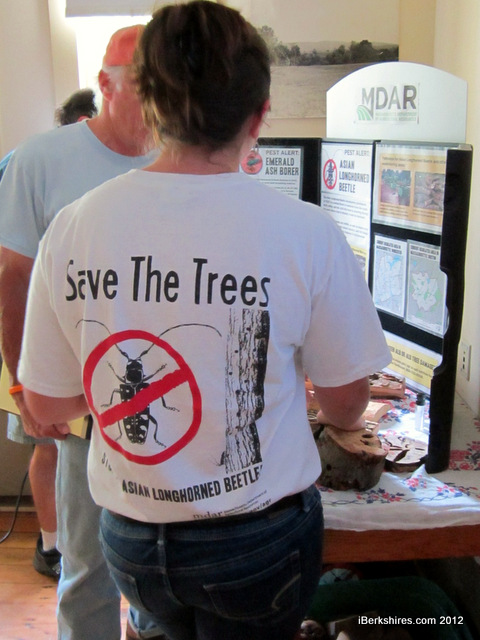 Samantha Brady, a forest pest outreach and survey coordinator with the Massachusetts Department of Agricultural Resources, wears an Asian Longhorned Beetle awareness shirt. |
"There are 200 native species of longhorned beetle in Massachusetts," Brady said.
The one we need to worry about is the one that "hitchhiked" to North America aboard packing materials used to ship some of the billions of consumer goods imported from China.
Asian longhorned beetle has been discovered in Illinois, Ohio, New York, New Jersey and Massachusetts as well as in Ontario.
The Worcester infestation is perhaps the most significant because it is the one closest to large expanses of forest dominated by sugar maples — one of the pest's preferred hosts.
According to the U.S. Department of Agriculture's Animal and Plant Health Inspection Service — the lead agency in containing and eradicating ALB — four million jobs in the eastern United States depend on forests that are vulnerable to the beetle. That includes not only maple syrup production — a major industry in Vermont and Quebec — but also timber and tourism, which in New England relies heavily on fall foliage season.
The Bay State currently has examples of the devastation ALB can cause when not detected and the value of early detection.
In Worcester, where the bug is believed to have been present for 15 years before its discovery in 2008, more than 31,000 maple trees have been chopped down and chipped up by APHIS because, Brady explained, once a tree is infested, it cannot be saved.
The quarantine zone in the central Massachusetts city now covers a 110-square-mile area, and anyone caught moving wood in that zone faces a $3,000 fine.
Contrast that with Boston, where an alert groundskeeper at Faulkner Hospital spotted the bug in 2010. It is believed that the Asion longhorned beetle was only present at the Jamaica Plain site for two to three years, Brady said, and so far it has only been found on six trees. It does not appear to have migrated to the nearby Arnold Arboretum, a 265-acre site operated by Harvard University.
"That is why we rely on people like you," Brady told a crowd of about 35 in Hopkins Forest's Rosenburg Center.
The Asian longhorned beetle is nearly indistinguishable from other pests when in its larval stage. That is when it lives deep inside hardwood trees and does the most damage. When it emerges as an adult (and is ready to reproduce), the beetle measures about 2 inches long with a black, shiny body featuring white spots. It has long black antennae with white bands, six legs and, often, blue-tinted feet.
 Purple traps have appeared around the county in case an emerald ash borers show up. |
The biggest difference between ALB and the native cousin, the latter has naturally occurring enemies that keep its population in check.
"Asian longhorned beetle has an 80 percent survival rate," Brady said. "For most insects, it's less than 10 percent."
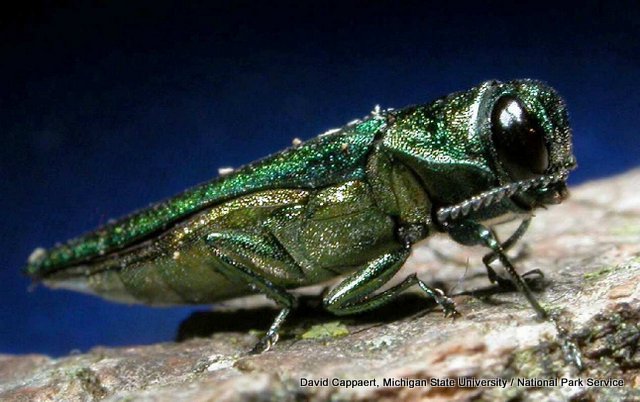
Likewise, there are no naturally occurring predators for the emerald ash borer, which owns the distinction of the most destructive non-native invasive insect in all of North America, accounting for the loss of tens of millions of trees in 15 states, Ontario and Quebec.
Although it has not been seen in Massachusetts yet, the bright green beetle was found in Saugerties, N.Y., two years ago and Albany last year. In the Berkshires, the DAR is scouting for the emerald ash borer with the large, purple triangle-shaped traps (nicknamed "Barney traps") that began appearing in local trees last summer.
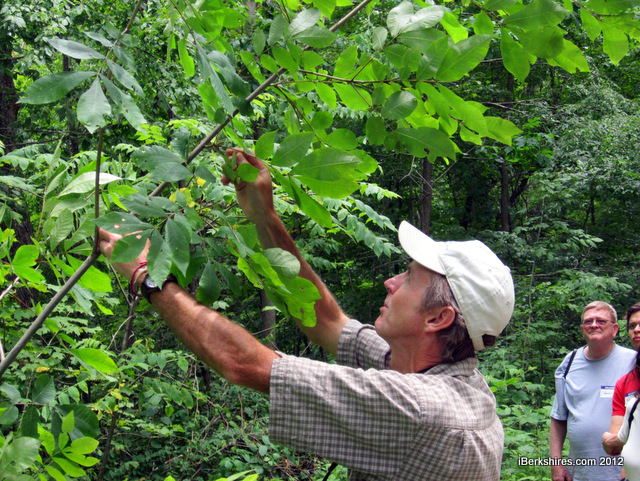 Hopkins Forest manager Andrew Jones sifts through a small tree. |
Nonetheless, vigilance in not allowing wood to be transported from infested regions remains the best way to prevent the spread of both pests — that and early detection of new infestations.
EAB can be identified in its larval stage, but larvae are usually hidden beneath the bark in the tree's cambium layer, Brady said. Like ALB, the bright green EAB tunnels its way out of the tree at adulthood — in the case of EAB leaving a distinctive D-shaped exit hole about 3 to 4 millimeters in diameter.
After doing a slideshow presentation on both pests, Brady joined Hopkins Memorial Forest manager Andrew Jones in leading a hike through some of the facility's 2,600 acres.
As expected, they did not find any evidence of either of the pests in the forest, but they were able to help participants learn which trees they should be scouting for the pests.
For more about Asian longhorned beetles, visit www.beetlbusters.info.
For more about the emerald ash borer, visit www.emeraldashborer.info.
Tags: beetles, emerald ash borer, invasive species,