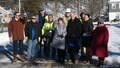
Landscape architects for the Sterling and Francine Clark Art Institute’s expansion outlined their approach to the project — an approach that highlights the natural features of the land — to a crowd that nearly filled the Williamstown museum’s auditorium Friday.
The award-winning firm stressed its affinity for natural, New England environments. It has worked in the Berkshires, at Simon’s Rock College of Bard in Great Barrington, and at nearby Bennington (Vt.) College. Its principals said they are in the analysis phase of the Clark project.
While Reed Hilderbrand Associates’ presentation was long on philosophy and ideology, a repeated theme was access to rural surroundings for museum-goers.
Much of the thrust seemed to be directed toward emphasizing the Clark’s rural setting, underlining its difference from many, if not most, museums, which are typically in urban centers.
But one listener Friday pleaded with the Clark to leave Stone Hill, which rises behind the museum complex, undisturbed.
Ronnie Levin, of 125 South St., urged using the existing road that gives access to the town’s water tank instead of building another road. Levin addressed head-on an issue — a road at least partway up Stone Hill with an overlook — introduced in the Clark’s master plan a year ago, but not specifically mentioned by the landscape architects in their presentation.
Douglas Reed, who founded the firm in 1993, responded, “The way we will go about this is through the investigation of many alternatives. It involves balancing many pushes and pulls. Through the generation of alternatives the solution will come clear. That will be part of the process.â€
Reed Hilderbrand was chosen because of the firm’s sensitivity to the New England countryside.
In an earlier release, Clark Trustees President Francis Oakley said, “We are the stewards of a campus of extraordinary natural beauty and of outstanding collections, and they are in dialogue one with another. [Award-winning Japanese architect Tadao] Ando and Reed Hilderbrand will bring a consistent, unified, and serene feeling to our entire campus, while allowing for the continued growth of our public and research programs.â€
Ando, in addition to numerous other awards, was recently named winner of the American Institute of Architects Gold Medal.
Reed Hilderbrand’s work in the Berkshires, in particular, emphasizes the area’s rural character, including the types of ponds, trails, meadows and scenic vistas found on the grounds of the Clark.
Other relevant projects include the New Shrub and Vine Collection at the Arnold Arboretum at Harvard University, the Taft Museum in Cincinnati, the Parrish Art Museum in Southampton, N.Y., and an enhancement of Mount Auburn Cemetery in Cambridge, originally designed by the famous 19th century landscape architect Frederick Law Olmstead.
Among the firm’s awards is the American Society of Landscape Architects’ prestigious President’s Award of Excellence for the Therapeutic Garden at the Institute for Child and Adolescent Development in Wellesley. Their work at Stan Hywet Hall in Akron, Ohio, won the National Trust for Historic Preservation’s Trustees Emeritus Award for Excellence in the Stewardship of Historic Sites.
Their work in the Berkshires, besides Simon’s Rock and Bennington, includes a private residence in Richmond.
Speaking at the Clark last week, Reed said they aim to “uncover or reveal distinctive features of the land, to connect the museum to the larger site, forging a coherent landscape experience.â€
Stone Hill, he said, offers “views of unparalleled beauty.â€
Hilderbrand characterized the firm’s approach to the Clark as thoughtful and careful.
“We will seek convergence of separate forces,†he said.
These are, he said, to give vital expression to the institution’s aims, considering “how we live and drive and walk on the land.â€
“How to achieve a fit with the community so the community remain stakeholders, and how to work devotedly and carefully with the land.â€
The museum, he said, wants greater commitment to community access, which is already pretty good, and “to build upon the beauty of the landscape.â€
“We are thinking of ourselves as agents of change,†he said.
“At present the museum-goer comes to view the art, has glimpses of the site and may catch a view of the hill. We wonder if we want to expand that.â€
And he stressed that the landscape is a creation of culture as well as natural forces.
“The fields and the edges of the woods are not a function only of nature,†he said.
Stone Hill, during its last 300 or 400 years, he said, “has made dramatic changes because of human intervention. We are agents of change whether we like it or not.â€
“We will engage in a discussion with the community on how much change is desirable,†he said.
And he described their work as “uncovering†features of the land that may have been obscured.
In addition to walking the site, they have examined archives, such as aerial photographs that show that a stand of oaks is part of a larger grove of oaks that is now mostly obscured from view.
“We want to enable the Clark to achieve its vision,†said Hilderbrand. “The aspirations are very high, and that’s how we like it.â€
Earlier, in a session with reporters, Reed said that while Stone Hill is Clark property, it is “a community resource.â€
While trustees may own it, it is thought of as one of the great spaces in Williamstown, he said, and the Clark has given both unwritten and verbalized allowance for community participation.
Hilderbrand said, “It’s already a great site.â€
They want, he said, “to change not what it looks like but to give all visitors access. The museum-goer doesn’t particularly get that experience.â€
An aim, he said, is to extend that experience beyond the boundaries of the museum, to give the visitor the experience of “how incredibly beautiful it is.â€
Said Reed, “It’s absolutely fundamental to determine the unique, special qualities of the site.â€
North Adams artist and entrepreneur Eric Rudd asked, during the public presentation, whether there might be the possibility of inviting “artists in to spice things up?â€
Rudd quipped that he was “not suggesting upside-down trees,†referring to Natalie Jermijenko’s inverted and suspended maple trees in the courtyard at MASS MoCA.
Hilderbrand replied that they do not “necessarily look to sculpture.â€
“When we grade the land, it’s the equivalent of the experience of art.â€
If you would like to contribute information on this article, contact us at info@iberkshires.com.
Your Comments
iBerkshires.com welcomes critical, respectful dialogue. Name-calling, personal attacks, libel, slander or foul language is not allowed. All comments are reviewed before posting and will be deleted or edited as necessary.
No Comments
Berkshire Food Project Closed for Power Issues
NORTH ADAMS, Mass. — The Berkshire Food Project is closed Monday because of a power outage early in the morning.
"We are unable to get proper electricity and heat to the building," according to Executive Director Matthew Alcombright. "We hope that this can be resolved and be open tomorrow."
The project does have some sandwiches and frozen meals that will be distributed at the entry.
The city has lifted a boil water order — with several exceptions — that was issued late Monday morning following several water line breaks over the weekend. click for more
The bridge had been closed to all vehicle traffic since March 2023 after being deemed structurally deficient by the state Department of Transportation. click for more