Q&A: Gloria Steinem on Progressivism, Women's Rights
.JPG) |
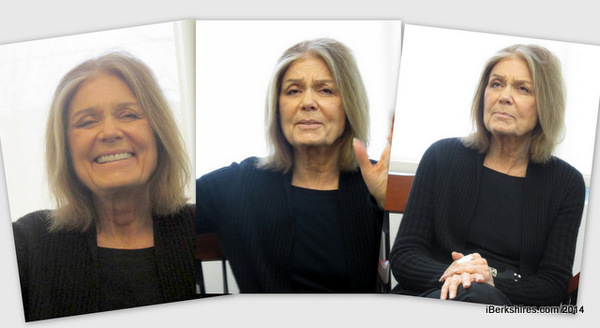
NORTH ADAMS, Mass. — Gloria Steinem was happy to be at Massachusetts College of Liberal Arts on Tuesday because of what the public college represented.
"I'm glad to be on a campus that is closer to universal free education that I wish we had as a country," she said. "It's more accessible and I think I understand that students are less likely to end up in debt. Which is a current outrage in this country."
The equal rights activist, journalist, lecturer, editor and author shared more of her occasionally "outraged" thoughts on current social and political issues, the progress of women's rights and other topics with local media before an appearance at the college's Church Street Center later in the evening to a capacity crowd.
Her talk on "The Progression of Feminism: Where are we going?" as part of the college's Public Policy Lecture had people lined up around the block to get — and more than few couldn't get in the doors.
The attraction isn't hard to fathom. The co-founder of Ms. magazine and the Women's Action Alliance has been championing women's rights and social justice since the 1960s. Her efforts, along with others, have had an immeasurable impact on the lives of women and their families.
Below are some questions from iBerkshires, The Berkshire Eagle, WAMC and the MCLA Beacon (edited for clarity) and answers from Steinem, who answered graciously and with humor.
Can you reflect a little bit on the direction that the progressive movement has taken in the last few years?
STEINEM: I do think that the progressive movement has gained a majority support over time from the anti-Vietnam era to public opinion that became critical and turned against two wars sooner, the Civil Rights Movement, marriage equality movement — by every measure we now pretty much have a majority support on the all the progressive issues, with the possible exception of the death penalty. That's changing rapidly as well.
The groups that are uncomfortable with that are in backlash; I think we've been dealing with some from of backlash since Reagan.
Do you see backlash coming back around, with the tea-party led government shutdown, etc. ?
STEINEM: Human beings work on yes, not no. These right-wing groups are mostly saying no. And I agree with you, I think the tea party paid that penalty. The whole shutdown of Congress efforts were not taken well by most Americans. The long-term problem is one of the two great parties has been taken over by extremists.
[Republicans] were the first to support the Equal Rights Amendment, Barry Goldwater was pro-choice and most of the recent Republican presidents could no longer get nominated by the Republican Party as it exists — they might get elected but the couldn't get nominated. That's very dangerous to have one the political parties in a two-party system taken over by extremists.
[Steinem thinks the long-term solution is in the state legislatures and that not enough attention is paid to them.] In red states, they have redistricted themselves into perpetuity, which is why we have a House of Representatives that doesn't represent the majority opinion and a Senate that does.
Real Republicans need to take their party back so that it is a centrist party; otherwise it pulls everything to the extreme.
Would it be worthwhile to resurrect the Equal Rights Amendment?
STEINEM: Yes ... because, as some of us remember, the great arguments against the ERA amendment was gay marriage and combat. We always said, hello, if those things would be covered by the Equal Rights Amendment they wouldn't have to be separate struggles. ... What's going to happen is we're going to go into combat without the Equal Rights Amendment — and that's what happened.
What was the tenor when you entered the women's rights movement compared to today?
STEINEM: It has improved dramatically in one way. In those days it was mostly ridicule and in some sense it is progress to go to right to serious opposition. But more importantly the issues that were raised then and were ridiculed are the majority issues [now] and that's a big difference.
What are the overarching goals for feminism now? Are there still institutional challenges to overcome?
STEINEM: We have the least family-friendly work policies of any democracy. We don't have any national child care and the expense of child care now surpasses the expense of a college education. Our health care, despite the advances of Obamacare, are more difficult to access than the single-payer system that other modern democracies have and that is a penalty for everybody, but also a special penalty for women.
There are many systemic remedies we need, but they all take the form of action. We should be past the point of seeing issues that especially affect female human beings as separate from other issues, or separate that have to do with race or sexuality or class ... They're not separate; they're all of a piece and we as a country [are] missing remedies that would help all of us because we divide ourselves in that way.
Does the replacement of industry with retail jobs, most of which are filled by women, create challenges to equal pay?
STEINEM: We have stimulus to bankers and Wall Street and Detroit, but we didn't talk about the greatest economic stimulus: equal pay.
Walmart is one of the worst, most discriminatory companies on Earth, whether they are here or in China. I wouldn't buy a toothpick from Walmart. (Discussing last year's dismissal of a class action lawsuit by women against the megachain.)
Two younger women in my office didn't know who you were. Do you think there's a disconnect between the pioneers in the women's movement and a younger generation that sometimes rejects the label of feminist even though they assume women's rights?
STEINEM: I don't think our schools tell us about Civil Rights or the peace movement, and the women's movement. It's not the individuals, it's a systemic problem.
I must say I don't care if they know who I am or not. I just want them to know who they are. ... If we look at public opinion polls, younger women are more likely to identify as feminists than older ones. ... More women identify as feminists than Republicans.
There's been a lot of effort to make feminism a bad word. Rush Limbaugh calls me a femiNazi with great regularity. I'm not complaining; if he liked me I would know that something's wrong.
(Many people saw rights movements as anti-white, or anti-man, she said, which was not true.)
I think a lot of it is guilt: 'Oh, they're going to do to us what we've been doing to them.' That has never been the point, it's always been about equality and individuality, getting out of from under group judgement.
 What impact do you think you've had?
STEINEM: It's not for me to say. But what is for me is to always draw attention to the fact that it's a huge, huge, huge diverse movement so it's not perceived through any image or the woods of any single person.
I think that's true in connecting human beings, I think it's important in connection issues.
The most reliable predictor [referring to "Sex & World Peace"] of whether there is violence internal to a country, in the streets, or a country is likely to use military violence against another country, is not poverty, or a lack of natural resources or religion or even to be a democracy — it's violence against females. Just because the idea of subject-object dominating is normalized. Challenging gender is a prison for both men and women.
Do you see any connection between the subjugation of women and the subjugation of non-human animals as well?
Yes, actually I do and it's interesting statistically it's true. The vast majority of the animal rights individual human beings are females.
Susan B. Anthony was born a stone's throw from here. Do you have a comment on her and her efforts?
STEINEM: I'm most related to Susan B. Anthony when I read that she said, 'Freedom of the press belongs to those who own the press,' and what she meant by that was she didn't own the press. "The Revolution," her newspaper or magazine, was owned by someone else. So, when we were struggling with Ms. magazine, I see what she means.
Tags: celebrity, civil rights, MCLA, rights activist, speaker,