Williams Alum Returns to Williamstown Fire Department
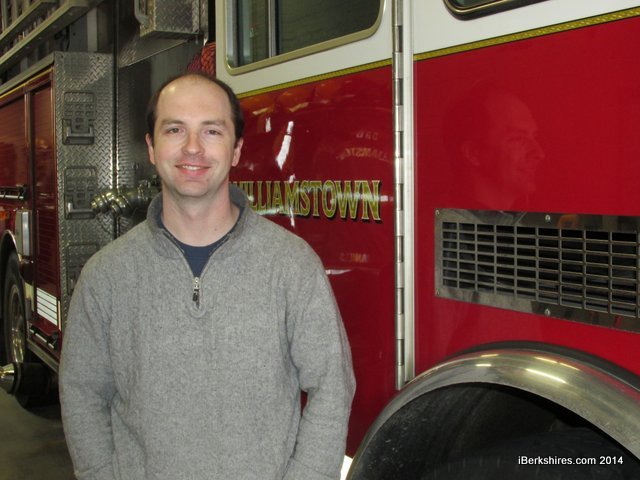 Dr. Erryn Leinbaugh, a Williams College alum, has rejoined the Fire Department after a 15-year absence. Dr. Erryn Leinbaugh, a Williams College alum, has rejoined the Fire Department after a 15-year absence. |
When the road of life brought him back to Williamstown, it only made sense to serve again.
"We bought a house just two blocks down from here, and I remember saying to my wife when we bought it, 'This is perfect, I can go right down to the fire station,' " Leinbaugh said recently.
So this summer, the new homeowner began his second stint as a call firefighter with the WIlliamstown Fire Department.
The first stint? Nearly 15 years ago when Leinbaugh was a student at Williams College.
Now a doctor of emergency medicine at Berkshire Medical Center in Pittsfield, Leinbaugh is glad to be back at the fire house, enjoying the fellowship and helping to keep the community safe.
His first experience with the town's first responders helped him figure out what he wanted to do with the rest of his life, Leinbaugh said.
"While I was on the Fire Department here, I worked for Village Ambulance, too," he said. "It was working for Village that got me interested in medicine. Initially, I planned to get a full-time job as a firefighter, and in most places you needed to be an EMT. And working at Village gave me experience. It also helped me pay my way through school.
"When I left here, I ended up getting a paramedic certification and working as a medic for a number of years. I volunteered and/or worked full-time as a medic all the way through med school."
It is not uncommon for Williams students to volunteer as call firefighters, in which firefighters receive a nominal stipend per incident.
The department has averaged about two or three college students on the force each year over the last couple of decades, Fire Chief Craig Pedercini said. Leinbaugh stood out during his four-year run with the department.
"What I remember of him was that he was always making calls," said Pedercini, who was an assistant chief with the department at the time. "You have your flow of good college students and some not so good. He was one of those who always seemed to make calls, except when he was in class, of course.
"He always came across as a very energetic and responsible guy. He took the firefighting part very seriously. I remember that part of him."
Pedercini said the department does not actively keep tabs on the students after they graduate from the college, so he cannot say how many end up volunteering with fire departments in their communities, but he was happy Leinbaugh did.
"He graduated in '99, and he showed up at my doorstep this past summer," Pedercini said. "I thought he was just coming back to say hi. It's amazing how long he's been gone. Time flies, and you don't hear from someone and they show up.
"He popped into the station, and we started talking, and he asked if we were still hiring firemen. I said we're always hiring firemen."
Although it never was a full-time job for Leinbaugh, firefighting has long been a part of his life, going back to his hometown.
"I guess I started out doing a summer as a firefighter for the Forest Service in the town where I grew up in Idaho," he said. "That was right after I graduated from high school. I just found it grew on me.
"I was a Boy Scout, and I spent a lot of time hiking and camping. It sounded like a good outdoor job that paid decently well. There weren't a lot of summer jobs available. ... It was a hard summer job to do, but it was easy to get."
His freshman year at Williams, Leinbaugh approached then-chief Ed McGowan and was accepted in the department. The schedule fit in well with Leinbaugh's studies; training sessions were evenings and weekends, and he responded to calls whenever he could.
At the time, he said, the department averaged about 180 calls per year, which is less than the current call volume.
But there is one fire that does stick in his memory, as it does for any of the firefighters with the department at that time, Leinbaugh said. It was the blaze that destroyed a three-story apartment building on Cole Avenue.
"I was on the nozzle of the first hand line going in the front door, and we had reports of people trapped upstairs," he said. "That turned out to be false. But because of those reports, we were really trying to get in.
"There was a very large fire there already, and we were unable to get up the stairs. I remember there were chunks of burning ceiling coming down on us that were the size of my fist."
Leinbaugh left Williamstown in the fall of 1999 and eventually attended medical school at Dartmouth College and Brown University. He and his wife of 13 years, whom he met at Williams, lived in Colorado for a number years before coming back to the East Coast. Earlier this year, they decided to relocate to the Berkshires with a preschooler and a baby on the way (their second child was born last month).
"We always liked Williamstown and came to visit fairly frequently," Leinbaugh said. "We were living in Providence [R.I.] at the time. And it just wasn't a really good neighborhood. There were shootings frequently. The house down the street was firebombed by a gang once.
"We'd had it with living in the city and were looking for a rural location. Berkshire Medical Center was hiring, so I came up for an interview."
As an ER doctor, Leinbaugh's hours at BMC are fairly well-defined, he said. He can serve the Fire Department without running into any time conflicts.
"A full-time ER doc at Berkshire Medical Center is 36 hours per week," he said. "Outside of that schedule, your time is your own. Once in a while, someone will call in sick and you go in to cover a shift, but it's not like the poor surgeons, where you're working 60 or 70 hours a week in the hospital and then have to take call as well. That would be pretty miserable."
Leinbaugh said his experience as a physician and an EMT could sometimes come in handy as firefighter, but for the most part the two roles are separate.
"The primary job of the fire service is to fight fires, not run EMS," he said. "If you have a dedicated department like Village [Ambulance Service] that specializes in medical calls, that's great.
"We do occasionally end up working with the ambulance crews, mostly on car accidents. And there have been a couple of accidents since I got on where my skills actually were required. But that's fairly rare. It might be once or twice a year where I'd need to do anything.
"I do have a skill set in terms of having a lot of experience on emergency scenes and managing emergency services that I suspect will be more useful as time goes on."
Tags: fire department, firefighter,