Mass MoCA Show Challenges Visitors to Consider 'Space Between'
NORTH ADAMS, Mass. — The galleries at the Massachusetts Museum of Contemporary Art are renowned for the challenging, inventive creations featured in them, but a new show at the museum challenges visitors to pay attention to the areas between the galleries.
With "The Space Between," which opens on Saturday, April 16, Williams Graduate curatorial intern Nina Wexelblatt has fashioned an experience that takes advantage of the parts of a museum experience that are not often focused on — what happens as you move from one exhibit to another.
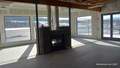
Wexelblatt says she was inspired by the building and campus themselves, which display a level of character that most museum buildings, built for their specific purpose, do not have. Wexelblatt's own visits to the museum, her own interaction with the space, also informed her conception for the show.
"I was also inspired by my weird experience of coming to Mass MoCA and even after many visits still being disoriented, and maybe getting lost or wandering," she said. "I wanted to do a show that could only be in a kind of space like this, and also something that would harness that disorientation or make that wandering quality productive, or make it something unexpected, and that would reward aimlessness or getting lost or stumbling on something."
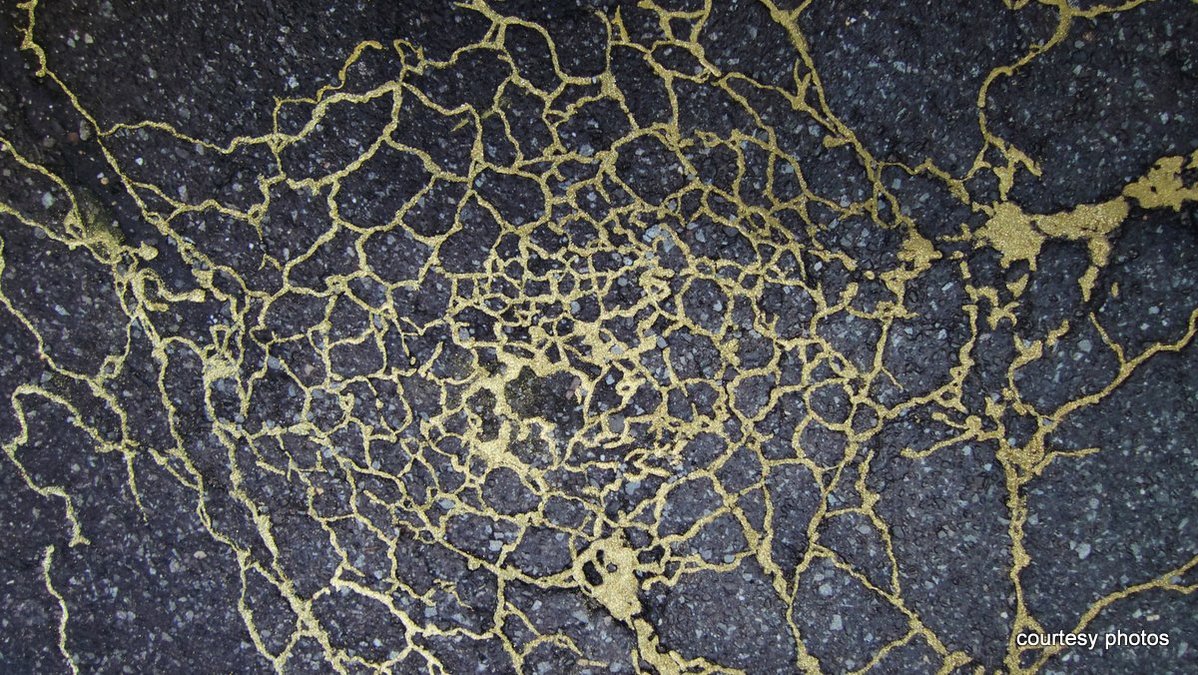
Wexelblatt chose a group of artists whose work had already dealt in some capacity with the concepts of the in-between, of gaps and absences, which resulted in some sight-specific installations, as well as some adaptations of previous work, as with Rachel Sussman's use of resin and gold powder to fill in the cracks in one of the museum's courtyard, a technique she used for her "Sidewalk Kintsukuroi" photography series.
Andy Graydon will install a sound piece in the light well between the Sol Lewitt gallery and Building 5, consisting of human voices offering incomplete art proposals for the actual space the sound art exists in. Each landing of the three-story staircase feature a different channel of audio.
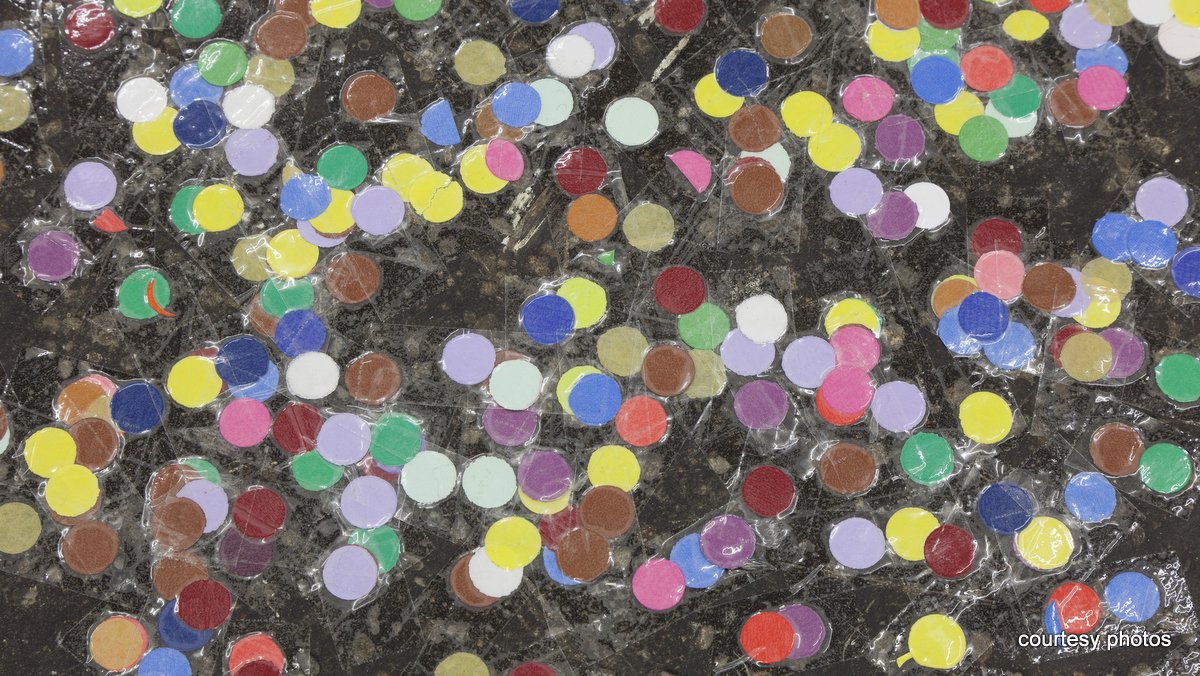
Amalia Pica's "Stabile #2 (with confetti)," features a scattering of confetti on the floor of the museum lobby, greeting visitors even as it hints that they might have missed the party.
"Her practice is a lot about communication and miscommunication, and what the physical remnants of that communication could look like," Wexelblatt said. "Maybe people would become more sensitive to not just what's presented, but maybe the way that things are put together — the structure of those experiences, the structure of communication, the structure of movement, in a way that they are not always trained to be aware of."
Walead Beshty's sculpture is actually a display of a glass cube that has been shipped inside a FedEx Box, along with the box itself. It's a collaboration with the invisible workers of shipping companies that get our packages from one place to another.
"They're not art handlers, so it cracks and breaks," said Wexelblatt, "and there's scuff marks and stickers that get put on the box and then it's displayed alongside the box that has these cracks and things along the surface of it. It's investigating the in-betweens of these invisible systems. It becomes an index of the treatment where you don't see it at all, you never think about what happens in transit. But there it is, this object that makes visible all the things that happened in transit. It's evidence of that in-between space."
Wexelblatt also included work in the show that is not properly on the Mass MoCA campus, as with Edson Chagas' billboard installation, featuring two photographs of found objects, one taken in his homeland of Luanda, Angola, and one taken in London. The billboard is currently on Route 8, but will move to the corner of River and Marshall streets in May.
Given the unusual proximity of the each work in the show to the other pieces, as well as some works to the inside of the museum, Wexelblatt sees two distinct ways to see the show among an infinite variety of subchoices. One is to use the gallery guide with the map on the back up it to seek out the pieces, but she doubts many people will do that.
"If you were coming to go to the shows, you would go from gallery to gallery and the middle spaces would be on your way from place to place, so this would be an alternative way of charting a root through the museum," Wexelblatt said.
And part of the problem in taking this approach is to assume that there is an orderly path from one piece to the next.
"There are any number of ways that you could go from one to the next, it's more of a network than a circuit," said Wexelblatt. "There's not a clear path from one to the next. There aren't necessarily any sight lines, you can't see one from another one in every case."
Or you could just stumble upon them, and work your way backwards to figuring out context.
"Maybe you would be curious about what is going on and there would be some information there about the show and you could find the others from the maps that are at every location," said Wexelblatt.
This approach is all part of another inspiration for the show, an essay by artist Vito Acconci called "Public Space In A Private Time."
"He's diagnosing contemporary public space at the time he saw it as not nodes, but circulation routes, not plazas and buildings but roads and bridges," Wexelblatt said. "There's a way that everyone is always on the go and if you're not careful, it all seems like a blur. And if that's what your public space is then you're never engaging with place at all. You're never situating yourself."
Wexelblatt's hope is that not only will a visitor's encounter with the show — in whatever form it takes — bring some understanding of the show itself and the pieces within it, but also be a gift that transforms their perception of the rest of the world.
"I hope people will walk away with a sense of heightened awareness," she said, "that there are things on the way to other things that will remind people of the new way of encountering space, or encountering where they are."
Tags: art show, mass moca,