Poet Begins Six-Month Amy Clampitt Residency
Print Story | Email Story

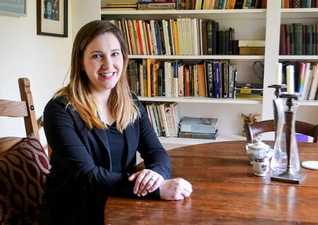
SHEFFIELD, Mass. — Poet Dora Malech has been named the 22nd recipient of the Amy Clampitt residency.

For 15 years, the Amy Clampitt residency has provided poets and literary scholars a paid six- or 12-month stay at Clampitt’s former residence near Lenox, Mass., where they can focus exclusively on their work. Residents are selected by a committee that includes prize-winning poet Mary Jo Salter; Clampitt’s editor at Knopf, Ann Close; and Massachusetts-based poets Karen Chase, of Lenox, and John Hennessy, a past residency recipient currently on the faculty at UMass Amherst.

This one-of-a-kind award was established through the generosity of Clampitt's late husband, Harold Korn, who made provisions for it in his will before his death in 2001.

A poet, professor and visual artist based in Baltimore, Malech graduated from Yale University with a bachelor's degree in fine arts, and earned her M.F.A. in poetry from Iowa Writers' Workshop at the University of Iowa. She has published two collections of poetry, "Shore Ordered Ocean" (2010) and "Say So" (2011), and her work has been featured in the New Yorker, Poetry London, Tin House, The Yale Review and more.


Malech is co-founder and former director of Iowa Youth Writing Project, an arts engagement program for children and teens. Currently, she serves on the faculty of the Writing Seminars at John Hopkins University and participates in Writers in Baltimore Schools, a program that provides low-income middle school students with creative writing workshops.

Malech will spend her residency working on a new collection of poetry and a book of prose.

"It’s so significant to have this time and space to focus and to be able to dignify my own work," Malech said. "The luxury of being able to have a creative path for these months that I'm here is really fantastic and invaluable."

 

If you would like to contribute information on this article, contact us at info@iberkshires.com.

Pittsfield: Should Park Square Be an Historic District?

By Brittany PolitoiBerkshires Staff

PITTSFIELD, Mass. — The committee drafting a proposed local historic district around Park Square wants to generate interest and participation in the process. 

Members launched the charge during meetings in August and September. A survey and public hearing are planned to gather feedback early on. 

City Planner Kevin Rayner explained they are not just doing this out of a love for historic buildings, but for the timeless sense of place you get when you step into Park Square, which was laid out over 200 years ago and hosted the first-ever agricultural fair in 1810. 

"I think that the main thing that we need to kind of park on is that this is the heart of our community, and it really sets the stage for the sense of place in Pittsfield, and any change to that should have some review and some consensus from folks who have a passion for protecting the history and that character of Pittsfield," he said to the new Local Historic District Study Committee last week. 

"And there's that private property versus historic resource thing, but I’d say that a lot of these buildings on the square belong to the soul of Pittsfield here, and deserve to be protected, and I don't think that the layer of regulation that we're throwing down here is going to be unreasonable or a real boundary." 

In March, the City Council voted to amend the City Code, Chapter 2, to establish the study committee.

Pittsfield has more than 20 locations on the National Register of Historic Places, including the Park Square Historical District, but the designation just allows communities to apply for federal tax credits and doesn't impose restrictions on buildings. The central area was laid out a few decades after Pittsfield was given a town charter in 1761.

A district can be one building, several buildings, or an area. Historic restrictions only apply to the exterior of buildings; the committee has authority to say a building in the district cannot be demolished. 

View Full Story

More Sheffield Stories