American Institute for Economic Research Names Next President
 |
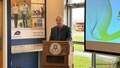
GREAT BARRINGTON, Mass. — Edward P. Stringham, a prominent U.S. political economist and thought leader in the field of private governance, has been named president of the American Institute for Economic Research, an 84-year-old research and education organization headquartered in Great Barrington.
In addition, he will serve as the organization's director of research and education. The appointment, announced by AIER’s Board of Trustees, was effective May 24.
"Dr. Stringham's accomplishments and experience make him uniquely qualified to build upon AIER’s great traditions and lead the institute in fulfilling its goals," said AIER Chairman Gregory van Kipnis. "We are confident that under his intellectual leadership AIER will succeed in carrying out its mission of educating the American people on the value of personal freedom, free enterprise, property rights, limited government and sound money in advancing peace, prosperity and human progress."
Stringham, who is the K.W. Davis Professor of Economic Organizations and Innovation at Trinity College in Connecticut, is a frequent contributor to both academic journals and the popular media. In addition to his position at Trinity, he also serves as editor of the Journal of Private Enterprise. He also is past president of the Society for the Development of Austrian Economics and the Association of Private Enterprise Education.
Prior to his Trinity appointment, Stringham taught at Texas Tech University, Fayetteville State University in North Carolina, Klagenfurt University in Austria and San Jose State University in California.
He is the author or editor of three books. His most recent, "Private Governance: Creating Order in Economic and Social Life," was published in 2015 by Oxford University Press.
A native of Brookline, Mass., Stringham received his B.A. from College of the Holy Cross, Worcester, Mass., and his Ph.D. from George Mason University, Fairfax, Va.
"The mission of AIER is in perfect alignment with my interests, philosophical beliefs and life's work,” Stringham said.
Tags: aier,