Mount Greylock Committee Settles on Direction for District Office, Fields
WILLIAMSTOWN, Mass. — The Mount Greylock Regional School Transition Committee on Wednesday decided to proceed with a phased approach to addressing the capital needs that the district has long planned to address with part of a $5 million gift from Williams College.
In a special meeting at Town Hall, four members of the seven-person panel voted unanimously to move forward with a plan to use just less than half the gift to build a multi-use building on the Mount Greylock campus.
District officials plan to hold $1.5 million of the gift in reserve, where it will remain as part of the college's endowment and earn interest that the district can apply to future building needs — a similar model to a gift the college gave to Williamstown Elementary School when it was constructed.
The remaining $3.5 million has been earmarked for athletic field renovations needed to bring the district into compliance with the Americans with Disabilities Act and Title IX and the replacement of the district offices, which used to be housed at Mount Greylock.
The planned district office would be part of a building that also houses public restrooms for the athletic fields, a storage area for the school's facilities department and a room that could be used by the athletic department — primarily as a waxing room for the cross-country ski team.
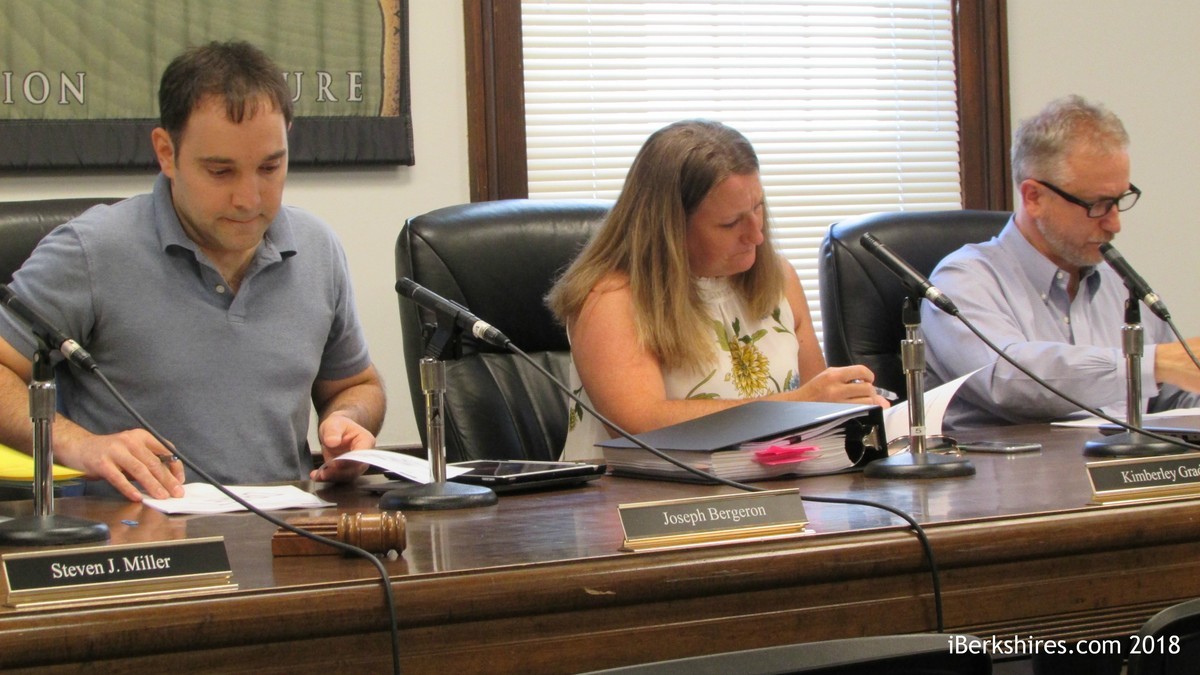
On Wednesday, the committee reviewed a cost estimate for the building that places its price tag at $2.37 million, a significant decrease from earlier iterations because of cuts that have been made to the proposed building, Transition Committee Chairman Joe Bergeron said.
"The width along the longer end is a little narrower than it was," he said. "Some of the mechanical storage and bathrooms are squeezed in a little more to make them more space efficient. The ski waxing room and custodial storage is tightened up as well.
"The other notable change related to a lot of the work is where we have seasonal use of roads or pathways [to the athletic fields], meaning we don't use them in the inter, what happened with this design was the architect said we could use a surface that's not blacktop and instead use gravel. That saves a significant chunk of money."
Collectively, the projected cost for the building and the athletic field compliance work is estimated to be about $3.8 million, which is why Bergeron and Transition Committee member Chris Dodig, who formed a working group to address the site issues, recommended a phased approach.
"What we could potentially do is get this ball rolling on things that don't think are going to change and whose use is time sensitive," Bergeron said. "This is something we know we need to get done. Why not go ahead and do it right now?"
The field work — while necessary from a compliance standpoint — is less time sensitive, the committee decided, and the district also can look at additional fund-raising efforts to support the fields while using the $2.37 million from the Williams gift in the short term to house the PreK-12 district's central office, which starting in late August will be in trailers on Cold Spring Road campus.
"If we were to take the first phase and, as we whittle it down, we could find we can do it for less money than was originally, conservatively projected and have more money for [the fields]," Bergeron said.
"That makes a lot of sense," committee member Steven Miller said. "It allows us to start moving, and if things come in under budget, it lets us know what we have for the next phase."
None of the work under consideration by the committee on Wednesday is part of the district's $64 million addition renovation project for the middle-high school. The Massachusetts School Building Authority, which is partnering with the district on the school building project, does not participate in costs related to district offices and sets firm limits on how much "site work" it will pay for — limits that the project surpassed long before it got into items like the parking lot or the athletic fields.
One thing that appears to finally be off the table is any solution for the district office that involves an existing "off-campus" building. District officials searched for more than a year to find a workable solution that did not involve new construction. Unfortunately, Bergeron said, any such structure would have involved costly modifications that made an existing property impractical at any price.
That includes a late addition to the process: space at the rear of Williamstown's Milne Public Library that formerly was occupied by the Williamstown Historical Museum.
"As soon as you touch [a building] and need to make it so a municipal organization can inhabit it, you introduce hundreds of thousands of dollars in cost," Bergeron said.
In the case of the library space, that added up to an estimated $350,000, according to consultations with Perkins Eastman, the architect the district is using on the school building project.
Bergeron noted that wherever it puts the central administration, Mount Greylock needs another building on the campus to provide other uses intended for the multipurpose building: storage of landscaping equipment, bathrooms for the athletic fields and a room for the cross country ski team and storage for other sports in the fall and spring.
"[The $350,000 renovation price tag] made [the library] start to look less and less desirable relative to the portion of that [on campus building] for the purpose of the central office," Bergeron said. "If you look at that portion of the building in isolation — just the square footage for the district office — it came down to $500,000."
While voting to move ahead with the phased approach on the campus projects, the Transition Committee did not vote to take action on a proposed fee of $173,600 for design work and construction management from Perkins Eastman, the Boston team that did the initial schematics.
In part because the committee was operating with a bare quorum of four members, those present felt uncomfortable committing the district to such a large contract. And it agreed to meet again in early August to address that issue as well as issues arising out of a discussion of the newly expanded district's policy book.
At Wednesday's meeting, the Transition Committee voted to officially rescind all the former policies at Mount Greylock middle-high school and replace it with a policy book that covers the entire newly expanded district. Since Lanesborough Elementary School and Williamstown Elementary School ceased to be single school districts as of June 30, their respective policy books already were voided, and the Department of Elementary and Secondary Education required the regional school district to put new policies in place this summer.
For several years, going back to the time when the three schools operated as part of a "Tri-District" that shared the cost of central administration, the then three separate school committees worked to align the policies of all three schools.
What remained on Wednesday were two questions regarding policies related to transportation.
In answer to a question from Williamstown resident and Williamstown Elementary teacher Fern Murtagh, the committee noted that while, in practice, the elementary schools provide transportation to pre-school students, its policy, as written, only covers children in kindergarten through 12th grade.
And a separate policy on third-party transportation of students to off-campus activities may need to be modified to reflect the realities of current practices. At Lanesborough Elementary, the school committee had adopted a policy banning the practice; at the middle-high school, it is relatively common for parents to "carpool" student-athletes home from road games instead of sending the kids home on the team bus.
Tags: central office, MGRHS school project, MGRSD,