Mount Greylock Committee Faces Sticker Shock on Office/Storage Building
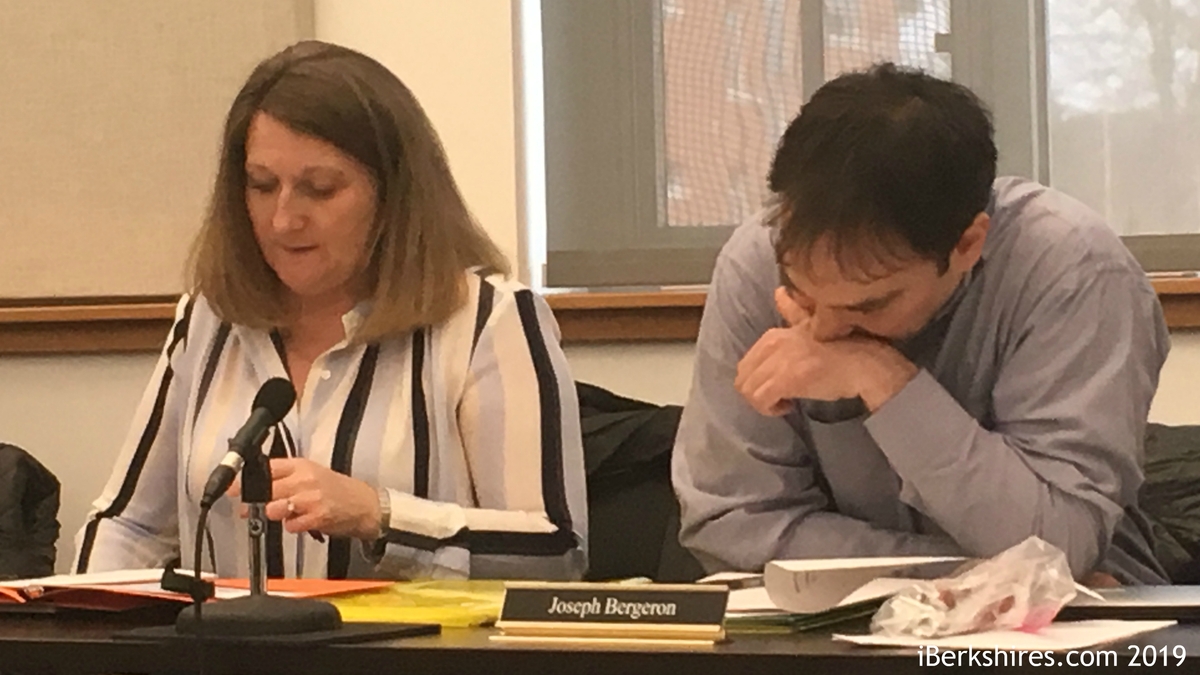
Mount Greylock Superintendent Kimberley Grady and School Committee Chair Joe Bergeron participate in Wednesday's special meeting.
Architect Dan Colli of Perkins Eastman told the committee that bids on the project came in at just under $2.8 million, significantly more than the $2.3 million the architect had estimated.
That was bad news for a committee hoping to fund the project out of a $5 million capital gift from Williams College while still having funds in that account to support needed improvements to the middle-high school's athletic fields and a desired $1.5 million rainy day fund for extraordinary maintenance expenses on the recently completed $64 million school.
The multipurpose building has four components. It is intended to house the district's central administration, which was dislodged from its former home in the old, oversized Mount Greylock. It has storage for the school's facilities department, which has, among other things, equipment needed to maintain the school's grounds that currently is stored in a freight container. It has a room for the school's athletic department to use for storage and as a waxing room for the Nordic ski team. And it has public restrooms that would support the outdoor athletic fields.
The committee asked Colli if it could have more time to weight its decision before accepting the lowest of three bids on the building, and he indicated that the panel's regularly scheduled April 11 meeting would be soon enough to make a final decision.
Committee member Al Terranova advocated for pulling the trigger on Wednesday, but Steven Miller argued that the district, in light of the higher than expected cost for the building, should make one more stab at finding alternatives to the building project.
Miller, while acknowledging that the district explored every possible alternative to buy or lease existing office space in the towns of Lanesborough or Williamstown in the past, said it is important to do due diligence and try one more time to find an off-campus site for the district offices.
"Someone in the community asked me if the [soon to be replaced] Williams Inn is an option," Chairman Joe Bergeron said. "I have not reached out about that. I believe there were other plans for that site."
"I'd be in favor of exploring other options, as painful as that might be," said Miller, who served on the "legacy" Mount Greylock School Committee -- prior to regionalization -- when it studied alternatives off campus. "Is there space in existing structures? What needs to be done to make the trailer workable? Could we do a better modular unit than the one we have now?"
The district superintendent and her staff, eight people in all, currently work out of construction trailers to the north of the school's academic wing.
Regina DiLego balked at the notion of keeping the district offices in a trailer for another year while looking again at alternatives.
"Better trailers … is not providing an answer to what needs to be done at some point in time," DiLego said. "Putting that off, possibly elevating the cost because we're putting that off … we need permanent solutions, not Band-Aids."
Terranova has been the most vocal advocate for maintaining at least $1.5 million of the Williams College gift in a capital reserve. But he suggested Wednesday that $2.7 million for the multipurpose building and an estimated $2.3 million for the athletic fields improvements (expenses triggered by Title IX and Americans with Disabilities Act compliance concerns) are the kinds of expenditures that constitute a "hold your nose type vote."
"I can't believe I'm saying this, but I'd be willing to vote now for $2.7 for the building, $2.3 for Phase II [the fields] in hope that the excess above $5 million stays in the endowment," Terranova said, referencing the interest already earned on the gift, which is held in Williams' investment pool, reported to be $2.5 billion in June 2017.
"I think trailers are not a viable option," Terranova continued. "I think we should make a vote and go forward on this. I'd go $2.7 and $2.3 and not one penny more … and the rest stays in the endowment and is not touched for 10 years."
Neither Terranova nor another member of the committee put that notion in the form of a motion, and ultimately the body took no action. Bergeron said it will be an agenda item at the April 11 meeting for a final decision.
During Wednesday's discussion, committee member Dan Caplinger asked Colli why the bid numbers came in so much higher than the estimate.
Colli reported that the concrete for the foundation, the site work and the electrical sub bids all came in higher than anticipated.
"It's a small project," Colli said by way of explanation. "There's probably a lot of other work going on [in the area]. … Sometimes, the smaller projects do tend to see that. To deviate from a large project to come do a small project, there's a premium."
Caplinger asked whether that phenomenon was considered in developing the estimates that the committee saw previously.
"We did not make an adequate allowance for that," Colli said.
Wednesday's special meeting of the School Committee was held to address a couple of time-sensitive issues, including an expenditure to service oil tanks that were installed in the early 1990s and an executive session to discuss contract negotiations related to the district's business manager position. That post has been vacant for some time; the district has been using an Auburn-based firm to manage its finances but advertised this winter for someone to serve the district on a full-time basis.
The brief executive session -- rushed by outside engagements for committee members -- did not touch on a petition that the committee received at its last meeting.
Rick Paris, a former employee at Lanesborough Elementary School, presented the committee with a petition signed -- as of Wednesday evening -- by 244 people. The petition asks the committee to look into the "turnover of union and non-union personnel experienced at the district and school level" since Grady was promoted to assistant superintendent in July 2016.
The petition came on the heels of an extensive and well circulated March 2 social media post by Paris in which he accuses Grady of "bullying" and "targeting employees" among other unspecified and -- in the post -- unsubstantiated claims.
Wednesday’s executive session did have the superintendent’s contract on the agenda, but that topic was not discussed. Bergeron, after the meeting, confirmed that the petition was not part of that agenda item and has not, to date, been discussed by the committee. He did agree that it would be beneficial for the committee to address the issue -- publicized by the Berkshire Eagle last week -- to put the community’s mind at ease.
"If possible, yes," Bergeron said.
Grady was the director of pupil personnel services (special education director) for the Lanesborough-Williamstown Tri-District (the precursor to the fully regionalized PreK-12 region) prior to her being named assistant superintendent.
In fall 2016, she was named interim superintendent after the abrupt departure of Douglas Dias shortly into the second year of his three-year contract.
Grady served as interim superintendent from 2016 until last spring, when the Transition Committee (formed after the November 2017 to fully regionalize the district) selected her for the post after conducting a search process.
None of the accusations made by Paris in his March 2 Facebook post were raised in public meetings during Grady's tenure as interim superintendent, the committee's months-long discussion about whether to conduct a search for a full-time superintendent or simply offer her the job, or the ensuing search.
Bergeron said Wednesday he did not know whether any of the Transition Committee members or members of the then Williamstown Elementary, Lanesborough Elementary and Mount Greylock Elementary School Committees heard those accusations in private conversations during the hiring period.
Five members of the current School Committee, elected in November 2018, served on the Transition Committee that appointed Grady superintendent: Bergeron, Caplinger, Miller, Terranova and DiLego. The other two members of the Transition Committee were members of the now defunct, or "legacy," Mount Greylock School Committee.
Miller abstained from a 6-0-1 vote to offer the position to Grady.
Tags: central office, MGRSD,