Governor Closes Schools Statewide, Bans Gatherings of More Than 25
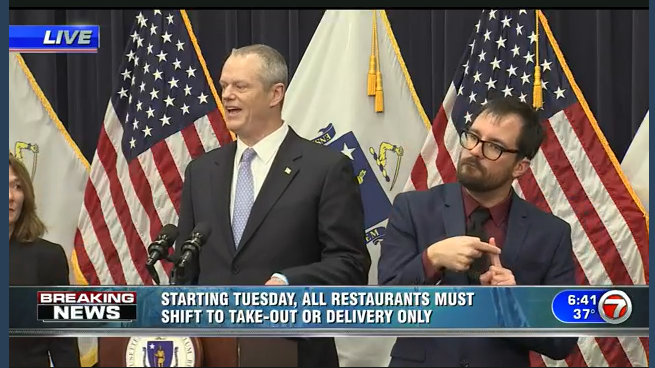
Gov. Charlie Baker speaks at a press conference detailing emergency actions being taken by his office.
BOSTON — State officials are taking "unprecedented" measures to prevent the spread of the novel coronavirus, including closing all private and public schools, banning gatherings of more than 25, prohibiting on-premise patronizing of restaurants and taverns, and disallowing all visitors to long-term care facilities and nursing homes.
The school and restaurant orders take effect Tuesday.
"I realize these measures are unprecedented. But we're asking our residents to take and understand the rationale behind the guidance," said Gov. Charlie Baker at a press conference on Sunday.
The administration is also directing hospitals to postpone elective surgeries to ensure beds and health-care workers are available and requiring them to screen and limit visitors. Berkshire Medical Center initiated some of these actions last week.
The state is also extending renewal times for certain credentials, including the need for customers to physically visit Registry of Motor Vehicle offices, and "relaxing" some requirements for unemployment claims.
"We will file emergency legislation that will allow new claims to be paid more quickly by waiving the one-week waiting period for unemployment benefits that currently exists under state law," he said. "We will also file emergency regulations expanding the eligibility around collecting unemployment for people who have been impacted by COVID-19."
Baker also anticipated filing legislation to help towns and cities in addressing the impact of the pandemic, such as delays in town meetings and fiscal 2021 budgets, and due dates set in law for school district action and improvement plans and Massachusetts Comprehensive Assessment Testing.
The Boston Marathon has already been postponed to Sept. 14 and legislation will filed to make it official.
The governor said these actions are in line with federal guidelines to promote "social distancing" to contain the spread of the virus that has already killed more than 6,000 worldwide and more than 60 in the United States.
"People still need to go, obviously, to the supermarkets and then to the pharmacies in a variety of other places like that," the governor said. "We do need to have a program in place, as I said in my remarks, to make sure that the sort of basic necessity requirements for a lot of the kids who rely on and depend on school for a big part of their sustenance every single day continue to access and get it."
Last week's emergency declaration had limited gatherings to 250, but Sunday's order dramatically reduces that to 25. That includes all community, civic, public, leisure, faith-based, entertainment and sports events that bring people within a confined area. This also includes fitness centers, clubs, and theaters.
Restaurants and taverns can remain open for takeout or delivery only.
"[They] must also follow the social distancing protocols set forth in the Department of Public Health guidance," said the governor, and will be in effect from Tuesday, March 17, through April 17 6. "This order doesn't apply to grocery stores. This is about bars and restaurants, and those people do not absolutely have to go to."
Baker asked people not to hoard goods because doing so many mean their neighbors may go without: "People are taking stocking up a little overboard."
The state will also work with school districts to keep buildings open for special services and for how to equitably provide alternative access to learning opportunities.
Massachusetts has received waivers from the U.S. Department of Agriculture to continue food programs in districts with higher concentrations of low income students and is working to get additional waivers for other schools.
North Adams, Hoosac Valley Regional and the Pittsfield Public Schools have made plans to provide "grab and go" lunches.
"It's important that we all take a couple of minutes to think about why dispersing classes and school gatherings is necessary to help us mitigate this threat to public health," the governor said. "COVID-19 will feel like the flu for the vast majority of the people who get it. But it's highly contagious, and by breaking up large gatherings and encouraging social distancing, we can prevent the spread.
"But we can't simply transfer a group full of kids from their classroom to your neighbor's play room for days on end. We will not be doing our part to prevent the spread."
He urged parents and caretakers to take to heart the need for social distancing — no playdates, just immediate family.
The order does not affect child-care programs at this point or residential, special needs or group homes although they are urged to take health precautions; call for temporary closures based on actual direct or indirect exposures to individuals with COVID-19.
"At the same time, [Department of Early Education and Care] will prioritize the maintenance and expansion of child care capacity, serving front-line health care workers and first responders," he said.
Higher education facilities, many of which have already made plans to suspend or close campuses for the next weeks, were encouraged to move to long-distance learning to avoid having large numbers on campus.
Health and Human Services Secretary Marylou Sudders reiterated that last week's emergency order tells insurers "to cover medically necessary telehealth services in the same manner and to pay the same rate as in-person services."
"Telemedicine is one of the most important things we need to divert care from hospitals and ambulatory sites for patients," she said. "By enabling patients to remain at home, rapid treatment delivery can be provided."
In addition to limiting access to hospitals and long-term care facilities, with certain exceptions for end of life, the order allows some pharmacists to make hand sanitizers to address the shortage in the state.
Sudders said if anyone has questions, they should call 211. The information number has received more than 1,600 calls since going live and that has reduced non-urgent calls to the state's epidemiological line.
"I think one of the great challenges we're all going to have over the course of the next few months is to recognize and understand that what we do every day is going to have a big impact not just on what happens to us, but what what happens to those people that we come in contact with," Baker said. "And we need to treat this and recognize that this is not a sprint — this is going to be a marathon."
Tags: COVID-19,
More Coronavirus Updates