State Changes COVID Color Codes to Reflect Test Positivity Rate
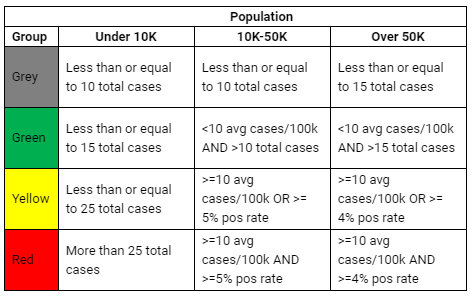
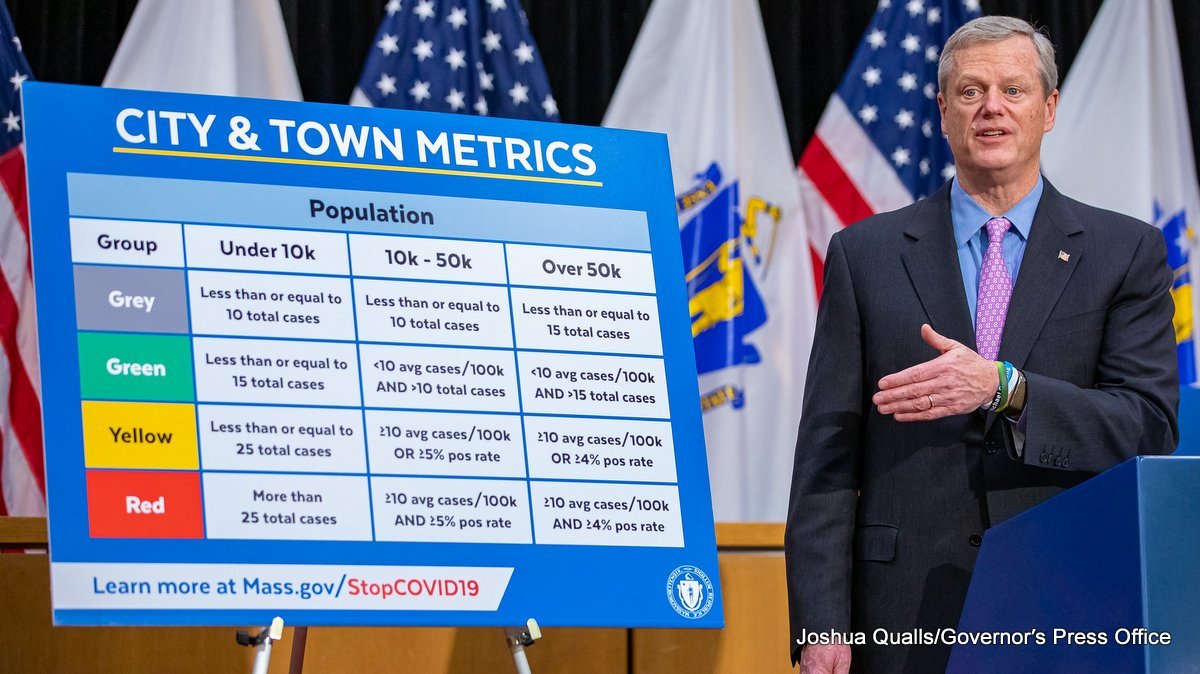
On Friday, Gov. Charlie Baker and Secretary of Health and Human Services Marylou Sudders announced what Baker called a "more nuanced" color coding system that takes into account test positivity rates instead of just incidence of COVID-19 per 100,000 of population.
And Secretary of Education Jim Peyser and Commissioner of Elementary and Secondary Education Jeffrey Riley joined Baker at his news conference to reinforce the idea that local districts are "expected to prioritize in-person learning, across all color-coded categories unless there is suspected in-school transmission," in Peyser's words.
Baker characterized the red-yellow-green categories the commonwealth created in August as punishing small communities, where infections in two households could push a town from gray to yellow, and any community with an aggressive testing regimen.
"Over the past three months, we've received feedback from municipalities that the threshold should, perhaps, be more nuanced," Sudders said. "We've heard from some that a few cases within a couple of days in a small community can cause them to move between risk designations quickly. … We've also heard that feedback from some communities that conduct significant testing that a matrix that takes into consideration a percent positivity rate should be added.
"So our updated metrics adjust for the reporting of cases by municipality's population size. These metrics incorporate cases per 100,000 residents and the percent positivity rate when determining a municipality's color designation."
Under the new metrics, Sudders said the commonwealth would report later Friday that 16 municipalities currently are red, 91 are yellow, 79 are green and 165 are gray. She said the new Massachusetts metrics are "generally in line" with New York, Connecticut and New Jersey, except that Massachusetts' metrics take into account population differences among towns and cities.
The Department of Public Health on Thursday had delayed for a day the community positive incidence reports and accompanying map that normally are published in the weekly public health report.
Baker said he wanted metrics that rewarded testing instead of discouraging it.
"I don't want a community to say, ‘We're not going to test because we're worried about increasing our numbers,' " he said.
Baker added that the entire commonwealth is testing more now than it did in August.
"We're testing, more often than not, somewhere in the vicinity of 150-200 percent of what would be the appropriate level of testing given our population and our number of cases per 100,000," according to World Health Organization guidelines, Baker said. "There are a lot of other states testing in the 50 percent, 60 percent, about a third of what we are.
"But we've heard from many communities, and we heard from our colleagues in New York, who are using a positive test rate as one of their measures for making decisions: You don't want to tell a community not to test as much as it possibly can. Because finding cases and contact tracing and helping people support themselves in isolation is a better answer than not doing the testing because you don't want to raise your number per 100,000."
Sudders said the altered metric will help municipalities make decisions at the local level.
"Providing municipal level data to local officials about COVID-19 infection rates is critical to making informed decisions about businesses, keeping our kids in schools and understanding what is going on locally," Sudders said.
The point about "keeping our kids in schools" led directly to remarks by Peyser, Riley and Dr. Mary Beth Miotto, the vice president of the Massachusetts chapter of the American Academy of Pediatrics.
Miotto said that while the novel coronavirus must be respected and schools must implement the cleaning, social distancing and face-covering guidelines that the commonwealth released in June, the goal has to be getting students back in the school building.
"While all of us are acutely aware of the virus' risks, the health risks of remote learning are becoming evident to us every day," Miotto said. "The long term consequences of rapid weight gain and sedentary lifestyles will certainly be seen for years to come.
"Another sobering narrative on mental health is being revealed. Last week, I heard, yet again, from pediatric intensive care specialists, who told me their hospital census is consistently reflecting more hospitalizations for youth suicide attempts than pediatric COVID cases. What is so concerning is that many of these kids with suicidal thoughts or attempts don't have a history of behavioral health problems. They're typical children bending or breaking under the stress of the pandemic, and specifically from being alone for long hours at the computer."
Moiotto and the state officials said there is ample statistical evidence globally, nationally and in the commonwealth that in-person instruction in schools is not a source of COVID-19 transmission. Baker pointed to parochial schools in Massachusetts that have been fully in-person since August with lower transmission rates than the cities where the schools are located. Miotto said "viral transmission rates are not lower in students or teachers working remotely" than in their in-person counterparts.
"The time to get kids back to school is now," said Riley, the head of the Department of Elementary and Secondary Education.
When pressed by reporters, Baker and Riley declined to say what consequences there would be for school districts that do not toe the line and open the schoolhouse doors for in-person instruction.
" At the department, we have a responsibility and obligation to make sure folks are following the guidance to the greatest extent possible," Riley said. "If people start to deviate, certainly, we'll address that individually, but we also respect what happens locally."
Riley was then asked, again, what penalties districts would face.
"We'll address that with each individual," Riley said. "I don't want to speak to hypotheticals. But we'll address when people aren't following the state guidelines."
Tags: COVID-19,
More Coronavirus Updates