Mount Greylock School Committee Talks About Long-Term Enrollment Trend
WILLIAMSTOWN, Mass. — Like most school districts, Mount Greylock is working every day to figure out how to get through the challenge of the next week in the COVID-19 pandemic.
Last week, the School Committee took some time to look at the difficulties the district will face in the next 10 to 20 years.
First-year Superintendent Jason McCandless used the opportunity of an often routine report on enrollment to talk about concerning long-term decline in student population that the two-town district can foresee over the next couple of decades.
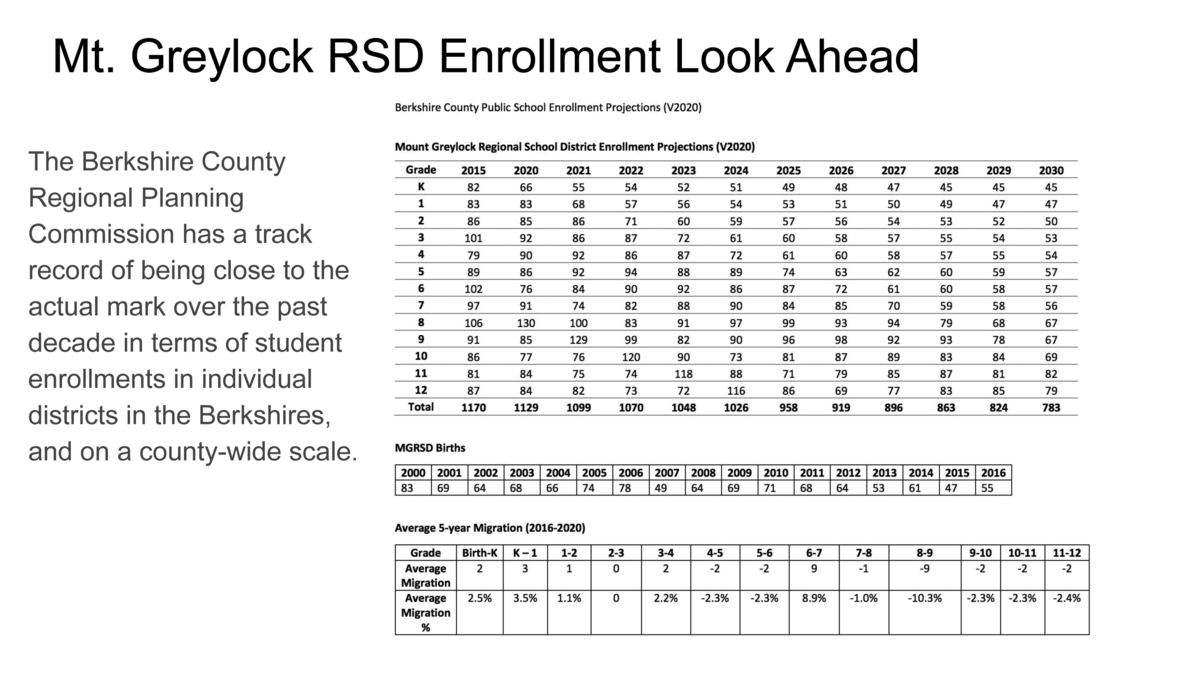
He pointed to projections from the Berkshire Regional Planning Commission that show the district's enrollment falling to 783 students, kindergarten through 12th grade, by 2030. That would be a loss of 296, or 27 percent of the current K-12 population of 1,079.
McCandless said the BRPC has a good track record for predicting such population trends, and that the district needs to start thinking about what those impacts will be.
Two impacts mentioned last Tuesday: a loss of state aid and a potential inability to offer as robust a program of academics and extracurriculars at the middle-high school.
State funding based on enrollment for fiscal 2020 is about $3.5 million, Business Manager Joe Bergeron told the committee; that represents about 15 percent of the district's $23 million operating budget.
McCandless noted that losing, in theory, a quarter of that funding would have less impact in a district like Mount Greylock than it would in his last district, where state aid can account for 60 to 65 percent of the operating budget.
"A budget in a Holyoke, in a Springfield, in a Pittsfield is going to be much more sensitive to large-scale enrollment trends like that," McCandless said. "That's one of the reasons the state is working to be upfront and honest that it costs more to educate some students. It's a societal issue, but it's one we as public school educators are morally obligated to address."
But even in the Lanesborough-Williamstown district, declining revenue from Boston will mean shifting more of the cost for public education to local property taxpayers.
As for the educational program offered by the district, that also could see a hit in a time of declining enrollment.
"If you think about what we can offer at the high school for students competing for college slots with students around the country and the world, it's urgent. We're looking ahead five years, 10 years, 20 years," McCandless said. "We owe it to the students to offer as much as we possibly can, but the number of students that we'll be able to do that with, which is what our budget, at least from the state, is based on, will continue to drop."
The silver lining, McCandless said, is that studies show that in order to run a high school that offers an appropriate breadth of programming, a school needs to have 400 to 500 students in Grades 9 to 12.
"Even in the worst case scenario, we're in that ballpark," he said. "That bodes well for our ability to keep and protect the programming we must keep and protect in this community."
Another reason for optimism, McCandless said, is that the county's schools are looking into ways to pool their resources and offer classes across district lines at the high school level. Ironically, the upheaval in education caused by the pandemic may help make that type of cooperation seem more attainable.
"If we could get our schedules to mirror each other to a better degree, a student on the Mount Greylock campus could take a specialized course at Mount Everett using Zoom or some other medium," he told the School Committee during the virtual meeting. "We've learned we can do that and it could work."
McCandless said some of those innovations are being talked about by the Berkshire County Education Task Force, a body which, itself, has not had unanimous support on the Mount Greylock School Committee.
"Whether you agree with the work the task force has done, whether you're buying what they're selling or not … I would say that what they're 'selling' is not about regionalization and consolidation," McCandless said. "It's about collaboration. Our ability to collaborate will become more and more crucial as we have fewer and fewer students driving the needs and wants for an even broader array of options"
As for the short-term enrollment picture, McCandless said Mount Greylock is part of a trend nationally: rising numbers of homeschoolers.
"Many families feel that if, essentially, you are homeschooling for the most part anyway, maybe it's time to wade into the pool of homeschooling a little deeper and give it a try," he said. "We don't know what the long-term impact of this will be."
As for this year, the district has seen a jump in homeschooled children from 20 in 2019-20 to 61 this fall, an increase of more than 200 percent. It is one big reason the district's overall enrollment is down from 1,165 (PreK-12) last year to 1,098, a drop of 5.7 percent.
But McCandless was not sounding the alarm on Tuesday.
"I will say that as I began preparing this presentation, the [Williamstown Elementary homeschool number] was 30 students," he said, pointing to the slide that showed 26 homeschoolers currently in the would-be WES student population. "So we are seeing a return."
Tags: enrollment, MGRSD,